
Rethinking Virtual Special Education: How inclusive technology unlocks independence for IEPstudents

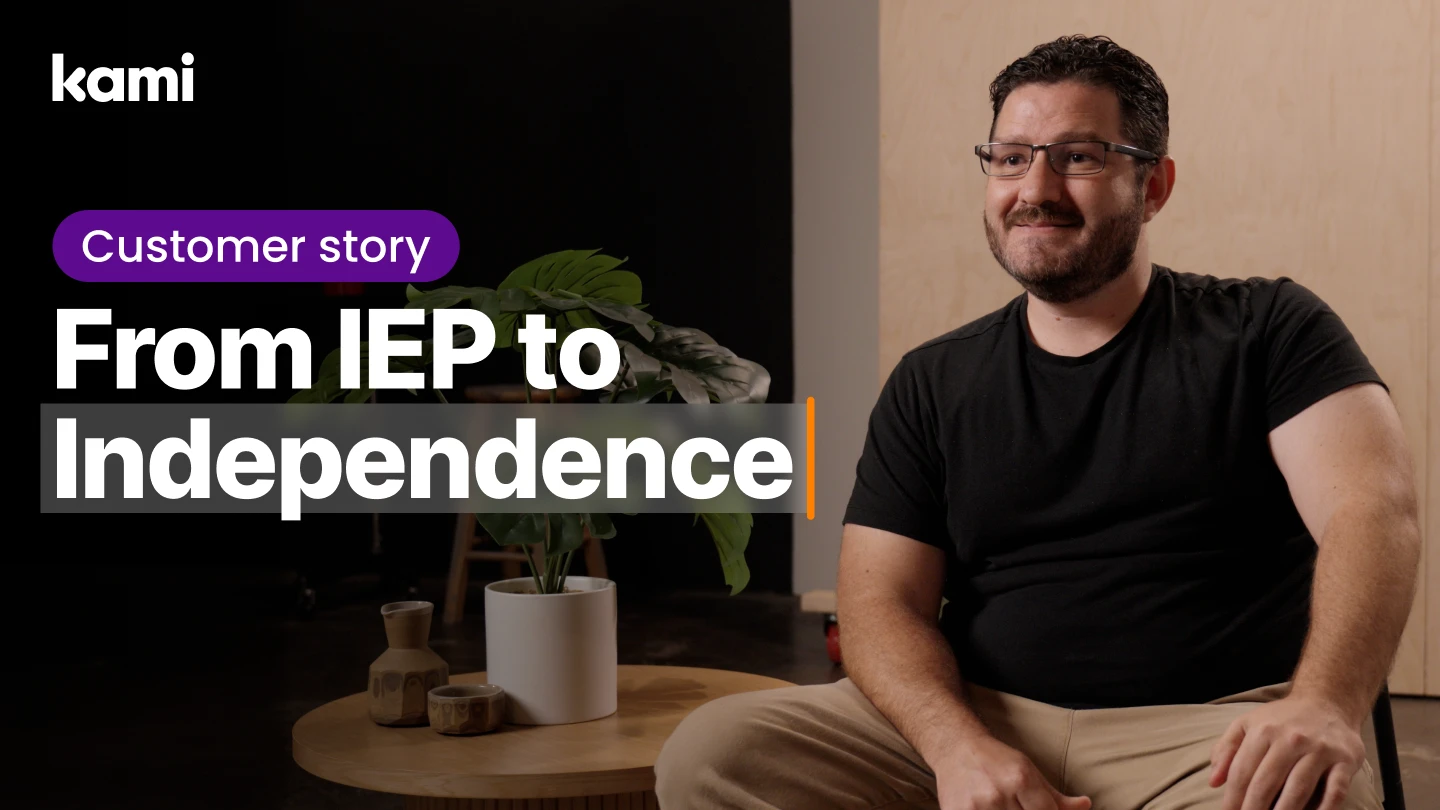

When Kyle McKoy reflects on his path into special education leadership, he often returns to one defining moment. As a child with an IEP, he listened to adults question whether he would ever finish high school.
“I had teachers who genuinely believed I wouldn’t finish,” he said. “College wasn’t even in the conversation.”
Those experiences stayed with him and continue to shape how he supports special education students and teachers today.
Kyle graduated near the top of his class, earned a master’s degree, and is now the Program Specialist for the Special Education department at Peak Prep, a virtual independent-study program serving 1,100 students across California. More than 150 of those learners have IEPs, and Kyle supports the 60–70 teachers responsible for delivering special education and related services.
Running a fully virtual special education program requires more than online access. It demands instructional systems that support student progress, specially designed instruction, and student independence, while still meeting compliance requirements under the Individuals with Disabilities Education Act (IDEA).
Kyle explains why inclusive technology became non-negotiable at Peak Prep. When designed well, virtual special education can offer flexibility, personalized pacing, greater family involvement, and meaningful opportunities for students to build independence, but only if the systems underneath are built to serve each student’s unique needs.
Districts and private schools evaluating online school options must carefully assess how providers:
- track student progress
- document IEP evidence
- communicate with families
- maintain compliance
Strong instructional systems are essential.
The realities of virtual special education
Peak Prep serves learners who were not fully supported in traditional school environments — due to academic needs, medical or social factors, disabilities, or structural barriers. The program enrolls students with diverse IEP profiles, families opting for home-based instruction, and learners from across the state.
Operating a virtual, by-choice program has many of the same challenges districts face everywhere. Virtual special education services must meet the same legal standards as in-person programs.
- Fragmented instructional tools and workflows:
Teachers moved between Teams, Google Docs, email, PDFs, Zoom, and personal systems to manage caseloads and assignments. Documentation was spread across tools, making compliance and audit readiness harder to maintain - Limited data visibility for IEP decision-making:
Work samples lived in multiple locations and formats, making it difficult to maintain a clear view of student performance or track IEP progress confidently.IEPs are living documents that must evolve as students’ needs change. Without centralized evidence, updates were slower and less precise.
- Accommodations dependent on adult support:
Supports such as read-aloud, simplification, summarization, or writing assistance often required immediate adult availability.Under IDEA, schools must provide accommodations but reliance on adult support limits student independence.
- Limited digital supports for building independence:
Without tools designed to scaffold executive functioning and self-management, students missed opportunities to build the independence needed for long-term success.Peak Prep needed a coherent instructional system for virtual special education at scale. One that supported individual needs while combining digital learning, offline work, and meaningful interaction with teachers and peers.
A structural shift: how Kami evolved from a PDF tool to an instructional system
Peak Prep was first introduced to Kami as a straightforward annotation tool. Kyle used it the way many educators do at the start:
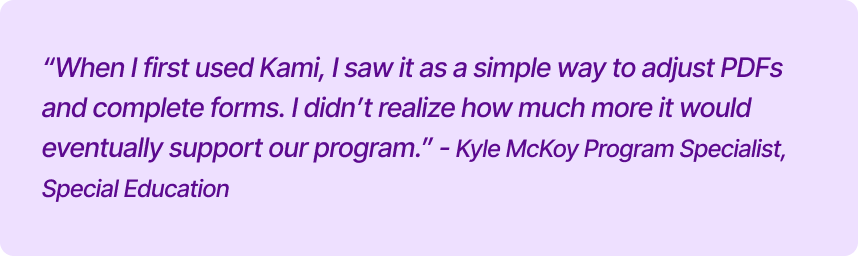
That perception shifted as Kami and Kami Companion expanded. What began as a document-level solution revealed itself as a platform capable of bringing together instruction, data collection, and accommodations into a single virtual special education ecosystem.
Capabilities that once felt peripheral became essential to:
- managing IEP caseloads
- structuring instructional workflows
- providing consistent accommodations
- supporting student independence at scale
“Now I could use Kami to collect work samples and data,” Kyle said. “It bridges a gap by allowing students to access their curriculum independently through built-in accommodations.”
Kami’s impact became most visible in the coherence it introduced—providing teachers and students with a shared structure for instructional work across a distributed virtual environment.
How Peak Prep changed their practice with Kami
1. Centralized evidence that strengthens IEP decision-making
“Kami gave us real-time data we simply didn’t have before,” Kyle said. “It changed how we monitor progress and how we write meaningful goals.”
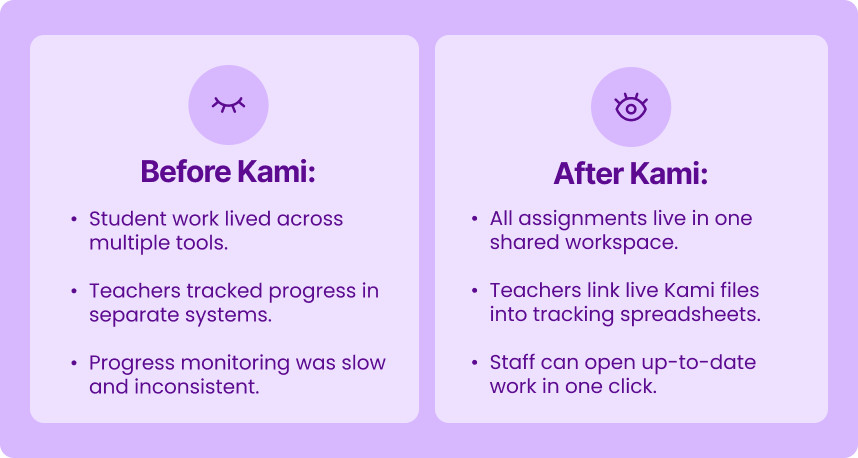
This transformed the speed and accuracy of IEP work, making it easier to track each student’s IEP and ensure the educational plan is tailored to their unique needs.
Impact: IEPs now reflect real-time student performance, improving accuracy, responsiveness, and compliance readiness.
2. Live collaboration that mirrors in-person support
Virtual programs often lose the immediacy of in-person guidance. Kami helped restore it. Using Kami’s Classview with real-time collaboration, teachers can: watch a student work as it happens, annotate alongside them, scaffold directly on the document, and respond at the moment support is needed.
This approach mirrors the rhythm of an in-person classroom—something Peak Prep had been working to reclaim in a virtual setting.
Impact: Timely support strengthens comprehension, reduces frustration, and improves instructional continuity.
3. Kami Companion transformed how students access accommodations
Supports that once required adult intervention — read-aloud, simplification, summarization, or writing assistance — are now available directly on the student’s device.
With Kami Companion, learners can: listen to text on any document or website, simplify or summarize challenging passages, dictate written responses through talk-to-text, access these supports while navigating web-based content, assignments, and research.
Kyle describes Companion as a “toolbar” that follows students throughout their digital environment.
Real world example:
Kyle worked with a middle school student whose reading and writing challenges were creating barriers in a history assignment. The student understood the concepts being taught but struggled to access the content independently and express her understanding in writing.
By importing the assignment into Kami, Kyle showed her how to:
- highlight text and have it read aloud
- simplify complex language to improve comprehension
- summarize longer passages into key points
- use talk-to-text to complete written responses
With these supports available directly within the assignment, the student was able to move through the task at her own pace, without waiting for adult assistance.
“She was able to complete the entire history assignment independently using Kami.”
Impact: Students engage with content more independently across documents and websites, reducing reliance on immediate adult support while strengthening participation, academic performance, and confidence.
4. Consistent workflows across distributed virtual teams
With educators working across multiple locations, consistency is critical. Kami supports continuity through shared instructional structures, predictable workflows, and aligned practices across special education and general education teams.
Impact: Teachers save time, support staff stay aligned, and students experience steadier instructional support.
Implications for district leaders
Peak Prep’s experience reflects broader trends in special education:
- schools are consolidating tools to reduce workload
- progress monitoring requires timely access to data
- independence is a core instructional outcome
- accommodations are expanding beyond IEP-only use
Kami strengthened the systems supporting these shifts, replacing fragmentation with coherence.
Four key lessons for district leaders
- Consolidated tools reduce instructional friction
Annotation, feedback, collaboration, and evidence collection now happen in one place, decreasing tool switching and allowing teachers to devote more time to instruction. - Centralized student work improves IEP qualityKami provided a single ecosystem for current work samples, giving teams clearer visibility into performance trends and supporting more accurate, responsive IEP decisions.
- Student-controlled accommodations promote independence
Read-aloud, simplification, summarization, and voice-to-text became supports that students could access themselves—across documents and websites—reducing reliance on adult availability and expanding equitable access. - Consistent workflows create stability across environments
Kami offered a predictable structure for organizing work, monitoring progress, and communicating across teams, ensuring continuity even as staffing configurations or learning environments shifted.
District leaders exploring online special education services should consider how well their systems support independence, compliance, and data-informed instruction. Peak Prep’s experience shows that when tools align with how special education actually operates, both students and educators benefit.
See what inclusive instruction looks like in practice
👉 Explore how Kami, Kami Companion, and Book Creator support special education teachers and students across virtual and in-person settings. Speak to us today.
Blogs you may also like

An Educator’s Journey with Kami

Engaging every learner: How Kami transforms passive lessons into active learning
One platform, every learner: How Fond du Lac School District transformed digital learning with Kami