5 Reasons Why Working in Special Education is Awesome



This blog is written by Leanne Fisher, a Speech and Language Pathologist at a specialist school for students 5-21 years.
I’ve been working in the field of Special Education for 10 years. Sure, there have been a fair few challenges, tears (sad and happy), and 4 am “solving the world’s problems” wake-up calls – but over the years, I have come to appreciate the area of Special Education as an exciting and rewarding area to work in. Ahead of National Special Education Day on December 2, I wanted to share with you the top five reasons why I love working in Special Education.
1. The students
This is hands down the best thing about working in Special Education. I have met so many students and each of them has taught me something different. These students have a variety of skills, interests, communication styles, and personalities (or “pizazz” as a parent has referred to it before). Being with these students helps to bring me back to the present; something as small as a look, a sound, or a smile can make a “missed alarm, no coffee, no time for reports, too many meetings” kind of day into an awesome day!
Although every student is different, I have learned that they all benefit from me being a responsive partner. Someone who can share their interests; interpret their communication attempts; and give them space and time to be themselves, while helping them develop new skills along the way.
2. Teamwork makes the dream work
I’ve also had the pleasure of working with a number of different people within the world of Special Education. This includes Specialist Teachers, Assistive Technology Specialists, Occupational Therapists, Physiotherapists, Speech and Language Pathologists, Psychologists, Music and Art Therapists, Vision and Hearing specialists, and most importantly, Paraprofessionals and families. Each member of the team brings with them a different set of skills, experiences, and knowledge – to paraphrase one of the greats, “with our powers combined” we can achieve so much more for our students (Captain Planet, of course).
Being open, flexible, and collaborative allows me to be the best support person for my students, and after a while, you might even notice you have become addicted to working with others! Problem-solving, “geeking out”, sharing the “not so good”, and celebrating the small wins are all better done with others rather than on your own.
3. The worldwide community
When I studied at university, I was lucky enough to complete a few Special-Education-specific papers. However, there is only so much that can be squeezed into a course, the rest comes from the real-world classroom.
With the growth of social media and online platforms, now is the best time to get into the field of Special Education! I am forever finding new blogs, podcasts, online webinars, articles, and Instagram feeds that inspire and challenge me to think about my students and how I can continue to create engaging learning opportunities for them.
Warning now, this can send you down a bit of a rabbit hole. Not all resources are created equal, but setting some time each week to look at a few different resources can keep things fresh rather than overwhelming. Don’t forget to acknowledge people’s work if you have used it and “pay it forward” by sharing anything that has worked well for you. This could be with your student’s families, the teacher next door, or on social media!
4. Keeps you sharp
Many times I have slaved over creating specific plans or resources, all for that student to show little interest or protest in a big way. This has taught me the importance of being flexible and ready with Plan B or C or even F. It’s no easy feat and I still don’t always get it right, but thinking about where a student is at, and problem-solving with my team to find a solution, is one of the most rewarding parts of my job. If all else fails, pausing, observing, and following my student’s lead has led to some surprising and unexpected learning opportunities that I could never have expected or planned for!
5. The whole family unit
I know I have already said students, but they are so great I wanted to mention them again.
I have not only met great students but I’ve also had the opportunity to get to know their families. All families are on their own journeys and can be the biggest advocate for their children. Most of the students I’ve worked with haven’t been able to communicate to me how they may be feeling or what they like or dislike using verbal language alone.
So families play an important role in sharing this information as well as a wealth of knowledge about who the student is and their history. Building relationships with families helps me to get to know the student better, and once families build that trust, they often feel more comfortable sharing what’s happening at home.
Sharing what‘s working well at school can also help families understand and connect with their children in new ways. It also helps remind me that the skills we’re focusing on at school will have a lifelong impact on these students when they leave the classroom – this is super fulfilling and a big reason why a lot of us entered this field to begin with!
I encourage anyone who has ever thought about or dipped their toe into the world of Special Education to take the plunge and dive in. I promise you won’t regret it!
Blogs you may also like
Kami Companion: proven classroom accessibility tools that empower districts to deploy at scale

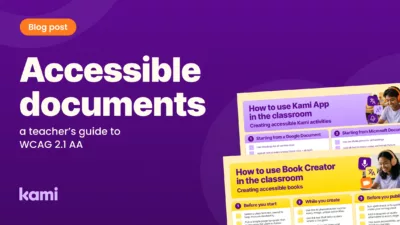
Accessible documents: a teacher’s guide to WCAG 2.1 AA | Kami
Differentiated Instruction in Adult Education: How Kami Builds Student Confidence