



This is part of Kami’s ongoing series of executive briefings for education leaders. Each month, we’ll discuss solutions to a top-of-mind issue and share actionable resources and inspiration for leading your team. Be sure to subscribe to have this free resource delivered to your inbox.
Summary
- What is a “Portrait of a Graduate” and a “Portrait of a Learner “?
- How authentic teaching and learning practices address concerns about AI and student engagement
- Action guide and roadmap for implementing a Portrait of a Graduate
What if the current challenges of low student engagement, academic integrity in the age of AI, chronic absenteeism, and teacher burnout were somehow related?
Six years after the global pandemic, amid shifting funding and rapid technological growth, the status quo no longer serves students or educators. In response, many states and districts are moving beyond traditional annual test scores to embrace a more student-focused approach: the “Portrait of a Graduate.” This model redefines success by focusing holistically on the skills young people need to thrive in post-secondary education, the workforce, and civic life.
What schools are being asked to do and why it’s not working
An educational disconnect lies in the fact that our systems are optimized for standardization, while our students and the modern workforce require personalization and adaptability.
Instead of viewing these struggles as individual failures, we must recognize them as the natural result of a system that is no longer in sync with what students and teachers actually need to thrive.
Researchers have found:
Post-pandemic achievement data show that the pandemic learning recovery has stalled (Dewey et al., 2025)
While attendance is up slightly since 2020, chronic absenteeism and student behavior (Long, 2024) and disengagement continue to be a problem. (Gallup & Walton Family Foundation, 2024)
Teacher burnout and recruitment are real challenges to staffing. (RAND Corporation, Pew Research Center, 2024)
The workforce readiness gap continues to grow (Cengage 2025, Springboard/SHRM 2024)
Twenty years of test-based accountability have largely failed to produce what it promised (Ravitch et al., 2022)
Traditional educational systems have largely struggled to keep pace with social, economic, and technological changes, which is why education leaders are considering alternatives like Portrait of a Graduate.
At least 21 states have developed Portrait of a Graduate frameworks, and more are exploring similar efforts. (Terrell et al., 2025) New York State recently became the first state to phase out its 150 year old Regents high school exit exam in favor of a portrait of a graduate model. (Amin, 2025)
Rather than just a graduation requirement, the “Portrait of a Graduate” is a way of learning that brings everyone together. It creates a common language for success, ensuring that students, teachers, and families work toward the same meaningful outcomes.
What is Portrait of a Graduate?
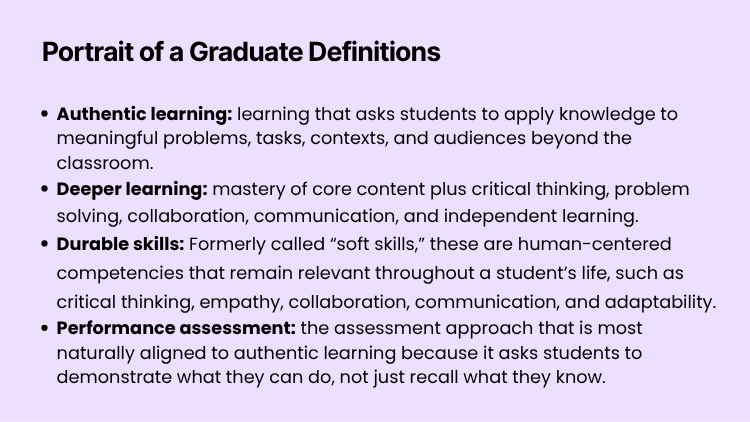
A Portrait of a Graduate (sometimes called a Profile of a Graduate or Profile of a Learner) is a collective vision that defines essential competencies for success beyond high school. At its essence, a “Portrait of a Graduate” (POG) is a community-created, outward-facing articulation of the knowledge, skills, mindsets, and dispositions a school system commits to developing in every learner by graduation (Atwell & Tucker, 2024; McTighe, 2020)
It should shape classroom practice and culture, and rather than focusing solely on academic grades or standardized test scores, a “Portrait of a Graduate” model emphasizes performance-based assessments and requires students to demonstrate and apply knowledge by solving meaningful problems and directly exhibiting skills. Assessments are curriculum-anchored, and developmentally appropriate.
Sometimes, districts use a POG simply as a strategic plan and guiding north star (Battelle for Kids, 2023). This is a light touch approach can lead to uneven outcomes. Other districts have embraced a more encompassing version that has led to the redesign of curriculum, grading systems, and can even inform hiring practices.
But is POG pedagogically sound and effective or just another education fad? Here’s what the research says, along with an action plan to help school leaders design and implement their own “Portrait of a Graduate” plan.
The case for Portrait of a Graduate and authentic learning
Student disengagement and relevance.
In a 2024 Gallup Poll, as many as 54% of students surveyed reported that they lack engaging experiences in school, such as feeling that what they are learning is important or interesting, (Gallup.com). Research suggests that discipline issues are often symptoms of an engagement problem (Wang & Fredricks, 2014). When a student is off-task, it is frequently a rational response to a task that is too difficult, too easy, or lacks personal relevance. (Cents-Boostra, et. al, 2021)
Improve motivation, engagement, and self-efficacy.
Students in deeper learning settings, like those made possible by Portrait of a Graduate systems, reported stronger collaboration, engagement, motivation to learn, and self-efficacy than peers in comparison schools. The Organization for Economic Co-operation and Development (OECD) also emphasizes that engagement and motivation are vital to acquiring and retaining knowledge and skills. (ERIC)
Improve academic outcomes.
Portrait of a Graduate models that use authentic learning can also improve test scores. Studies of New York City Public Schools that use “Deeper Learning” –a type of authentic pedagogy–find a strong relationship between authentic learning and performance on the OECD PISA-Based Test for Schools, and state ELA and math tests, plus a roughly 9-point advantage in on-time graduation for students. (ERIC).
A cluster randomized trial of second-grade PBL found higher growth in social studies and informational reading (PBLWorks), and a study by USC found that project based learning increased advanced placement test scores. (Saavedra et al., 2021)
Assessment in the age of AI.
Standardized tests, essays, and worksheets are susceptible to cheating with AI. Experts argue for performance-based assessments because they are not only cheat-resistant, but measure higher-order thinking, disciplinary practices, and deeper learning competencies. (Learning Policy Institute)
Durable skills and career readiness.
AI and geopolitical turmoil have drastically changed what career readiness means. Rather than training students for a single job that may eventually be displaced, educational experts and businesspeople stress the importance of developing durable skills that help students be adaptable in the workforce and resilient in social contexts.
The World Economic Forum, for example, continues to emphasize analytical thinking and other adaptable human skills in a changing labor market. (World Economic Forum, 2025) Industry leaders–including those from Anthropic and Microsoft– say that a liberal arts education that focuses on critical thinking and ethical decision making is more important than technical skills.
Portrait of a Graduate facilitates the strengthening of these skills because of its emphasis on student agency and performance-based assessments. (Slover, 2026)
Action guide for leaders
This action plan can help you develop a Portrait of a Graduate in your district.
1. Map your progress from vision to practice
- Assess your current state — What does your system currently measure, reward, and communicate as success?
- Build your Portrait — Engage your community in the development process to determine learning outcomes, assessment strategies, and pedagogy that supports these. Read this toolkit for ideas.
- Align the system — Curriculum, instruction, assessment, professional learning, hiring
- Shift instructional practice — Make incremental shifts and empower teachers through professional development rather than top-down mandates
- Redesign assessments — Move toward performance-based and authentic assessment alongside (not replacing) traditional assessments
- Measure and communicate progress — What does implementation data look like? How do you tell the story to your community?
- Sustain the work — Success comes by building a culture, not launching a program
2. Create the conditions for success
- Create a shared student/graduate vision tied to district strategic plans–it shouldn’t be a side project or end-of-the-year extra.
- Clarify the district’s graduate outcomes. Audit whether the portrait is specific enough to guide instruction, or will simply remain guiding principles.
- Align curriculum and assessment so that portraits are not disconnected from daily instruction.
- Make space for teacher professional learning and collaborative planning time, especially around task design and assessment.
- Implement a phased rollout, not a districtwide overnight transformation. Use a few schools, grade bands, or pathways first.
- Provide plenty of examples of evidence students can produce: capstones, portfolios, exhibitions, public products, internships, defenses, community-based projects.
- Partner with local employer/community members where relevant, especially for secondary schools and career-connected learning.
- Show evidence publicly. Student exhibitions, portfolios, capstones, and community-facing products help make the change visible.
- Track a broader dashboard. Include engagement, attendance, quality of student work, course completion, graduation indicators, and stakeholder feedback, not only test scores.
3. Pitfalls and considerations for efficacy
While the vision is broad, respected institutions note that the efficacy of a POG depends on successful implementation:
- The Assessment Gap: Educators often lack experience integrating interdisciplinary skills into everyday teaching. Tracking student progress across diverse grade levels remains a challenge because skills like “collaboration” and “communication” are often interconnected and difficult to measure independently (Digital Promise & Pearson, 2025).
- Consistency Issues: There is a risk of creating a “diverse patchwork” of graduate profiles that vary significantly between schools or districts, potentially leading to inconsistent educational priorities and student outcomes across a district or state.
- Need for Alignment: For a POG to be effective, it needs to be translated into measurable objectives and aligned with state standards to provide a roadmap for instructional improvement.
Read more briefs like this for education leaders: Subscribe to our free monthly briefing to get curated resources delivered straight to your inbox.
Main illustration by Gavin Wilshen, with photography from Jordan González, Bozhin Karaivanov, Deng Xiang, and Jei Lee
Blogs you may also like
An Educator’s Journey with Kami

Engaging every learner: How Kami transforms passive lessons into active learning
One platform, every learner: How Fond du Lac School District transformed digital learning with Kami