


Use this demo passage with the Kami Companion toolbar to see what students in science class may experience.
The Great Water Journey: How the Earth Recycles Water
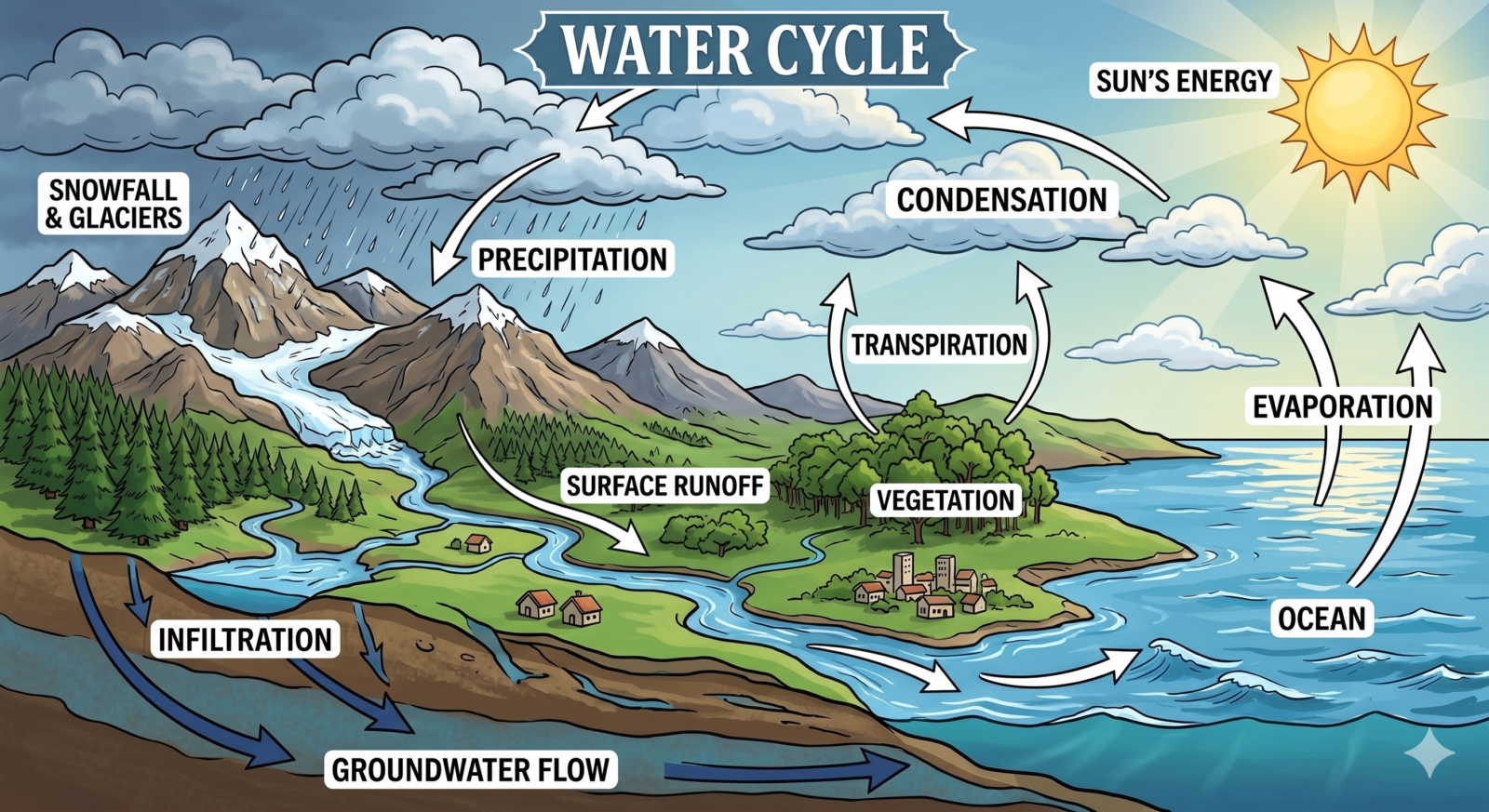
Have you ever wondered if the water you used to brush your teeth this morning is the exact same water a Tyrannosaurus rex drank millions of years ago? It sounds crazy, but it’s true! Earth doesn’t get new water from space. Instead, it recycles the water we already have over and over again in a giant, never-ending loop called the water cycle.
This incredible journey is powered by the sun and moves water through three main stages: evaporation, condensation, and precipitation.
Stage 1: Evaporation
The water cycle begins when the sun warms up the water in Earth’s oceans, lakes, and rivers. When the water gets hot enough, it changes from a liquid into an invisible gas called water vapor. This process is called evaporation.
Because water vapor is light and warm, it leaves the ground and floats high up into the sky. (Plants help out with this journey too! When they sweat out extra water from their leaves, it turns into vapor in a process called transpiration.)
Stage 2: Condensation
As the invisible water vapor floats higher and higher, the air around it gets colder. When the vapor cools down, it changes back into tiny liquid water droplets. This is called condensation.
These tiny droplets attach themselves to bits of dust floating in the air. When billions of these droplets stick together, they form the beautiful, fluffy clouds you see in the sky! If you’ve ever seen your breath on a freezing cold day, you’ve witnessed condensation firsthand.
Stage 3: Precipitation
Inside a cloud, the water droplets are constantly moving around and bumping into each other. As they stick together, they grow bigger and heavier. Eventually, the droplets become too heavy to stay floating in the air.
Gravity pulls them down to Earth as precipitation. Depending on how cold the air is, precipitation can fall as rain, snow, sleet, or hail.
The Cycle Continues
Once the water falls back to Earth, it doesn’t just sit there. Some of it soaks into the ground to feed plants or become groundwater. The rest fills up our rivers and flows right back into the ocean. This is called collection.
As soon as the sun shines down and warms that water up again, the whole cycle starts all over. So, the next time it rains, remember—you are watching Earth’s oldest recycling program at work!
Want to see how Kami Companion supports UDL principles in practice? Download the Kami Companion UDL one-pager for a shareable overview you can bring to your next planning conversation or team meeting.
Gemini. (May 18, 2026). Water Cycle [Digital image]. Google Gemini. https://gemini.google.com/
Blogs you may also like
Kami Companion in the English Classroom

Kami Companion in the Social Studies Classroom
Kami Companion in the mathematics classroom