


Use this demo passage with the Kami Companion toolbar to see what students in math class may experience.
The Architect of Broken Things
A Secondary School Mathematics Reading Passage
Mara had always been better at breaking things than building them.
That changed the summer her uncle handed her a set of blueprints and said, “Tell me what’s wrong with this roof.”
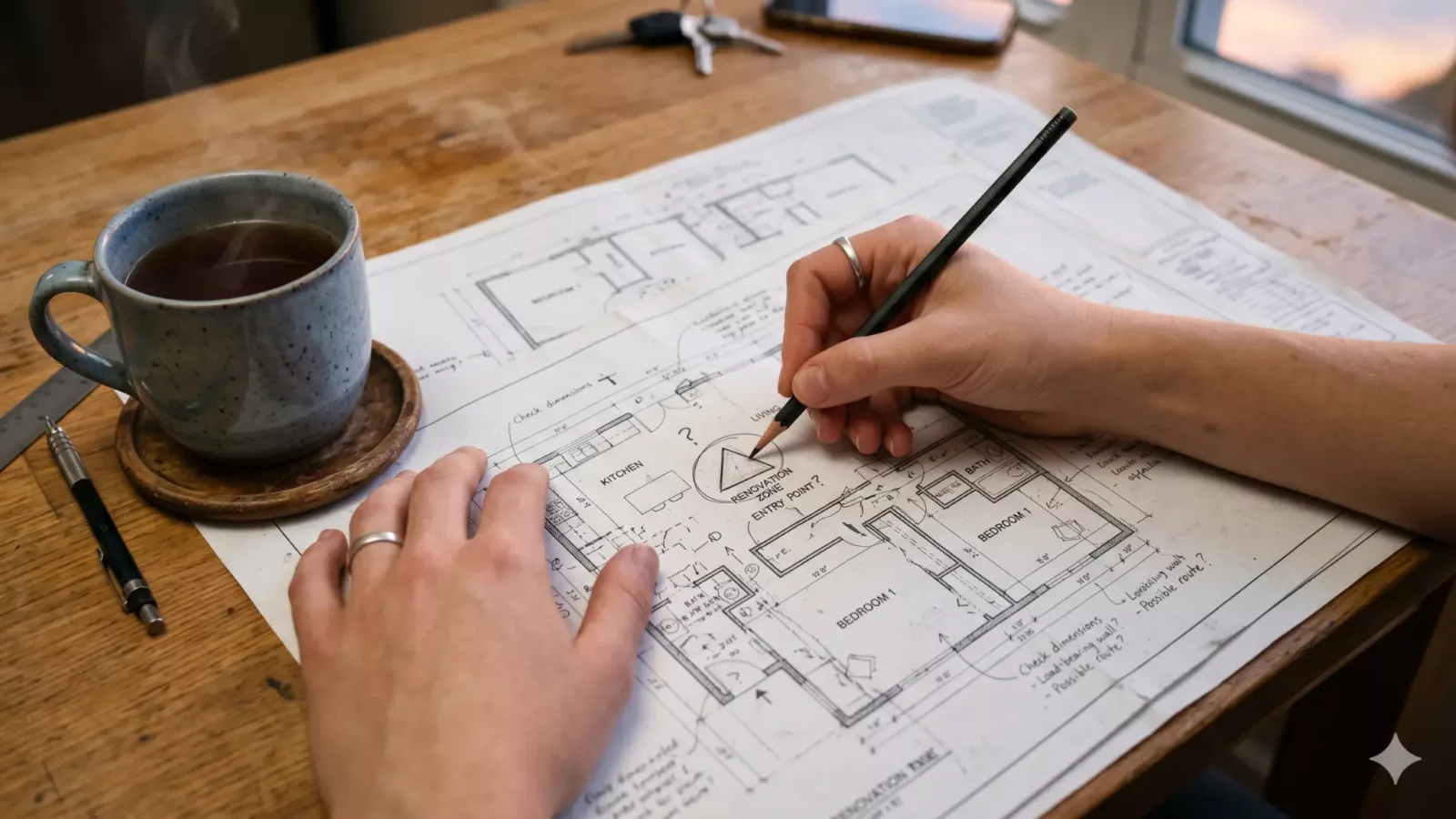
The blueprints showed a triangular roof truss — the internal framework that gives a roof its strength. Her uncle was a structural engineer, and he had been hired to inspect a local community hall that kept developing leaks. The contractor, he suspected, had made an error somewhere in the design. He just couldn’t find it.
Mara spread the blueprints across the kitchen table and studied them. The truss was made up of several triangles connected at shared vertices — the points where two or more line segments meet. She had learned in school that triangles were the strongest shape in construction, because unlike squares or rectangles, they cannot be deformed without changing the length of their sides. Engineers called this property rigidity.
But something was off.
She looked at the largest triangle in the truss. The blueprint labeled two of its angles: 47° and 61°. Mara reached for a pencil and did the calculation quickly. The three interior angles of any triangle, she knew, must always sum to exactly 180°. That was not a suggestion — it was a geometric law, true for every triangle on every blueprint in every country in the world.
47 + 61 = 108.
180 − 108 = 72.
The third angle should have measured 72°. But on the blueprint, it was marked as 68°.
Four degrees. It didn’t sound like much. But in a triangle, even a small angular error changes the proportions of the entire shape. The side lengths would be miscalculated. The truss would sit unevenly. Over time, under the weight of rain and wind and snow, the uneven stress would create gaps — and gaps, in a roof, become leaks.
“Here,” Mara said, circling the angle with her pencil.
Her uncle leaned over her shoulder and was quiet for a moment. Then he laughed — a short, surprised sound. “Four degrees,” he said.
“Four degrees,” she confirmed.
She had not expected geometry to feel like detective work. But sitting at that table, pencil in hand, she understood something she hadn’t quite grasped in the classroom: mathematics wasn’t a collection of rules invented to make school harder. It was a description of how the physical world actually behaved. The angles were always going to add up to 180°. The roof was always going to leak.
The numbers had been trying to tell someone for months. They just needed someone who knew how to listen.
Want to see how Kami Companion supports UDL principles in practice? Download the Kami Companion UDL one-pager for a shareable overview you can bring to your next planning conversation or team meeting.
Gemini. (May 18 2026). Architectural Blueprint Investigation [Digital image]. Google Gemini.https://gemini.google.com/
Blogs you may also like

Kami Companion in the English Classroom

Kami Companion in the Science Classroom

Kami Companion in the Social Studies Classroom