


Ask a group of high schoolers whether they care about data science and most will shrug. Ask them whether they’ve ever wondered why a streaming app keeps recommending the same three shows, or which players actually deserve a spot on the fantasy team, and the room wakes up. That’s data science. They just didn’t have the term for it yet, and that gap between the subject’s reputation and its actual content is the first problem any high school data science curriculum has to solve.
Why a high school data science curriculum matters now
Data science is no longer confined to tech companies. It shapes streaming recommendations, tracks environmental change, and informs decisions in nearly every field students might enter after graduation. A curriculum built around the data science cycle gives students a repeatable process for making sense of the world instead of taking claims at face value. That cycle has four moves: ask a question, collect data, analyze patterns, and present results.
Something as ordinary as school lunch preferences can become a real investigation. Students survey classmates, collect cafeteria data, and analyze what they find well enough to propose an actual change. At that point they aren’t completing an assignment, they’re reasoning from evidence, and that’s the habit the rest of a program builds on.
Real-world connections make the subject stick. Streaming algorithms explain why a platform recommends certain shows. Player statistics in popular video games predict which features will matter most next season. Environmental data shows the local effects of climate change. Sports statistics settle arguments about which player actually performs better. These aren’t manufactured examples. They’re the same reasoning students already use informally, made explicit and testable.
The demand for the skill set keeps growing. According to the Bureau of Labor Statistics, data scientist employment is projected to grow 34% from 2024 to 2034, much faster than the average across occupations, with a median annual wage of $112,590 in 2024. A high school program gives students a chance to picture themselves in that kind of work before they have to choose a major or a postsecondary path. Just as important, data literacy builds informed citizens who can question sources, spot bias, and reason from evidence rather than assumption. Most students won’t become data scientists. All of them will be handed a chart designed to persuade them of something.
What a semester could look like
A curriculum doesn’t need a dedicated course to start. One realistic shape spreads the cycle across a semester so each move gets real attention.
The first few weeks stay on question design, because it’s the step most programs rush. Students learn the difference between a question data can answer and one it can’t, and they practice narrowing something broad (“is social media bad?”) into something testable (“how does screen time in our class compare across weekdays and weekends?”).
The middle stretch covers collection and cleaning. Students gather their own data through surveys or observation, then confront the part nobody warns them about: inconsistent responses, missing entries, and the judgment calls involved in deciding what to do about them. This is where data literacy is actually built.
The back half moves to analysis and presentation. Students build graphs, identify patterns, and then make an argument to a real audience, whether that’s the class, a school leader, or families. Presenting to someone who can push back changes how carefully students reason.
Where a high school data science curriculum usually stalls
Three problems account for most of the trouble.
The first is starting with tools instead of questions. A curriculum that opens with a spreadsheet tutorial teaches spreadsheet mechanics and not much else. Students need a question they care about before the software has any meaning.
The second is using clean datasets. Prepared data is faster to work with and teaches the wrong lesson, because it skips the judgment that real analysis requires. A messy set of 30 survey responses from students in the building is worth more than a tidy national dataset.
The third is stopping at the chart. Producing a graph feels like finishing, but the analytical work is in interpreting it and defending the interpretation. If a program ends at visualization, students learn to make things that look like conclusions.
Making the high school data science curriculum accessible to every learner
Data science has a reputation for being math-gated, and that reputation keeps students out of it who would do well. A curriculum built for a broad range of learners scaffolds a complex task into smaller pieces, collecting data one day and analyzing it the next, so students stay organized instead of overwhelmed by trying to do everything at once.
Multimodal tools matter here as much as the content does. Text-to-speech supports students working through reading challenges. Speech-to-text gives students who reason better out loud a way in. Options to upload video, audio, or images mean a student can show their analysis in whatever format demonstrates their thinking, rather than being assessed on how well they write about it.
There’s a practical equity argument too. If the entry requirement is prior comfort with statistics, the curriculum will recruit the students who already had access to it. If the entry requirement is curiosity about a question, the pool widens considerably.
What students learn
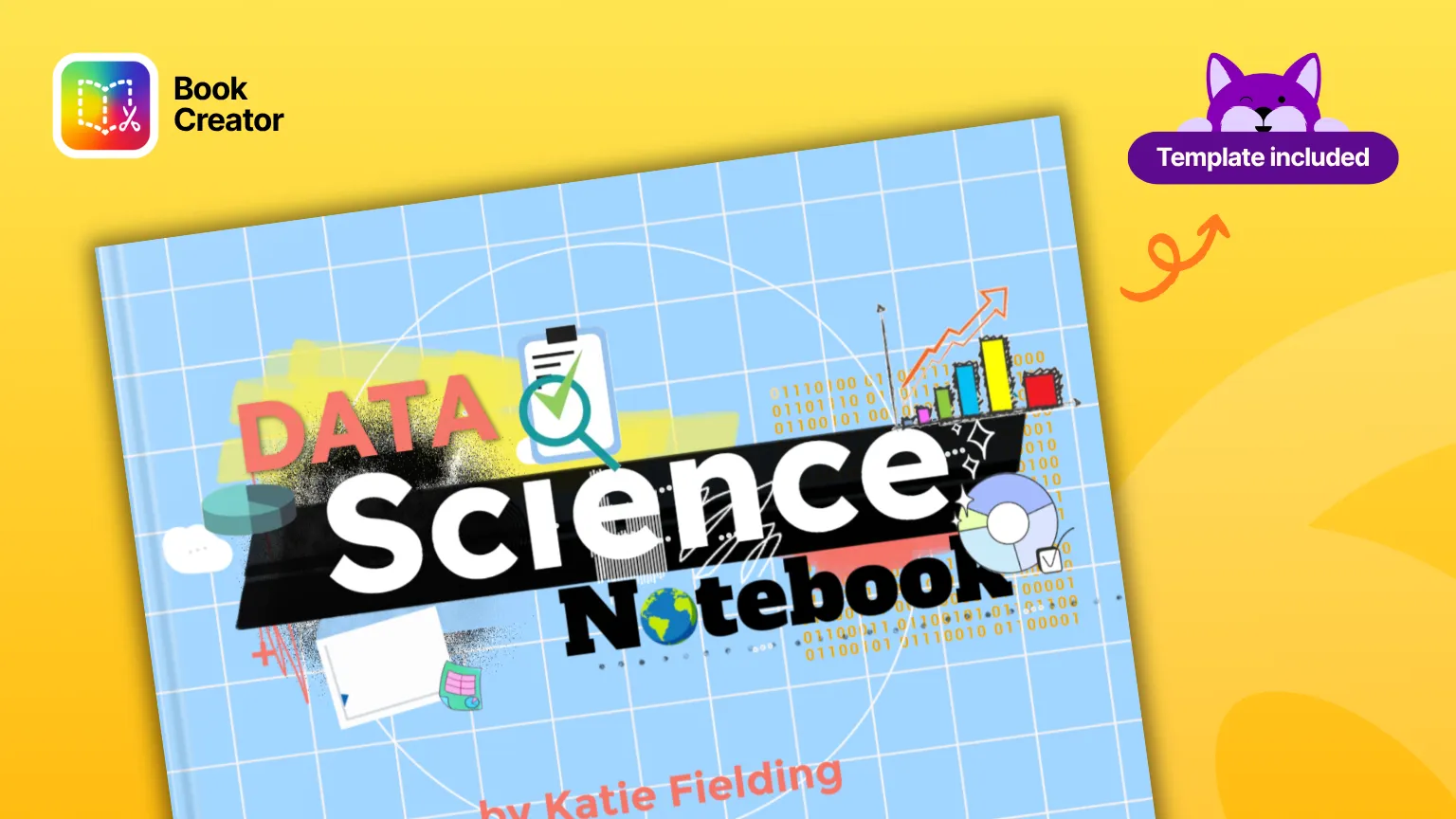
Book Creator’s data science notebook walks students through the full cycle, connected to topics they already care about. Students craft data-driven questions about subjects like social media trends or favorite sports, then gather data through surveys, digital tools, or direct observation. From there they use tools like Google Sheets or Canva to build graphs and identify patterns, and they practice thinking critically about bias and data quality along the way.
The statistical vocabulary comes along with the investigation rather than ahead of it. Measures like mean, median, and mode land differently when a student needs them to defend a claim about their own dataset than when they arrive as definitions to memorize.
Book Creator gives students a way to demonstrate that understanding and gives teachers a shareable portfolio of it. For a coordinator, that portfolio is the useful artifact: it’s what makes a pathway conversation with a student concrete, and it’s what a capstone or work-based learning placement can actually look at. A data science program is one of the more tangible STEM teaching strategies a school can point to, and the student work is the evidence. The 5E model offers a comparable structure for science instruction, and the two pair well in a coordinator’s toolkit.
Using the notebook in your curriculum
The notebook flexes around however a curriculum actually runs. Coordinators and teachers can remix and reorder activities to match their curriculum, assign the notebook individually or to small groups, and reuse the same activities across different units so students get repeated practice with the cycle rather than a single exposure to it.
Start with one investigation on a question students chose themselves, and give them an audience for the result. Those two conditions do more for engagement than any amount of framing about career demand.
See Book Creator’s data science notebook to bring this cycle into your high school data science curriculum.
Blogs you may also like
How the 5E model sequences a science lesson, phase by phase

How the transformational learning principles reshape STEM content design