


A fourth-grade teacher who spent a decade in marketing before switching careers is three weeks into her first science unit on ecosystems. She knows the content. What she doesn’t have yet is a reliable structure for teaching it the way a science lesson is supposed to unfold, so students investigate before they’re told the answer.
That gap is common, and it isn’t a reflection of the teacher. Elementary teachers are generalists, often asked to teach science without discipline-specific training in how science instruction differs from reading or math instruction. Career changers arrive with deep subject knowledge and no pedagogical scaffolding for it. The 5E model exists to close exactly that gap.
What the 5E model is
The 5E model is a sequence built around five phases: engage, explore, explain, elaborate, and evaluate. It was developed at the Biological Sciences Curriculum Study (BSCS) in the late 1980s, proposed by Rodger Bybee and building on earlier learning cycle work by Atkin and Karplus. Each phase has a specific job, and the order matters as much as the content inside it.
Engage sparks curiosity before any formal instruction happens. Teachers pose a question or scenario connected to the topic and let students respond using video, images, or audio. The goal is to surface what students already know, including the misconceptions, and get them genuinely curious about what comes next.
Explore comes before explanation, on purpose. Students investigate hands-on, through virtual labs, simulations, or physical materials, and encounter the phenomenon directly. Letting students explore a model before naming its parts helps them understand both what the model shows and where it falls short.
Explain is where direct instruction happens, but only after students have already experienced the phenomenon without the barrier of unfamiliar vocabulary. Introducing tier-three scientific terms after exploration rather than before it means students attach new words to something they already understand instead of memorizing terms in isolation.
Elaborate asks students to apply what they’ve learned to a new situation: designing a solution, running a related investigation, or taking on a small project-based task. This is where understanding gets tested against a problem the student hasn’t seen before.
Evaluate isn’t a single event at the end of the unit. It runs continuously, through formative checks during the cycle and a summative assessment at the close, so teachers can catch misunderstanding while there’s still time to address it.
What a 5E model unit looks like in practice
It’s easier to see the sequence with a single topic running through it. Take the fourth-grade ecosystems unit from earlier.
In engage, students watch a short clip of a pond and record what they notice and what they wonder, in writing or by voice. Nobody defines a food web yet.
In explore, students build a simple terrarium or work through a simulation where removing one organism changes the rest of the system. They log what happens over several days.
In explain, the teacher introduces the vocabulary students now have direct experience of: producer, consumer, decomposer, food web. Students go back and relabel their own observations with the correct terms, which is a far better check on understanding than a matching quiz.
In elaborate, students take on a new scenario, a local pond with an invasive species, and predict the downstream effects using what they’ve built.
In evaluate, the teacher isn’t waiting until the end. She’s reading the “notice and wonder” entries after day one and the relabeled observations after the explain phase, which is where she catches the three students who still think decomposers are a kind of plant.
Where the 5E model tends to break down
Two failure modes come up more than any others.
The most common is collapsing explore into explain. Under time pressure, the exploration turns into a demonstration the teacher narrates while students watch. The activity still happens, but the sequence inverts, and students end up with vocabulary attached to nothing they experienced themselves.
The second is treating evaluate as the test. If the only evaluation is summative, the model becomes a linear unit plan with a quiz on the end, and the diagnostic value of the middle phases goes unused. Building in one deliberate checkpoint after explore and one after explain is usually enough to fix this.
The third is compressing the whole cycle into one class period. This one is worth stating plainly because it’s the most common misreading of the model: the San Diego County Office of Education notes that using the 5E model as the basis for a single lesson reduces the effectiveness of the individual phases, because it compresses the time each phase needs. The model is built for a learning sequence, not a lesson plan template you fill in every day. A single phase occupying a full class period is normal.
Related, and useful once you know it: phases can be repeated rather than run strictly once each. A sequence might go engage, explore, explain, explore, explain, elaborate, evaluate. Research summarized by SDCOE points to the greatest impact when phases aren’t omitted or reordered, so looping back through explore and explain is fine while moving explain ahead of explore is not.
Turning the 5E model into a lesson plan you can reuse
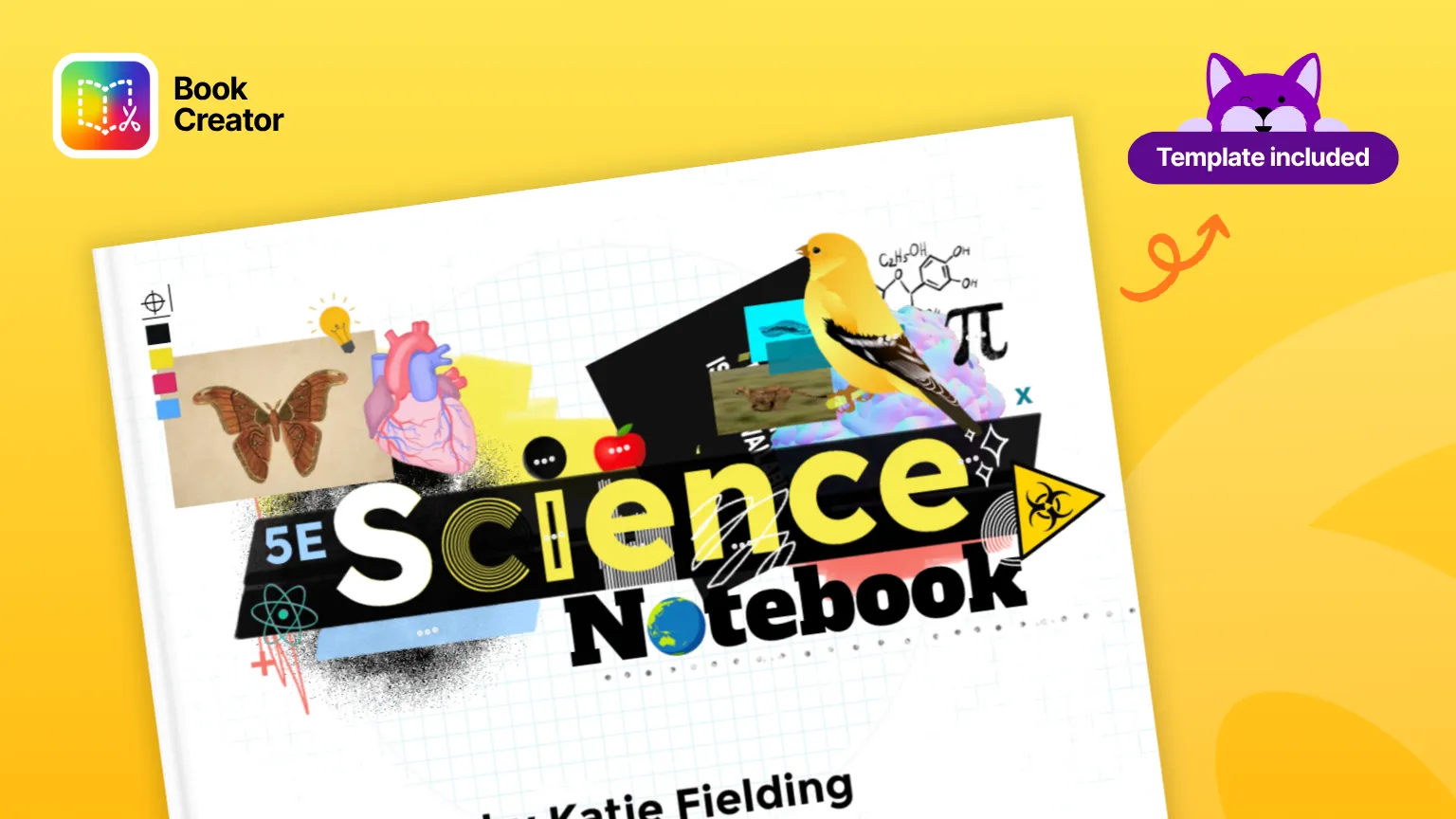
A 5E science notebook gives students one consistent place to move through all five phases, and it gives teachers a curated set of resources in the margins, useful whether a teacher is new to the model or just new to this particular topic. Book Creator gives students a way to demonstrate understanding and reflect on their learning, and gives teachers a shareable record of that progress rather than five separate handouts to collect.
If you’re building a 5E lesson plan from scratch, the structure that holds up across topics is straightforward. Write the phenomenon or question first, before any objectives, because the engage phase depends on it. Decide what students will physically do in explore, and make sure it produces something observable they can point at later. List the tier-three vocabulary you’ll introduce in explain, and confirm none of it is needed to complete the explore task. Choose an unfamiliar context for elaborate, not a repeat of the original activity. Then mark two evaluation checkpoints, one after explore and one after explain, rather than a single assessment at the end.
The notebook is meant to be adapted, not used as is. Teachers can remix it into their own library, then reorder or delete pages so the notebook matches their actual lesson flow instead of a generic template. Placeholder text marked “TOPIC” gets replaced with the real vocabulary and content of the current unit, which is what makes the notebook feel purpose-built rather than borrowed.
Because Book Creator supports text, audio, video, and drawing, students can respond to each phase in whatever format shows their thinking most clearly. That matters most during explain and elaborate, where written vocabulary can otherwise become the biggest barrier to demonstrating understanding. A student who can explain a food web out loud but not yet in a paragraph should still be able to show they understand it.
The 5E model is one of several STEM teaching strategies worth building instruction around, and it’s usually the easiest place to start, because it restructures lessons a teacher is already planning rather than adding anything new to the calendar.
Bringing it into your next unit
Start with the phase that feels like the weakest link in current lessons. If explanations tend to come too early, before students have explored anything hands-on, redesign that phase first and leave the rest alone for now.
Then pick a single unit rather than a semester. Run the full cycle once, keep the checkpoints after explore and explain, and see what those checkpoints tell you that a final assessment wouldn’t have. That’s usually the thing that makes the model stick.
See Book Creator’s 5E science notebook to bring the model into an upcoming unit.
Blogs you may also like
How the transformational learning principles reshape STEM content design

Building a high school data science curriculum students actually want to take
Seven STEM activities for middle school you can run with what’s already in the closet