

Icebreakers land differently with a room full of 13-year-olds than they do with a room full of six-year-olds. By middle and high school, most students have sat through years of “two truths and a lie” and can smell a forced bonding activity from the back row. That doesn’t mean the first weeks matter less. It means the activities have to respect that these students are older, more self-conscious, and more likely to opt out if something feels beneath them, which is exactly the bar back-to-school activities for secondary students need to clear.
The templates below are built with that in mind, covering real relationship-building work plus something a lot of middle and high school classrooms skip in September and shouldn’t: setting up the student portfolio habit before the year gets busy.
That second piece is worth sitting with for a second. Elementary teachers tend to build portfolios into daily routines without thinking twice about it. In middle and high school, portfolios often show up for the first time as a graduation requirement, a college application, or a scholarship deadline, which means students are trying to reconstruct three years of scattered work under pressure. None of that has to happen in September specifically, but September is when the habit either starts or doesn’t.
Getting students comfortable with the tools first
None of the templates below land well if students are still figuring out the interface while they’re supposed to be reflecting, setting a goal, or introducing themselves.
- Kami Scavenger Hunt for Secondary Level: a self-paced scavenger hunt that has students find and use Kami’s core tools on their own, which tends to land better with older students than a teacher-led walkthrough of the same material.
- Teach Your First Lesson: Teacher Guide: grade-by-grade lesson plans, from kindergarten through grade 12, for introducing Book Creator itself: logging in, joining a library, recording audio, and using the pen tool, among other things. Pick the lesson for your grade band and run it before assigning any of the books above.
Run it in the first week, before assigning the goal-setting or portfolio templates, so students aren’t learning the tool and the task at the same time.
Get-to-know-you activities for secondary classrooms
These give students a way to introduce themselves that doesn’t feel like it was designed for a much younger grade.
Why We Love It: the image generation template gives students creative control over how they’re represented, which matters more to a 14-year-old than any worksheet prompt ever will.
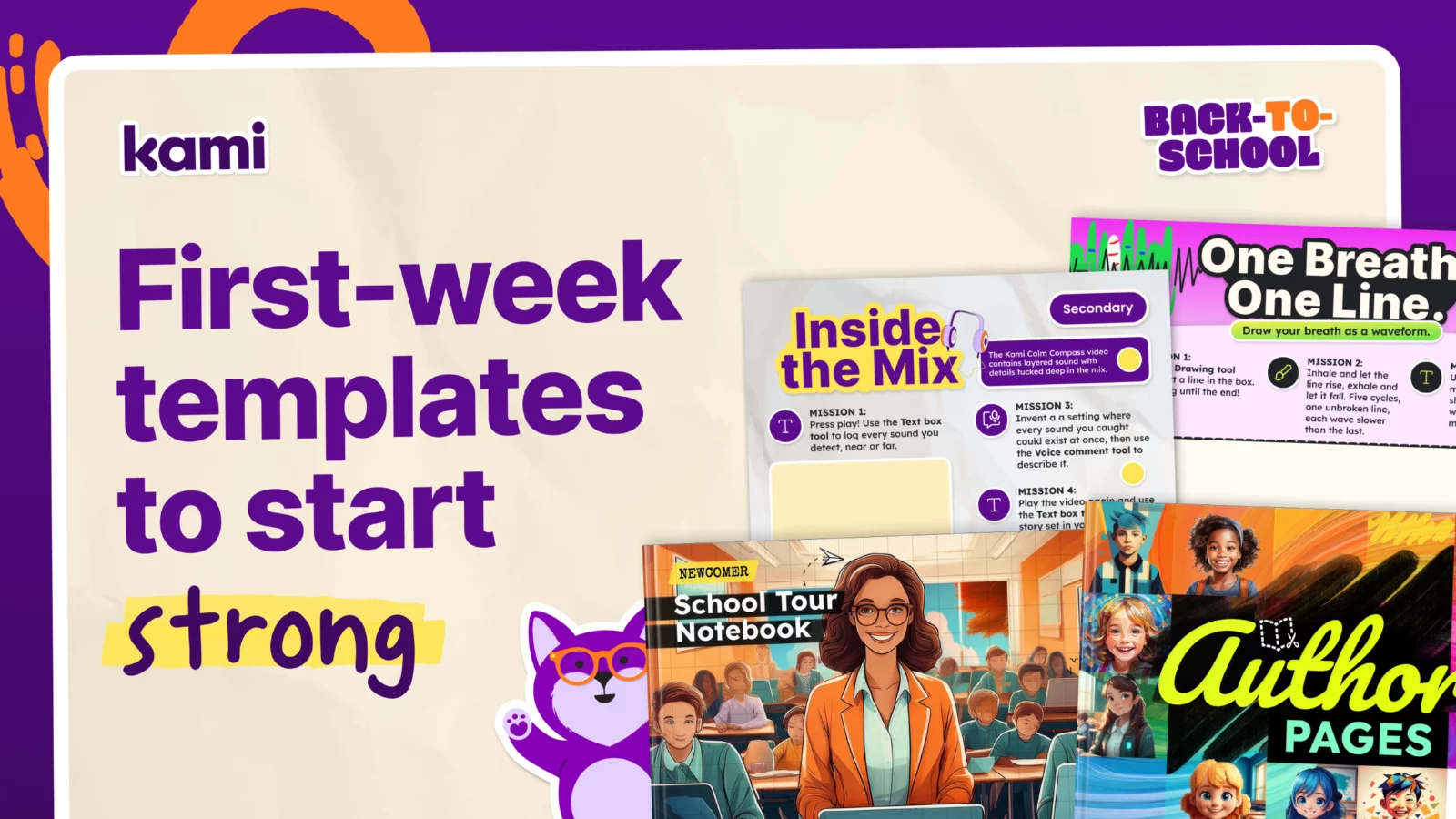
- Author Page: Image Generation: students generate a stylized “about the author” avatar (retro video game, chibi anime, watercolor, and more), then write a short bio to go with it. It works well as a cover page for any book students make later in the year, including their portfolio.
- All About Me Journal: a customizable journal covering favorites, feelings, and a self-portrait. Reads younger out of the box, but it’s easy to swap the prompts for something with more range, like a favorite lyric or a skill you’re proud of, to fit an older group.
- Newcomers: All About Me: built for multilingual newcomers of any age, with translation support built into Book Creator so a student can introduce themselves in their home language while you read it in English.
A quick note on tone: what lands with a sixth grader and what lands with a high school junior are not the same thing, even though both count as “secondary.” Sixth graders are often still fine with playful, visual prompts. By 10th or 11th grade, students respond better to activities that treat them like young adults, ones that ask about their actual interests, goals, or opinions rather than favorite colors and animals. Look at your specific grade level before deciding how much to adapt each template.
In the Kami App, a couple of templates do similar work for classes that run off shared documents instead of individual books:
- All About Me for students (customizable): an editable introduction sheet. The default prompts skew younger, so it’s worth swapping in questions about interests, goals, or opinions before handing it to an older group.
- Say My Name: a short, low-pressure activity focused on getting names and pronunciations right from the start. That matters just as much in a high school classroom as it does in a kindergarten one, maybe more, since teenagers notice when a teacher still hasn’t learned their name by week three.
More back-to-school activities for secondary students
Once introductions are out of the way, these templates help set up the rest of the semester.
Secondary Vocabulary Notebook: a cross-curricular vocabulary template built around listening, speaking, and reading practice, with a full week modeled out so you can copy the format for the rest of the term.
- Welcome to Our Class: a class handbook with a teacher profile, weekly planner, and classroom photos. Works best if you update the tone and images to match your actual classroom rather than leaving the defaults in place.
- School Tour Notebook: Teacher Guide: this one has both elementary and secondary versions built in, so new students and families get an orientation to the building, staff, and routines that’s pitched at the right age.
- Back to School Night: a shared, collaborative book where every teacher on a team or in a department adds their own page, so families who couldn’t attend back to school night still get the introduction and expectations for each class.
Calm and focus activities for secondary classrooms
Teenagers carry a lot into the first weeks of school, new schedules, new social dynamics, a full course load that starts on day one instead of easing in. A minute of genuine calm isn’t a soft add-on for this age group. It’s often the difference between a student who can settle into a lesson and one who’s still running on the hallway they just left.
These work best framed as tools students choose to use, not a mandatory calm-down corner. Secondary students opt out fast when something feels like it’s for younger kids, so treat these as legitimate strategies worth having in their own toolkit, the same way you’d introduce any other study skill.
- Inside the Mix: students explore soundscapes by detecting natural and human-made sounds in the Kami Calm Compass video, and weaving their observations into a creative story using the Text box tool.
- One Breath, One Line: students draw their breath as a waveform using an unbroken line over five breathing cycles to promote focus and explore the benefits of breathing exercises.
- The Museum of One: Secondary students curate their own single-masterpiece museum exhibit, using Kami tools to analyze a chosen artwork, design the exhibit text, and record a curator statement.
- The 60-Second Masterclass: a personalized page where students name the specific conditions that help them concentrate, something they can return to whenever a task isn’t landing.
- Text to Future Me: students reflect on the upcoming year by sending a message to their future selves, utilizing Kami tools to document their hopes, anticipated personal changes, and questions.ed.
Goal-setting and progress-tracking activities
Getting to know a room full of teenagers is only half the job in the first weeks. The other half is helping them start owning their own progress before the semester gets away from everyone. These two Kami App templates handle that, and they set up the portfolio work below nicely, since a goal only means something if a student can actually see whether they’re moving toward it.
- Track Your Learning: a running record students update themselves, so progress becomes something they can see rather than something a teacher reports back to them after the fact.
- Goal Setting: a template for setting and revisiting personal or academic goals, useful as a first-week activity and worth revisiting again at each grading period.
The Kami App is built for this kind of ongoing check-in, turning a shared document into something students return to and update across the semester instead of filling out once in September and never opening again.
Student portfolios worth starting on day one
Portfolios are one of those things everyone agrees are valuable and almost nobody starts early enough. By the time a student needs a portfolio for a college application, a scholarship, or a Portrait of a Graduate requirement, it’s a scramble to reconstruct three years of work from memory. Starting the habit in the first weeks of school solves that problem before it exists.
- Portrait of a Graduate: a digital portfolio framework built around the competencies many districts define for graduation, with reflection prompts and top tips for getting students to actually use it as a working portfolio, not just a folder of assignments.
- Portrait of an AI-Ready Graduate: a newer competency framework covering how students use AI as a learner, researcher, storyteller, and collaborator, with a rubric to track growth across each area.
- Career preparation portfolio: built for older high school students to document career awareness, job-readiness skills, and postsecondary planning. It’s modeled on Pennsylvania’s career-readiness requirements, but the structure adapts easily to whatever framework your state or district uses.
Book Creator carries an ESSA Level III evidence certification, which matters here specifically: a portfolio only works as evidence of learning if the tool behind it can back that up.
One distinction worth teaching explicitly from day one: a working portfolio and a presentation portfolio are not the same thing. A working portfolio is where everything goes, drafts, false starts, work a student isn’t proud of yet. A presentation portfolio is the curated version, the pieces a student chooses to represent their best thinking, along with the reflection on why they chose it. Students who understand that distinction early stop treating the portfolio as a chore and start treating it as a record they actually have some say over.
If you want a deeper look at how to structure a Portrait of a Graduate portfolio so it holds up all year, we wrote a full guide on it, including eight tips from the educators who built this template. Scaling Student Success has also written well about how portfolios operationalize a graduate profile, if you want the district-level case for why this is worth the setup time.
How to make these your own
Secondary students notice when something was clearly built for a younger grade and handed to them unchanged. Before assigning any of these, look at the reading level, the examples, and the visual style, and adjust anything that reads too young. Swap stock prompts for ones with more range. Let students choose their own vocabulary words, career interests, or portfolio artifacts instead of assigning the same one to everyone.
For the portfolio templates specifically, resist the urge to make the first entry perfect. A working portfolio is supposed to be messier than a presentation portfolio. The goal in week one is just to get the habit started, not to produce something college-application-ready by Labor Day.
Where to start
If you’re short on time, pick one get-to-know-you activity for the first day, set up the portfolio template you’ll use all year during week one, and hold off on everything else until routines settle. The portfolio habit especially pays off more the earlier it starts, and it’s a lot easier to establish in a calm September than to retrofit in a busy April.
Looking for the elementary version of this list? Check out our back to school activities for elementary students, or browse the full Kami library and the Book Creator template collection for more.
Blogs you may also like
Your March Classroom Activities, Planned


Summer Reading Resources: Journals, Author Studies, and More
April Classroom Resources: End-of-Year Energy That Actually Inspires