
Teacher Burnout De-Implementation: A Back-to-School Audit Guide | Kami



Pruning with Purpose: Protecting teacher capacity through strategic de-implementation audits
This is part of Kami’s ongoing series of executive briefings for education leaders. Each month, we’ll discuss solutions to a top-of-mind issue and share actionable resources and inspiration for leading your team. Be sure to subscribe to have this free resource delivered to your inbox.
Every summer, district and school leadership teams gather around conference tables to roll out the upcoming school year’s strategic vision: mapping instructional goals, auditing digital platforms, and scheduling back-to-school PD sessions. These launch plans often come paired with good intentions, like staff wellness days and welcome-back breakfasts. But conversations at this summer’s International Society for Transforming Education (ISTE) conference made it clear that teacher burnout isn’t solved by adding wellness perks to an already overflowing plate. I heard from colleagues that Dr. Sabrina McGahee’s Innovator Talk at the ISTE Conference on teacher burnout and resilient school cultures packed the room, proof that leaders are looking for ways to protect their teachers. However, building resilience and taking things off teachers’ plates are two different issues, and this school year it’s time to tackle the second one. The success of district initiatives depends entirely on the willingness to systematically prune performative practices to restore teacher capacity.
The Cost of Initiative Fatigue: Why we must subtract before adding
To build a sustainable educational environment, we must acknowledge that educator morale and school culture suffer when we add without subtracting. Every unused software subscription, redundant multi-page lesson plan template, and low-impact compliance requirement taxes educator bandwidth.
In my Kami white paper, Intentional EdTech: Digital Learning for Purpose and Learning Outcomes, I noted that teachers are frequently forced into roles as login managers and administrative data entry clerks rather than learning facilitators. When leaders continually stack new expectations on top of old obligations, instructional focus fragments.
Strategic “de-implementation” means deliberately and systematically stopping specific practices, policies, or tools, using real data to decide what goes. High standards stay intact. What clears out is the operational clutter that keeps teachers from focusing on high-impact strategies and meaningful student interactions in the first place.
How “Addition Without Subtraction” Drives Burnout
When new expectations are continuously added without removing legacy tasks, it triggers three specific operational and psychological mechanisms for teachers:
- Cognitive Overload & Attention Fragmentation: Constantly switching between disparate digital tools, administrative logging, and actual instruction creates severe cognitive friction (Qui & Qui, 2026). Teachers end up spending critical mental energy navigating systems rather than focusing on high-leverage pedagogy.
- Perceived Lack of Educator Autonomy & Agency: Being forced to complete performative, low-value tasks, such as filling out multi-page lesson plan templates that go unread, can signal to educators that their time and professional expertise are undervalued, leading to cynicism and alienation (Wang et al, 2024).
- Educator Decision Fatigue & Emotional Exhaustion: When administrative overhead consumes prep periods and contract hours, essential teaching tasks (grading, planning, student support) bleed into personal time, eliminating recovery opportunities and driving chronic physical and mental fatigue (Sharma et al, 2025).
The true cost of teacher burnout:
Impact on Student Learning: Educator burnout measurably and concerningly affects students. Systematic reviews link teacher burnout directly to lower student achievement in foundational reading and math (Madigan & Kim, 2020). At-risk, neurodivergent, and multilingual learners may face the greatest learning consequences, as overworked teachers become too burned out to design differentiation, accommodations, or UDL scaffolding for Tier 1 assignments (Wong et al, 2017). Teacher stress can also transfer to students; elementary students in classrooms with burnt-out teachers exhibit significantly elevated cortisol levels throughout the school day (Oberle & Schonert-Reichl, 2016).
Classroom & Instructional Costs: Inside the classroom, educator burnout can degrade the core teaching experience. Mid-year departures and annual churn disrupt curriculum pacing, costing classrooms 32 to 72 days of effective instruction (NEA, 2019; MIT, 2020). Exhausted educators are forced into survival mode, retreating from high-impact, interactive learning toward passive worksheets and screen time (Arens & Moren, 2016). Crucially, this emotional exhaustion erodes the bandwidth required to build strong student rapport, offer timely feedback, and deliver personalized support (Wang et al, 2024).
Monetary Costs to the District: Unmanaged educator burnout can be financially staggering. Replacing a single teacher costs an estimated $12,000 to $25,000+ in recruitment, hiring, and substitute coverage, draining millions annually from mid-to-large district budgets (Learning Policy Institute, 2024). These costs can be compounded by higher healthcare claims and substitute costs from stress-induced teacher absenteeism, as well as millions poured into digital “shelfware”: redundant software subscriptions purchased without retiring legacy tools (Edustaff, 2024).
Impact on Stakeholders & District Culture: Finally, burnout fractures the broader school and district ecosystem. High attrition and visible educator dissatisfaction erode public trust, weaken community support for local tax levies, and strain school board relations (LPI, 2025). Delays in parent communication can create family friction, while the departure of veteran educators destroys institutional memory and collapses collective efficacy within Professional Learning Communities (Ronfeldt et al, 2013).
The Back to School De-Implementation Audit: A framework for district leaders
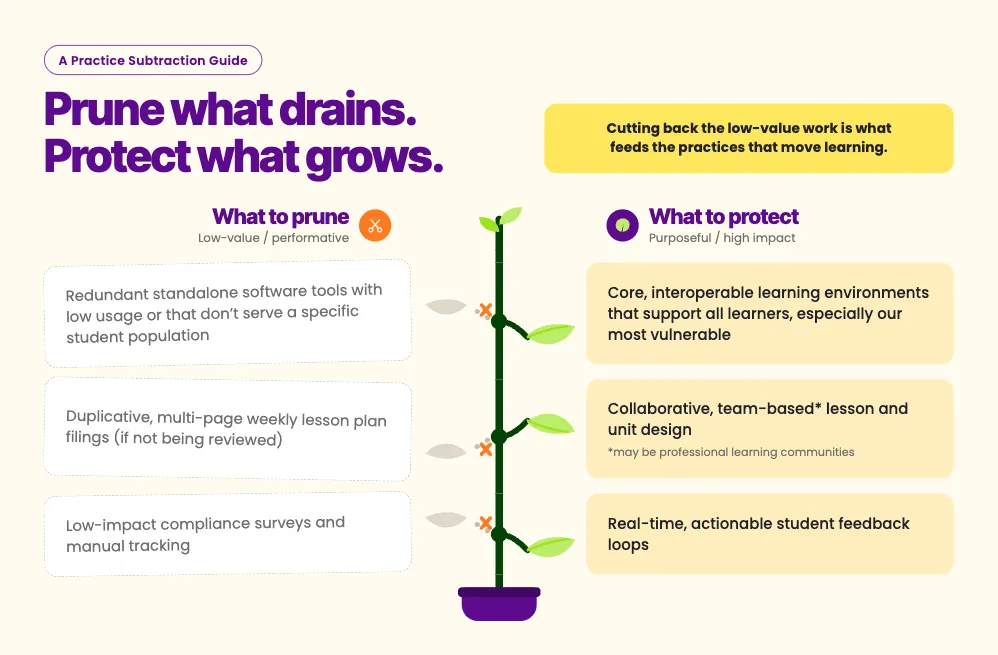
To operationalize strategic de-implementation as the school year begins, leadership teams can conduct a three-part audit focused on software, paperwork, and compliance.
Part 1: Audit Redundant Software and Digital Sprawl
In last month’s newsletter, we examined data showing that school districts maintain access to thousands of digital tools, yet students and teachers engage with only a fraction of them. A back to school software audit involves reviewing procurement lists and cutting tools that create app fatigue or lack verifiable evidence of learning impact.
- The Question: Which edtech platforms show low usage/adoption, lack interoperability, or duplicate the features of core learning platforms?
- The Action: Review unused edtech tool licenses and consolidate overlapping workflows into one platform that can do it all: annotation, accessible document sharing, and assessment feedback, rather than three separate logins. That’s the same principle behind Kami’s design.
Part 2: Prune Performative Paperwork and Administrative Fatigue
Over time, administrative requirements add layers of bureaucratic checks that rarely improve student outcomes. Ask educators where they think streamlining can happen to increase teacher efficacy and build trust.
- The Question: Are we requiring teachers to submit lengthy, multi-page weekly lesson plans or duplicative data logs that no one reads or acts upon?
- The Action: Shift from performative compliance to collaborative unit design. Streamline reporting metrics to focus solely on actionable data that directly informs Tier 1 instruction and student interventions.
Part 3: Evaluate Low-Impact Compliance Tasks
Many meetings, tracking systems, and approval processes exist simply because “that’s how we’ve always done it.”
- The Question: Does this specific administrative task directly improve teaching, support student safety, or fulfill a mandatory legal requirement?
The Action: If a task fails all three criteria, cut, consolidate, or automate it. If it fulfills a requirement but lacks a clear benefit, re-engineer it into a brief, automated process that minimizes the time teachers spend on administrative overhead.
Pruning leads to an organizational culture that values focus
Creating a de-implementation audit sends a powerful message to educators: leaders respect their time and are committed to protecting their capacity for meaningful instruction.
When leaders audit and retire legacy obligations before introducing new priorities, teachers gain the time and mental energy required to adopt new instructional strategies effectively. Strategic subtraction ensures that technology and instructional initiatives serve as cognitive amplifiers rather than administrative burdens.
Taking the next step: What will you subtract this school year?
As you finalize your back to school initiatives, sit down with your team and ask the harder question: not just what are we adding this year, but what have we been asking teachers to do that no longer earns its place?
I’d genuinely like to know: what’s one practice or tool your district is retiring this year? I’m always looking for real examples to bring into future issues.
For more on building a leaner, more intentional edtech stack, download the Kami white paper: Intentional EdTech: Digital Learning for Purpose and Learning Outcomes.
Read more briefs like this for education leaders: Subscribe to our free monthly briefing to get curated resources delivered straight to your inbox.
Blogs you may also like

EdTech Evaluation Framework: How District Leaders Vet New Tools | Kami


Initiative Fatigue in Schools: Leading for Coherence

Authentic Learning in the Age of AI: A Leader’s Guide