
EdTech Evaluation Framework: How District Leaders Vet New Tools | Kami



This is part of Kami’s ongoing series of executive briefings for education leaders. Each month, we’ll discuss solutions to a top-of-mind issue and share actionable resources and inspiration for leading your team. Be sure to subscribe to have this free resource delivered to your inbox.
Summary
- How the “safe, purposeful, proven” edtech evaluation framework gives district leaders a structured way to vet edtech tools, instead of relying on novelty or convenience
- Why usage and login stats aren’t proof that a tool improves learning, and what evidence-based edtech actually requires
- Three questions to ask before approving any new tool, built around the ISTE Safe and Purposeful EdTech Pledge
The early-2020s era of rapid tech adoption out of pandemic necessity has given way to something much more critical, cautious, and reflective. Educators and students are exhausted by app fatigue. IT directors are vigilant (and rightly so) about data privacy and security. District leaders, facing tightening budgets and heightened scrutiny, are asking the question: What actual, measurable evidence do we have that technology improves learning?
As the Senior Educational Strategist at Kami and university lecturer, my work sits at the intersection of learning science, district priorities, and professional learning design. Over the coming months, I’ll be sharing research, practical frameworks, and candid reflections on how we can navigate the evolving landscape of digital learning.
My thesis for our opening conversation is simple: We must stop accepting edtech that merely occupies screen time, and start demanding technology tools that are safe, purposeful, and proven.
The pendulum swing: From novelty to necessity
To understand where we are going, we have to acknowledge where we’ve been. For nearly two decades, edtech procurement was often driven by novelty or convenience. If a tool was engaging, colorful, or made workflow slightly faster, it found a home in many classrooms.
However, the explosion of edtech resulted in an unprecedented sprawl of digital tools across classrooms, schools, and districts. Recent 2026 data from Instructure’s LearnPlatform reveals that while school districts maintain access to an average of 3,001 distinct digital tools annually, students and educators actively engage with only four core tools on average.
Think about that gap for a moment. That isn’t an edtech ecosystem; it’s a labyrinth. It creates operational strain for IT departments, and instructional fragmentation for teachers who find themselves managing logins and managing off-task behavior, rather than engaging in teaching and learning best practices.
In my recent white paper, Intentional EdTech: Digital Learning for Purpose and Learning Outcomes, I argue that the solution to screen fatigue isn’t a total retreat from technology, but a shift toward intentionality through a “Blended Flow” model. Technology in the classroom must serve as a cognitive amplifier that enhances active learning, collaboration, and feedback.
When we evaluate tools through the lens of intentionality, we move away from asking “What can this tech do?” and start asking “What learning process does this tech enable that would otherwise be less innovative, meaningful, or impossible?”
What “evidence-based” actually means in practice
“Evidence-based” has become one of the most overused buzzwords in education. Every vendor claims their platform is backed by research, but when you look closely, that “research” often consists of satisfaction surveys or basic usage statistics. Logins and time-on-task are metrics of compliance, not indicators of learning.
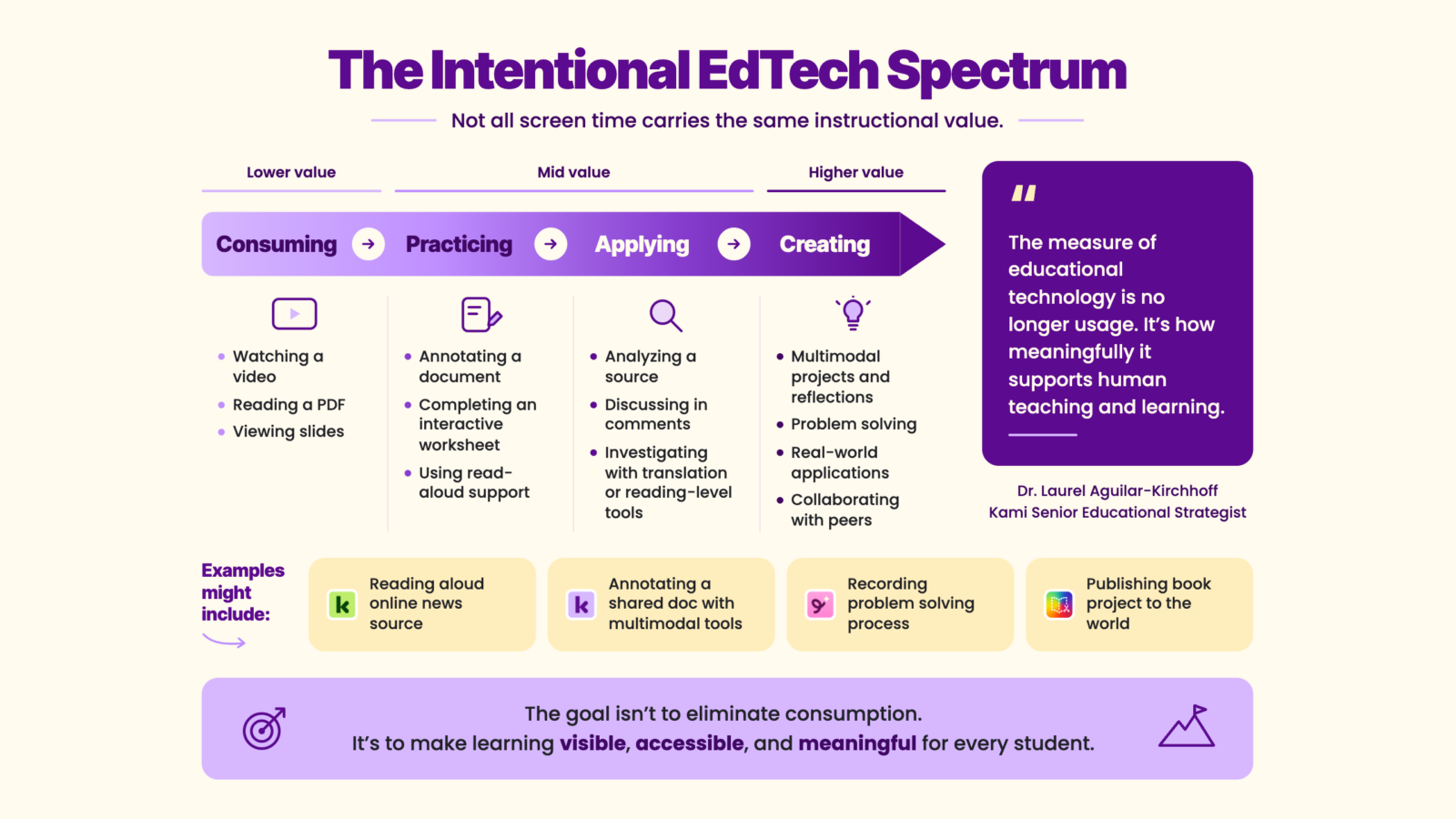
True evidence-based edtech is grounded in cognitive science and framework models like TPACK (Technological Pedagogical Content Knowledge). As Mishra and Koehler established, true integration happens at the intersection of technology, pedagogy, and content. Most critiques of screen time are actually critiques of basic technological substitution, where a device is used without changing the instructional pedagogy.
When our product and engineering teams design and iterate on our platforms like Kami, we anchor every feature in proven pedagogical principles:
- Active Cognitive Engagement: Active learning theory demonstrates that students retain significantly more information when they interact directly with content, highlighting, annotating, recording audio thoughts, and drawing visual connections.
- Universal Design for Learning (UDL): By embedding accessibility features like Read-Aloud, High-Contrast modes, and Voice Typing, we support all students through invisible inclusion. Diverse and multilingual learners can engage with rigorous grade-level Tier 1 content alongside their peers without stigma. (CAST.org)
- Synchronous Feedback Loops: Efficacy in personalized learning hinges on timely, actionable feedback. By accelerating teacher feedback through embedded video and voice notes, intentional edtech reduces the “correction gap” and supports student metacognition.
Raising the standard: The ISTE Safe & Purposeful EdTech Pledge
In response to growing demands for accountability, the International Society for Transforming Education (ISTE) launched the Safe & Purposeful EdTech Pledge. The pledge calls on edtech creators/companies and district leaders to commit to four foundational pillars:
- Safety and Data Privacy First: Protecting student data with enterprise-grade security, transparent privacy policies, and a strict commitment never to monetize student information.
- Pedagogical Purpose: Designing tools that directly support high-quality instructional practices, accessibility, and universal design for learning (UDL).
- Efficacy and Transparency: Providing clear, verifiable evidence of impact rather than anecdotal marketing claims.
- Interoperability and Usability: Ensuring tools integrate seamlessly into existing district ecosystems without creating technical friction or administrative burden.
Taking and upholding this pledge isn’t just a compliance checkbox; it’s a commitment to building trust. While data privacy and digital security must remain top of mind for all of us, educators and district administrators deserve technology partners who hold themselves accountable to these standards from day one.
At Kami, aligning with principles like ISTE’s Safe & Purposeful EdTech Pledge is central to how we approach product development and district partnerships. Whether it’s ensuring robust data privacy compliance or providing flexible accessibility features like text-to-speech and translation tools, safety and purpose must be built from the start, not tacked on as an afterthought.
Building a district culture of evidence and trust
So, how do district leaders, curriculum directors, and technology coordinators operationalize this shift from reactive app adoption to intentionality? It begins with an internal evaluation framework that bridges the gap between academics and technology.
In my work with districts across the country and internationally, I recommend asking three core questions before approving any new digital tool:
1. Is it Safe?
- Does the vendor explicitly state how student data is encrypted and protected?
- Is the tool compliant with FERPA, COPPA, and state-level/international privacy laws?
- Does the product minimize distraction and eliminate exploitative design patterns (like gamified ads or pop-ups)?
2. Is it Purposeful?
- Does this tool support Universal Design for Learning (UDL) principles, making content accessible for all learners?
- Does it promote active student creation and collaboration, or merely passive consumption?
- How easily does it fit into the existing learning management system (LMS) and teacher workflow?
3. Is it Proven?
- What evidence of learning impact does this product provide?
- Does the platform cite peer-reviewed cognitive science research or independent efficacy studies?
- Is there documented evidence of improved learning outcomes or pedagogical efficiency in comparable districts?
Looking ahead: Demanding more from our technology tools
The future of educational technology isn’t about screentime limits. It’s about refinement, intentionality, and trust. Additionally, as highlighted in the World Economic Forum’s Future of Jobs Report, skills like technological literacy, creative thinking, and digital collaboration are essential for future-proofing our students for the modern workforce. We owe it to students to cultivate these learnings in safe, teacher-led “sandboxes.”
As educators and leaders, we have both the opportunity and the responsibility to raise the bar. When we demand tools that are safe, purposeful, and proven, we send a clear signal to the industry: the measure of educational technology will no longer be simply usage, but how meaningfully it supports human teaching and learning.
I’m excited to continue this journey with you throughout this series. In my next post, we’ll dive into streamlining the teacher workload through “The De-Implementation Audit.” What can we consider as strategic subtraction to streamline teachers’ workflow and reallocate their time back to working with students?
In the meantime, I’d love to hear from you: How is your district shifting its approach to edtech vetting this year? What standards matter most to your team? Let’s keep the conversation going.
For a deeper exploration of how learning science and the TPACK framework can guide your district’s digital strategy, download the Kami white paper: Intentional EdTech: Digital Learning for Purpose and Learning Outcomes.
Read more briefs like this for education leaders: Subscribe to our free monthly briefing to get curated resources delivered straight to your inbox.
Blogs you may also like

An Educator’s Journey with Kami

Engaging every learner: How Kami transforms passive lessons into active learning
One platform, every learner: How Fond du Lac School District transformed digital learning with Kami