


Two students are handed the same engineering challenge. One has done a version of this activity every year since third grade and knows exactly where to start. The other has never seen a design brief and isn’t sure the activity is meant for someone like them. Both will be assessed on the same rubric.
That second student is the one most STEM content quietly assumes away, and closing that gap before it hardens into a pattern is what the transformational learning principles are useful for.
What the transformational learning principles are
The transformational learning principles, developed by ISTE+ASCD, are a set of evidence-based practices describing the elements that make learning effective. There are eight of them, organized into three categories: nurture, guide, and empower.
They pair naturally with Universal Design for Learning (UDL), which focuses on removing barriers to learning rather than assuming every student needs the same entry point. Where UDL asks what’s getting in this student’s way, the principles ask what the learning experience should feel like when nothing is. Applied to STEM content design, the three categories translate into concrete choices a teacher or curriculum designer can make before a lesson ever reaches a classroom.
STEM instruction needs that framing more than most subjects. For plenty of students, science and engineering classrooms still read as spaces built for kids who already see themselves as future scientists or engineers, not as spaces built for everyone. That impression is usually formed by the materials before it’s formed by the teacher.
Nurture: building belonging into the content itself
Three principles sit under nurture: cultivate belonging, connect learning to the learner, and ensure opportunity.
Belonging isn’t a poster on the wall. It shows up in whether students get to collaborate, brainstorm, and give each other feedback as a normal part of the work, and whether the materials in front of them signal that the content was designed with them in mind.
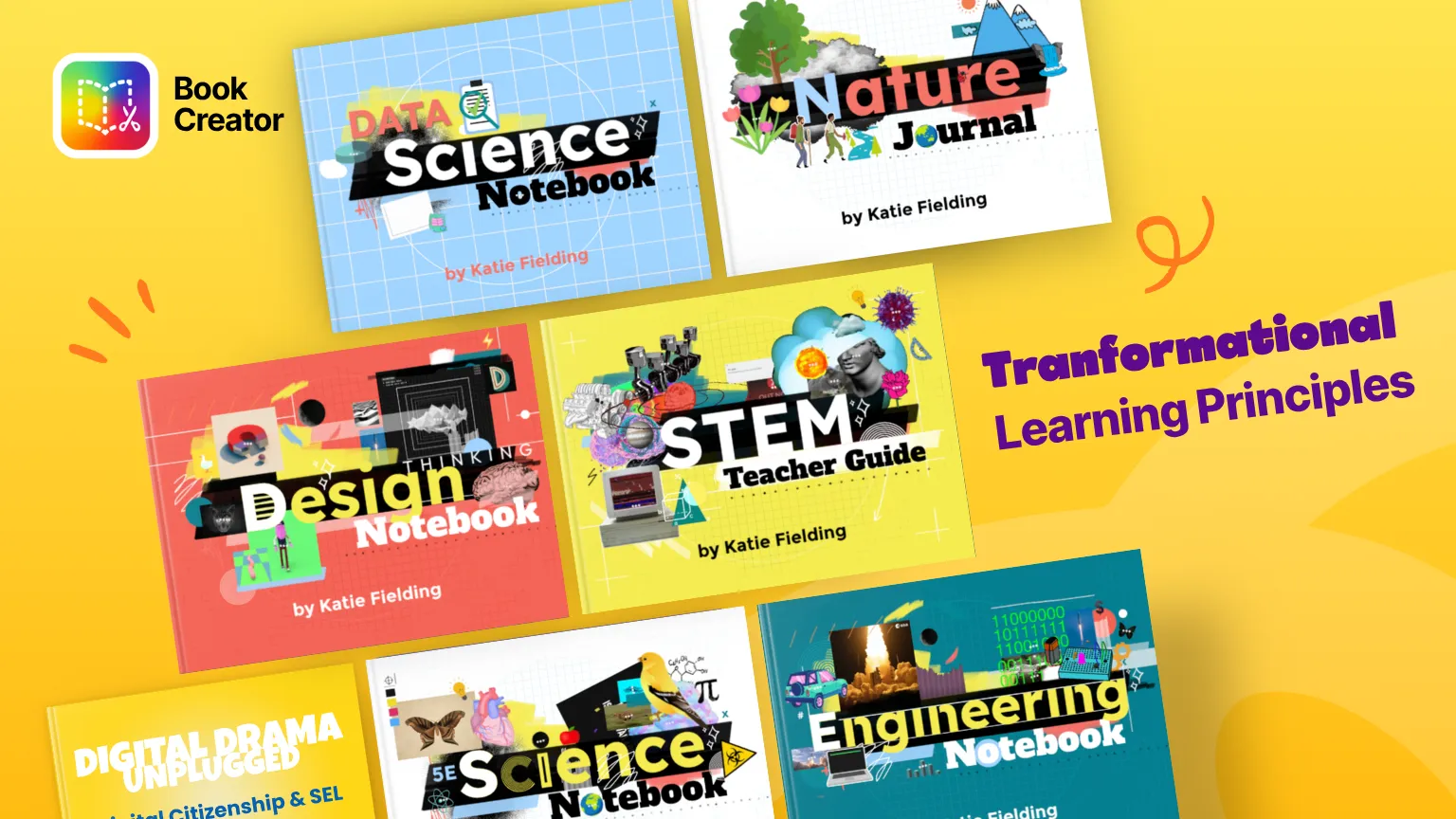
Author Rudine Sims Bishop’s “mirrors and windows” framing is useful here. Students need content where they see their own experience reflected and content that shows them experiences unlike their own. A nature journal cover featuring a range of students exploring outdoors, rather than a narrow default image, signals who the content is for before a student reads a single page. It’s a small production decision with an outsized effect.
Letting students introduce themselves as investigators at the start of a unit, sharing which mystery of the universe they’d most like to solve or which scientist from history they’d want to talk to, gives them a stake in the work before the content starts. It also gives the teacher a genuinely useful piece of information about each student on day one.
Ensuring opportunity is the one most easily assumed away, and it’s the gap the two students at the top of this post are standing in. One of them has done a version of this activity every year since third grade. If the material treats prior exposure as a given, it hasn’t ensured opportunity, it has rewarded it. That usually means building in an entry point that assumes no prior experience, without making it a remedial track that signals who it’s for.
The practical test for this category: could a student who’s never thought of themselves as a science person find a foothold in the first ten minutes?
Guide: sparking curiosity and building real expertise
Three principles sit under guide: spark curiosity, develop expertise, and elevate reflection.
Curiosity grows fastest when content connects to what students already care about. A data science notebook that lets students dig into sports statistics or social media trends instead of a generic dataset turns an abstract skill into something worth investigating. The subject matter didn’t change. The entry point did.
Building expertise from there takes deliberate structure: modeling how to think through a problem out loud, framing lessons around genuine questions rather than predetermined answers, and giving students varied practice so they apply a concept in more than one context. The 5E model is the most widely used sequence built on that logic, since it deliberately puts exploration ahead of explanation. A student who has only ever applied a concept in the setting where they learned it hasn’t finished learning it.
Elevating reflection closes the loop, and it’s the step most often cut for time. Giving students the option to reflect in video, audio, or text rather than writing alone means the reflection measures their thinking instead of their typing speed. That distinction matters enormously for multilingual learners and students with disabilities, whose understanding and whose written output can be very far apart.
The practical test for this category: does the lesson ask students to think, or to follow?
Empower: authentic work and real ownership
Two principles sit under empower: prioritize authentic experiences and ignite agency.
Problem-based learning, the kind where students design, prototype, and test something under real constraints, builds confidence in a way worksheet practice can’t. A challenge like designing and building a sculpture within material limits gives students a genuine problem to solve rather than a predetermined right answer to locate.
Agency follows when students make real choices throughout a project and share what they built at the end. A student who prototypes an idea, tests it, and presents the result to classmates has done something much closer to engineering than a student who has only read about it. The presentation isn’t a nice extra, it’s the part that makes the work feel like it counted.
The practical test for this category: whose decisions shaped the final product?
Auditing your materials against the transformational learning principles
The framework is most useful as a review tool rather than a planning theory. A short audit of an existing unit surfaces more than a redesign from scratch.
Pull one unit you already teach and read it as a student who has none of the background you’re assuming. Note where the first genuine choice appears, and how many pages in it is. Note whether any student could see themselves in the images and examples. Note whether the unit assumes prior exposure it never provides. Note whether reflection is written-only. Note whether the final artifact was shaped by student decisions or by your template.
Most units fail two of those four on the first pass, and each one is a small, specific fix rather than a rebuild.
Where Book Creator fits
Book Creator’s STEM notebooks, covering data science, the 5E model, engineering, and design thinking, align well with these principles because they were designed around UDL and the ISTE Educator Standards from the start. Book Creator holds UDL Product Certification, which is the clearest external signal that the multimodal options aren’t an afterthought bolted onto a text-first tool.
In practice that means collaborative activities, investigator-style introductions, real-world data prompts, and response options across text, audio, video, and drawing, so students can show understanding in whatever format fits how they think. Book Creator gives students a way to demonstrate understanding and create work they’re proud to share, which is the ownership piece made concrete.
See Book Creator’s STEM notebook collection to find a notebook built with these principles in mind.
Blogs you may also like
Your March Classroom Activities, Planned


Summer Reading Resources: Journals, Author Studies, and More
April Classroom Resources: End-of-Year Energy That Actually Inspires