

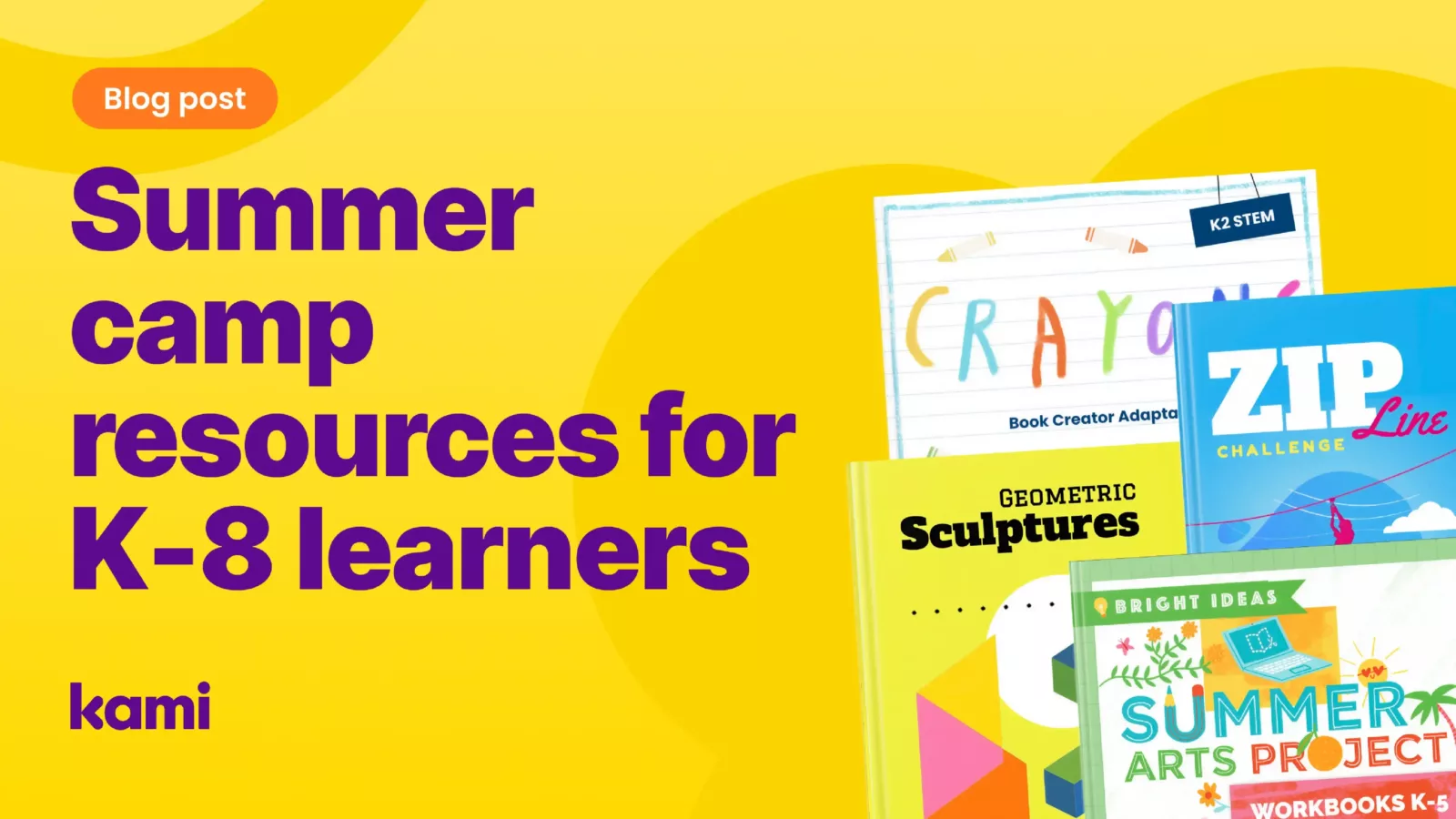

You survived the school year. Now you’re on summer program duty.
Summer programs face a real tension: campers need structure, but textbook-style lessons kill the energy that makes camp worth attending. The gap between “educational” and “engaging” is where most summer learning falls apart.
Book Creator’s summer camp collection closes that gap. These ready-made activity books give teachers a full arc of creative, standards-aligned work across digital art (K–5) and engineering design (grades 3–8, with options that stretch K–12) — no prior curriculum sequence, no special setup, no prerequisite knowledge required.
Here’s what’s included and how it fits a summer school or camp setting.
K–5 Summer Camp Activities: Digital Art Books
These books work well in any summer program with tablet access. Students move through foundational digital art concepts — line, shape, color, space — using Book Creator’s pen tool, shapes tool, and drag-and-drop icons. As they progress through grade bands, the work gets more compositional: arranging elements to tell a story, using color to convey mood, and creating balanced designs.
What makes these more than screen time: every book includes a reflection prompt. Students write or record responses explaining their creative choices — why they picked those colors, what the arrangement communicates, how the design connects to something they know. That’s visual literacy embedded in creation, not added on top.
Access the Art Books here:
6-8 Summer Camp: STEM Challenges
Eight hands-on engineering challenges are designed for grades 6–8 but scale easily from grades 3–12 depending on your campers. Materials are intentionally low-cost: cardboard, tape, string, straws, rubber bands, recycled containers.
Each challenge follows the Engineering Design Process aligned to NGSS: define the problem, plan and brainstorm, build a prototype, test and improve, share findings. That structure maps directly to how camp sessions naturally run — with built-in iteration time and a natural showcase moment at the end.
Book Creator is where the documentation lives. Campers record video walkthroughs of their prototypes, annotate their sketches, add audio reflections on what they changed and why, and publish a final multimodal engineering journal. It’s a ready-made showcase artifact families can actually see and interact with.
Find all the challenges in our STEM Library.
K-2 Summer Camp: STEM Crayons
This standalone unit is built specifically for early learners, using one of the most familiar materials around: crayons. Kids explore properties and changes in matter, complete a design challenge to recycle crayons into something new, practice graphing favorite colors, and write a creative postcard “from a crayon.”
It’s rigorous in the right ways for the age group — and accessible by design, with no reading-heavy instructions or complex setup.
Give Campers Something to Take Home: The Summer Memory Book
The last day of camp is full of energy — and then it’s over. Photos get buried in a camera roll. Projects get left behind. The friendships and moments that made the summer feel real fade faster than anyone expects.
A summer memory book changes that. With Book Creator, campers build a personal record of their time at camp — photos, drawings, audio clips, video, and writing all in one place — that they can share with family and revisit long after the session ends.
What goes in a summer memory book
Memory books work best when they’re built throughout the session, not assembled at the end. Campers add a page after each activity, capture a moment from free time, or record a quick audio reflection on something that surprised them. By the last day, the book is already full.
Remix the memory journal to your summer library today.
Built for sharing
When summer camp wraps, campers can publish their book and share a link directly with family. No printing, no lost pages. Parents get a real window into what their child actually did — not just a highlight reel, but the process, the thinking, and the voice behind it.
For summer camp directors, it also doubles as a portfolio of programming. A published collection of camper memory books is a compelling piece of evidence that your summer was worth the investment.
Why this works for camp
These resources aren’t textbook-dependent. They don’t require a specific curriculum sequence or prior knowledge. Book Creator’s touch-friendly tools make them accessible across a range of ability levels without additional prep work from facilitators.
Summer programs can use them as standalone daily activities, as documentation tools for other hands-on projects, or as the foundation for an end-of-session showcase where students share their published books with families.
If you’re building a summer program and want students to leave with something they actually made — a digital art book, an engineering journal, a reflection on their design process — this collection is a solid starting point.
Blogs you may also like
Your March Classroom Activities, Planned


Summer Reading Resources: Journals, Author Studies, and More
April Classroom Resources: End-of-Year Energy That Actually Inspires