


Back to school means pointing a new group of students toward books to read on Sora, and most of them will find something fast. Sora’s library mixes ebooks, audiobooks, magazines, and poetry, and a teacher or librarian can curate collections so students see titles that actually fit them, whether that’s independent reading, a class assignment, or something to grab for a quiet moment. Finding a book isn’t the hard part.
What Sora doesn’t do on its own is tell you what a student thought of it, whether they understood it, or whether they’d recommend it to another student. For a librarian trying to build a reading culture from day one, not just a completion rate, that’s the real gap.
What’s actually in Sora’s library
Sora works across formats, not just one, so a student who loves audiobooks and a student who prefers a graphic novel can both find something in the same place. Collections can be curated by grade band or reading level, and titles a teacher assigns show up front and center for a student alongside whatever they’ve chosen to read independently. That mix matters for reading culture: assigned reading and self-selected reading sitting in the same app, instead of two separate systems, makes it easier for a student to see themselves as a reader across the board, not just when there’s an assignment attached.
If you want a specific recommendation, try Hickory Hollow
Sora has its own original series worth knowing about: six books following different characters around Hickory Hollow, a town with a bit of a spooky edge, aimed at grades three through six. It’s a good answer for a student who’s browsed the library and still hasn’t landed on anything. We’ve also built a matching reading response guide for each grade level tier, using the same organizer format covered below, but with the series’ own characters built directly into the pages, so a student responding to a book gets to bring that character’s imagery into their own reflection. Pick the tier that matches your students and remix it straight into your class library.
Find Hickory Hollows guides for grades 3, 4 and 5 in our Discovery Literacy library.
Why a completion count isn’t the same as engagement
A student can finish a book in Sora without ever forming an opinion about it, and a librarian relying only on Sora’s own reporting has no easy way to tell the difference between a student who read closely and one who clicked through to unlock the next title. Reading response routines exist to close that gap. When a student pauses to reflect, even briefly, on a character’s choice or a theme they noticed, they’re doing the comprehension work that a quiz alone can’t capture, and they’re leaving behind a record you can actually use.
That record matters for more than one reason. It helps you have a real conversation with a student about their reading. It gives you material for book talks and recommendations. And if you’re building a case for your library program’s impact, a student’s own reflection on a book is exactly the kind of evidence that a circulation report can’t provide. We go into that in more depth in our piece on the AASL standards (from the American Association of School Librarians), if building that case is part of what’s on your plate this year.
What the Sora template covers
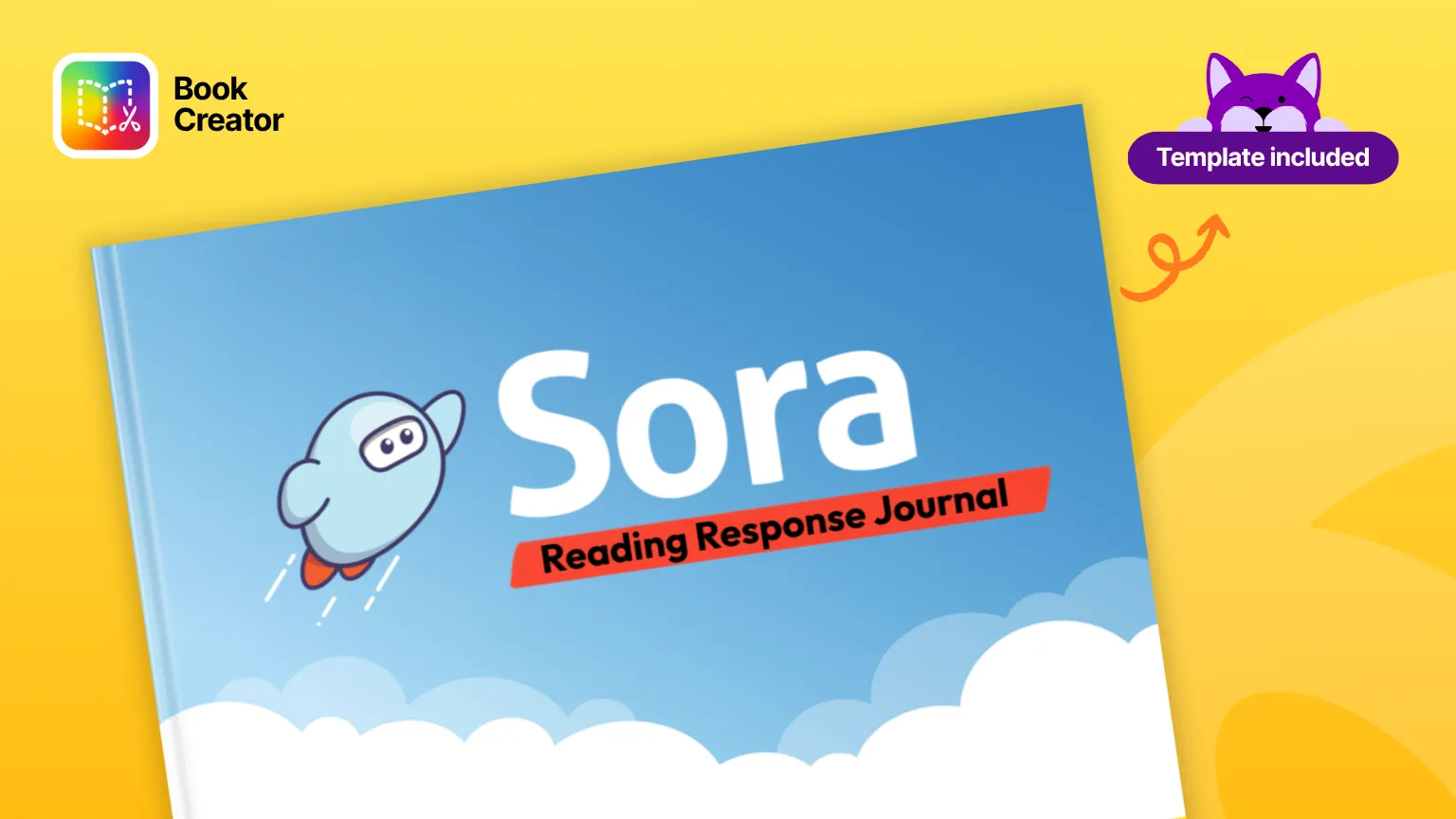
The Sora reading response journal is built for the way students already use Sora: they finish a book, or a section of a longer one, then open the template to respond. Inside, it’s organized as a set of graphic organizers covering summary, theme, connection, reflection, and partner activities, generic enough to use after any title in Sora’s library. You don’t need to assign all of them for every book. Pick one after a quick read, or work through several for a book study. Students can respond with text, a drawing, or a short voice recording, so it works for a wide range of readers, including students who read fluently but write slowly, and multilingual learners who can express more when they’re not limited to typed English.
Sora’s own notes, highlights, and definitions carry over nicely too. If a student marks a passage while they’re reading, dialogue that reveals a character’s voice, or a line that made them pause, they can bring that same excerpt straight into their Book Creator response instead of trying to reconstruct it from memory. It turns the response into a reaction to the actual line that stuck with them, not a general summary of the book.
Because it’s built in Book Creator, a student’s response becomes part of a book they’re building over the semester or year, not a worksheet that gets turned in and forgotten. Flip back a few pages and you can see how a student’s responses have changed since the start of the year, which is a much more useful conversation starter than a single grade.
Why we love it
The partner activity organizer is the quiet win here. Students comparing their reflections on the same book inside a shared class library does more for reading culture than almost any poster or bulletin board, because it’s peer-driven and it’s specific.
Setting it up takes minutes, not a planning period
Remix the template, share it with your class library, and you’re done, which matters most in these first few weeks when everything else about the new year is competing for your setup time. There’s no separate login for students beyond what they already use for Book Creator, and no new routine to teach beyond “when you finish a book, open your response page.” For a role that supports every grade and subject with no dedicated class time of its own, that zero-setup bar is the whole point.
Planning summer reading with Sora?
Watch this webinar from Spring 2025 5o see how Sora and Book Creator are the perfect pair.
A companion for Epic readers too
If your school also uses Epic, we built a matching template for that platform. See our post on the Epic reading log for the same approach, adapted to Epic’s library and reading structure.
Frequently asked questions
Sora carries ebooks, audiobooks, magazines, and poetry, plus its own originals like the Hickory Hollow series. Because a single title can be available in more than one format, a student who prefers listening and a student who prefers reading can work from the same collection.
Students browse collections a teacher or librarian has curated, and assigned titles appear prominently alongside whatever they’ve chosen themselves. That’s a meaningful design detail: assigned reading and independent reading sit in one place rather than two separate systems.
Yes. Collections can be curated by grade band or reading level, so what a second grader sees differs from what a sixth grader sees. This is one of the more common questions from library media specialists evaluating the platform, and it’s worth confirming the specifics with the Sora team for your own setup.
A short reading response is the highest-value next step. Sora records that a book was finished; it doesn’t capture what a student made of it. A summary, a reaction to one moment, or a recommendation for a classmate turns a completion into something you can discuss and something you can use as evidence of comprehension.
Yes, and it’s one of the better reasons to pair the two. Notes, highlights, and definitions a student creates while reading in Sora can move into their Book Creator response, so the reflection reacts to the actual line that stuck with them instead of a vague memory of the book.
Blogs you may also like
Your March Classroom Activities, Planned

Summer Reading Resources: Journals, Author Studies, and More
April Classroom Resources: End-of-Year Energy That Actually Inspires