

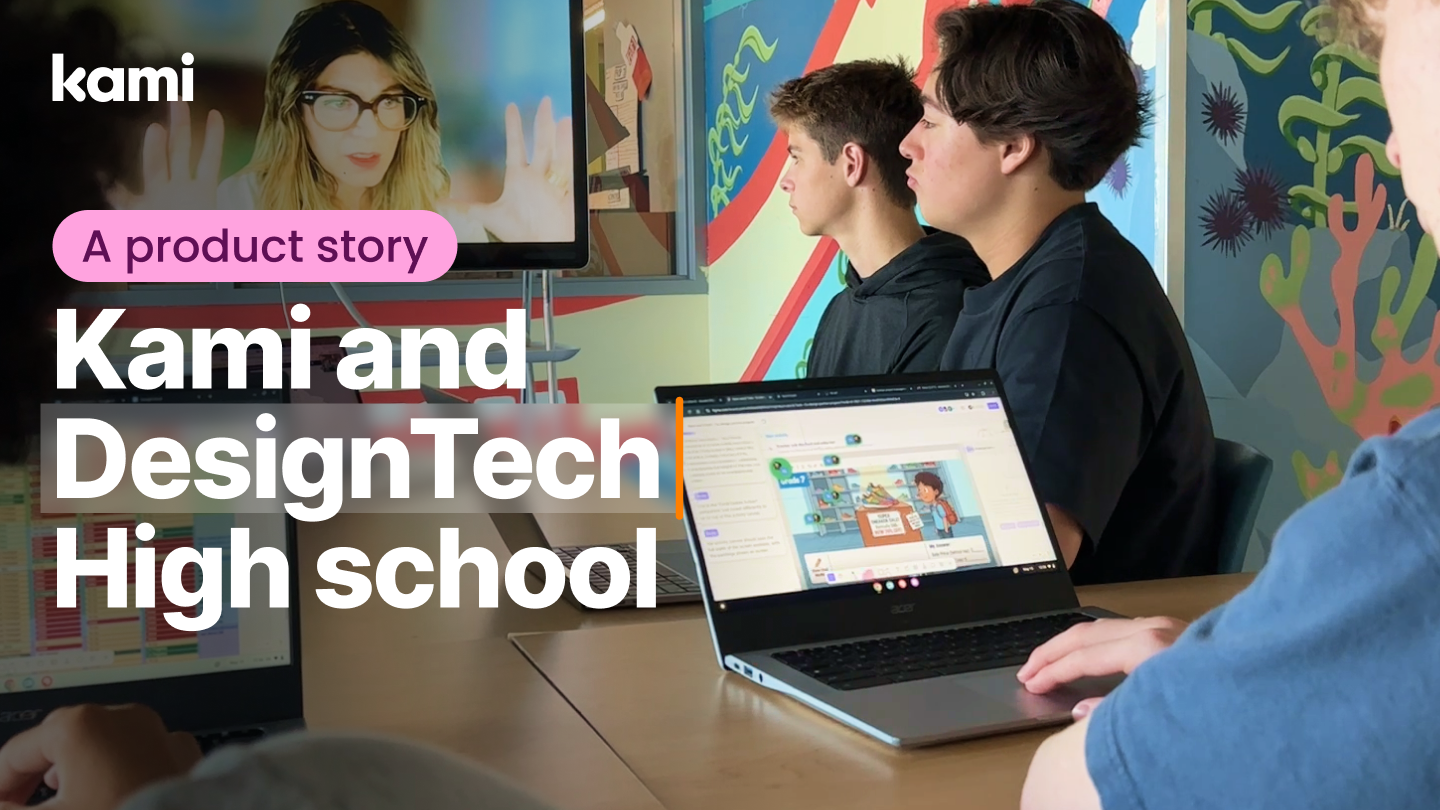

At a glance: Kami Coach is an AI-powered math coaching product that helps students work through problems independently, with hints, check-ins, and guided feedback that support learning without giving away answers. It was co-designed over a full semester with students at Design Tech High School. Learn more about how Kami Coach helps students work through math independently while keeping teachers informed.
Large class sizes make it hard for teachers to give every student the individual attention they need. Students arrive with a wide range of abilities, and there is rarely enough time in the day to meet each of them exactly where they are.
That gap is what Kami Product Manager Wallis Lavery set out to address with Kami Coach: a math coaching experience that gives students support as they work through problems independently, while keeping teachers informed at every step.
“There is anxiety around AI in education right now, and rightly so,” said Wallis, “So we wanted to be very considerate and very measured in our application of AI.”
Wallis’s team asked the questions teachers, parents, and district leaders are already asking: Can AI support equitable learning without replacing the human connection between teacher and student? Can students use AI safely and still experience the productive struggle that real learning requires?
To answer those questions, Wallis did not just build in a lab. She brought in the people the tool was for.
Co-designing with the students who’d actually use it
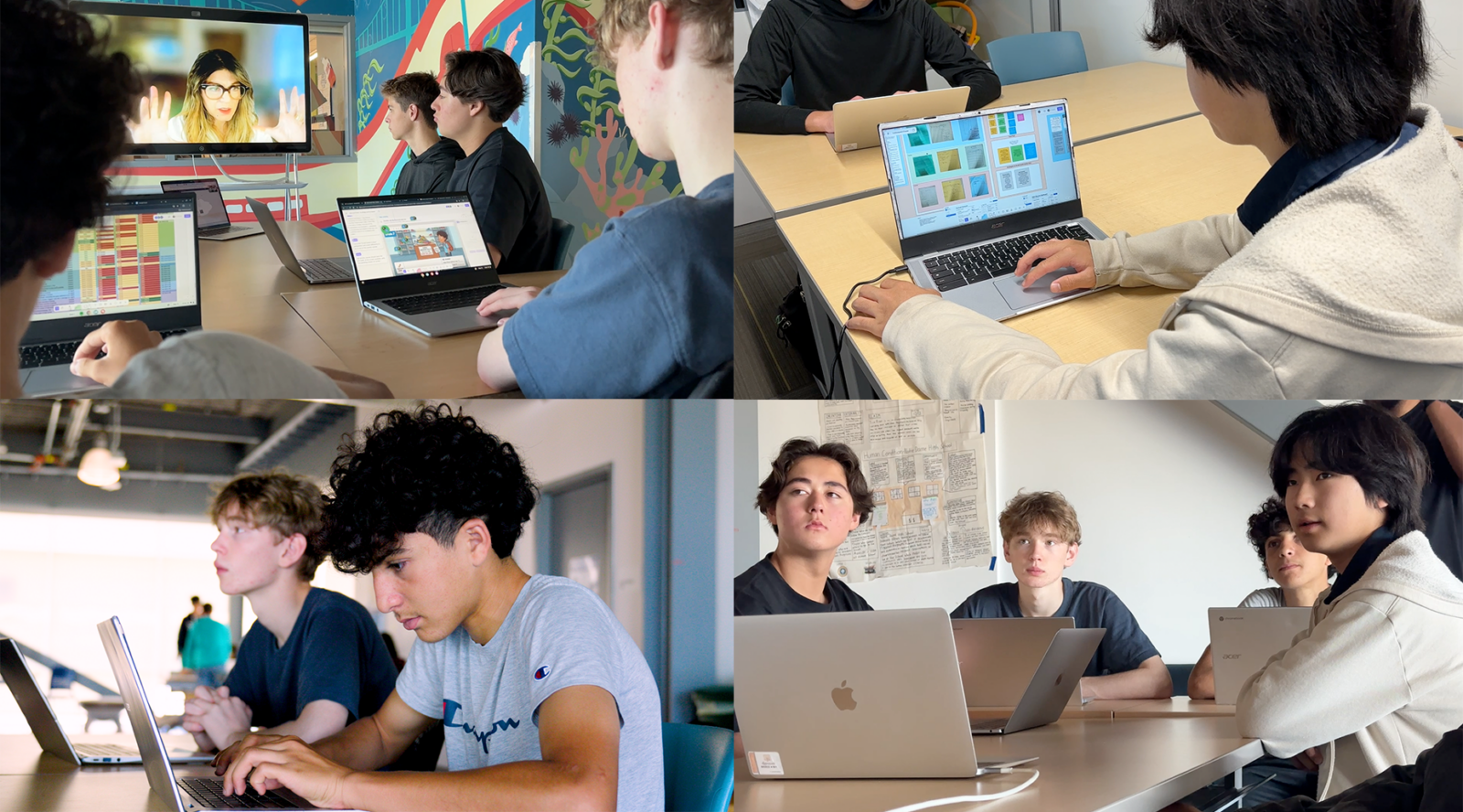
Design Tech High School in Redwood City, California, teaches through design thinking. Students there build products and systems as part of their coursework. A team of six sophomores spent a full semester working directly with Wallis to shape what became Kami Coach.
The teams met weekly to set goals and trade feedback. Between calls, the student team ran their own research: interviewing teachers and classmates, sketching UX ideas, and testing prototypes. Their feedback did not stay in a notebook. It changed what shipped.
Yuisho spent weeks testing the annotation tools and found real problems: the eraser only cleared small pieces of a drawing instead of the whole thing, and the select tool moved the entire screen instead of the item selected. After the team flagged it, Kami rebuilt both tools so a single selection now works cleanly.
Madani pushed on the login experience, telling the team it looked unfinished and felt clunky to use. The next beta shipped with a redesigned sign-in flow: clearer buttons, a smoother color palette, and a faster path to logging in.
The students together worked directly with the AI to test its guardrails and found it was holding back help students actually needed.
“We figured out the AI was being too strict and held itself back. It was annoying to the student, so we flagged it and got it fixed. Now it’s more communicative,” said Yuisho
Design Tech has partnered with tech companies before, but this felt different to the school’s staff.
“When I look for a company to work with, I’m looking to develop agency in students,” said Max Cady, the design thinking teacher who leads Design Tech’s co-design program. “So I need an organization that can really value and implement the perspectives and ideas of teenagers.”
Wallis says that honesty changed the product.
“Previously, you might build software, you put it in front of students, and you get applause. ‘Well done. This is great,’” said Wallis. “But actually we got real honesty from the students. We got real ideas beyond what we had considered.”
Ken Montgomery, co-founder and executive director of Design Tech High School, said authentic student partnership was essential.
“We need to believe that the company is going to authentically engage with our students,” said Montgomery. “It’s not just going to be some situation where they say, oh, we worked with students because that’s the thing they want to say. It has to be an actual co-design.”
Are kids “just gonna use it to cheat?”
That skepticism is fair, and Kami’s team heard it directly from the students helping shape the tool.
“That’s not going to work,” Elliot remembers when he first heard about the Kami Coach project. “Kids are just gonna use it to cheat.”
Student teammate Yuisho was also skeptical at first.
”I have experience using AI in school, and I think it was a negative experience for the most part, because even though it helped me finish the assignment, it didn’t really teach me anything.”
Those concerns shaped the product. Unlike most large language models like ChatGPT, Gemini, or Claude, where users ask a question and get a direct answer, Kami Coach is scoped to the math activity in front of the student. It is designed to guide students through their thinking, offer hints when they are stuck, and encourage them to show their reasoning – without simply handing over the solution.
“It gives them hints, it gives them guidance, and it helps to pull the knowledge that they already have into the math activity,” Wallis explained.
Henry saw that difference in practice.
“It really expands your learning and doesn’t just tell you the answers like how ChatGPT or or any other AI would,” Henry said. “It pushes you to actually think.”
Want early access to Kami Coach? Fill out this form
Giving teachers visibility, not replacing them
Kami Coach is built to help students succeed in math, but the underlying goal has always been to support teachers — particularly by surfacing which students need help before they fall too far behind.
For students, that matters because getting stuck can feel personal. Not every student wants to raise a hand in front of the class. Not every student feels comfortable saying, I don’t understand.
“If I was a student that was kind of struggling in class and I didn’t really want to admit it, maybe I’d want my teacher to know that. But I wouldn’t want to go tell her directly,” says Elliot
“It’s kind of hard when you fall behind, you might not understand something,” says Henry. “You don’t want to seem not smart…Being able to have the AI not judge you in any way is a great plus side.”
To build for that need, the student team ran empathy interviews with math teachers across the Bay Area. One clear need emerged: teachers needed better visibility into student understanding during independent practice, not only after work was submitted.
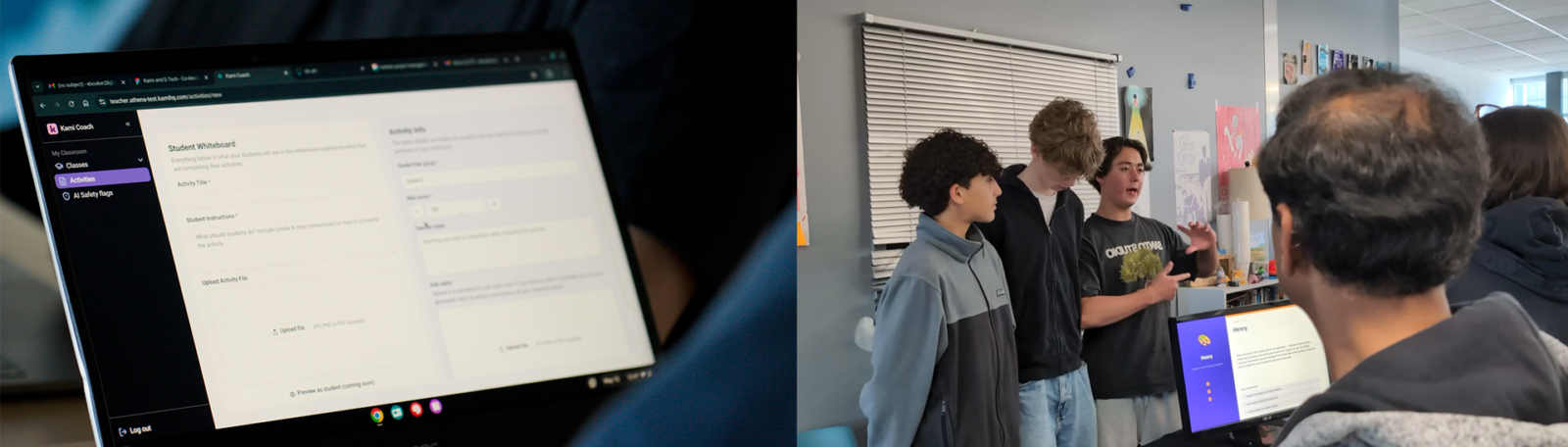
Kami Coach gives teachers insight into how students are working through problems, where they are getting stuck, and what misconceptions may be forming. Teachers can review the completed page, the student’s written work, and the coaching exchanges that happened along the way. That gives teachers a clearer picture of whether a student guessed, copied, got stuck, revised their thinking, or used support to move forward. The thinking process becomes visible, not just the final answer.
Elliot describes the student-side value simply:
“Kami Coach is almost like having one hundred teachers that can help students at any time.”
Wallis is clear that the point is not to replace teachers.
“This isn’t replacing teachers,” Wallis said. “Kami Coach comes after teaching. It’s a chance for students to show what they’ve learned.”
Responsible AI and guardrails
Balancing enough support against giving away the answer took real iteration.
“At first, the app was being too restrictive and held itself back. It was kind of annoying to the student,” Yuisho said about their initial testing of Coach. “So we flagged that and had it fixed.”
The students took the responsibility seriously. They did not just test whether Kami Coach worked. They tried to break it.
“They tried really hard to break it,” Cady said about their attempts to get the app to just give answers away. “And they haven’t figured out how to do it and they haven’t figured out how to cheat with it. And they’re pretty clever kids.”
That process helped sharpen the balance Kami Coach needed to strike: enough guidance to keep students moving, enough guardrails to protect productive struggle, and enough teacher visibility to keep AI use purposeful and accountable.
Kami Coach is not an open chatbot. Every interaction is scoped to the assigned activity, and teachers have oversight of the work and conversation. If students go off track, teachers have visibility into what is happening and can step in where needed.
“I’m most proud of Kami Coach’s ability to help those students in their productive struggle,” Wallis says looking back on the project. “For those students that might be reluctant to raise their hand in a busy classroom, or if the teacher is overwhelmed, I’m proud that we’ll be able to help them.”
What this means for districts thinking about AI
The Kami and Design Tech collaboration reflects a broader question every district is working through: how do you bring AI into classrooms without losing the human parts of teaching?
That human question sits alongside a practical instructional one: how do teachers know when students are stuck before the data arrives too late? We explore that challenge in more detail in this blog Kami Coach: A math formative assessment tool that shows you how students think
The answer is not simply to add AI. It is to design AI around people: students, teachers, and the relationships that make learning possible.
“I think AI can be used in a lot of wrong ways,” said Henry. “But I think AI in school is fine as long as you use it as a tool to expand your learning.”
“My hope is that AI can help us learn the things that really matter,” says Cady.
Montgomery sees that as the real opportunity.
“We always say the purpose of school is not to get better at school,” Montgomery adds. “It’s really important to view AI as an amplifier. So whatever is in the student AI can amplify that. … The key question schools need to answer is really, ‘how do we use AI to amplify human agency?’ There’s never been a better time to dream big.”
For districts, the lesson is not only that students liked the product. It is that student skepticism made the product stronger. The questions students asked about cheating, privacy, usefulness, and teacher visibility are the same questions district leaders are asking now.
Want early access to Kami Coach?
We’re launching Kami Coach with a small group of forward-thinking schools this term.
- Get early access to Kami Coach for your schools
- Be the first to hear about new features and updates
- Share feedback that helps us make it better
Blogs you may also like
Your March Classroom Activities, Planned


Summer Reading Resources: Journals, Author Studies, and More
An Educator’s Journey with Kami