
Kami Companion for multilingual learners: built-in language support that works

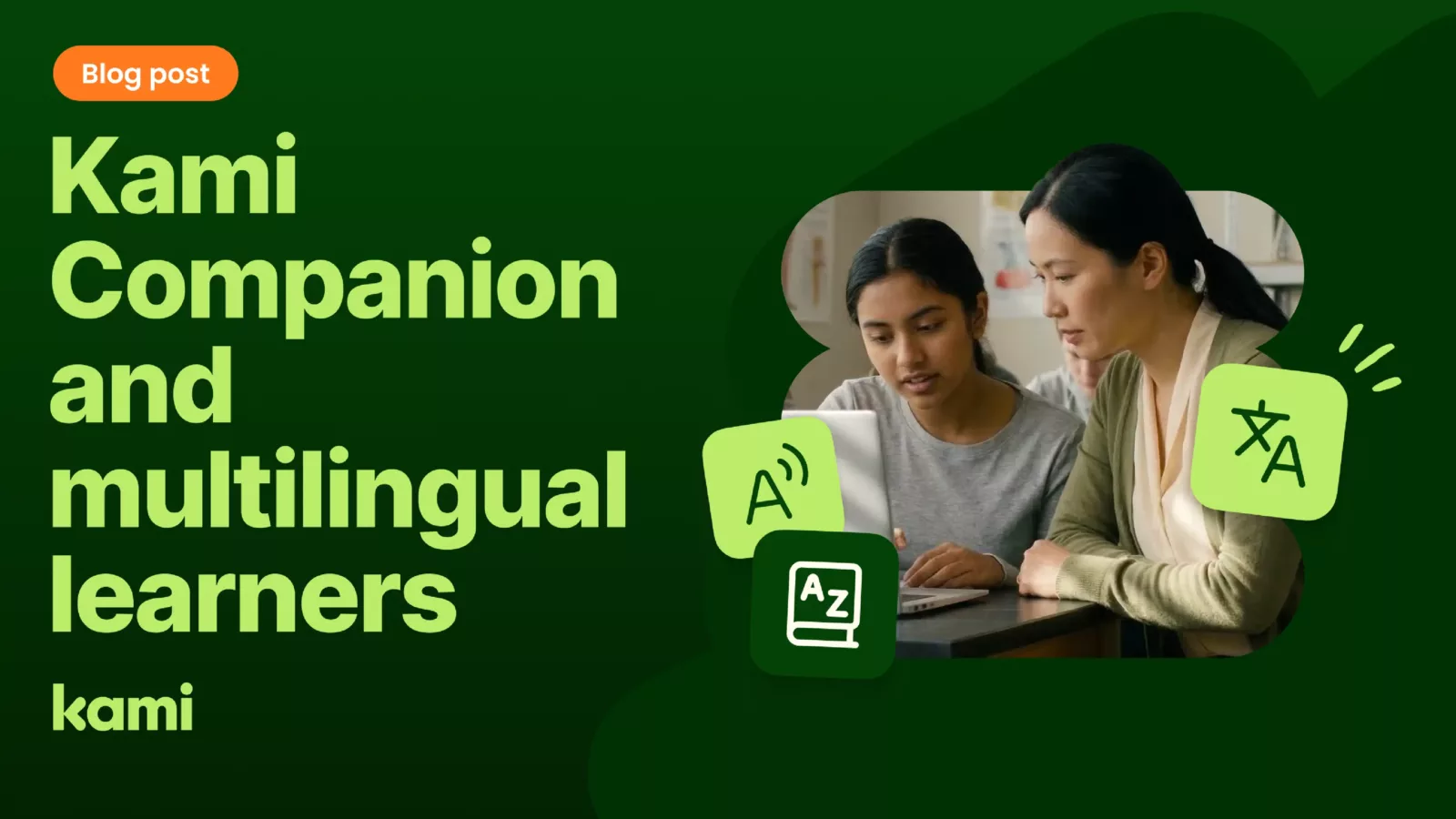

It’s the second week of June. School’s been out for ten days. A student is at the kitchen table with a tablet, watching a YouTube video about volcanoes because she got curious. She speaks Tigrinya at home, attended school in Eritrea for three years, and spent this past year in a classroom where a teacher could pause, explain, and check in. That teacher isn’t here now.
The video has captions. The related articles are in academic English. The curiosity is real — but so is the gap between her and the content. Without support, she closes the tab. The moment passes.
This is what summer looks like for many multilingual learners. The scaffolding that exists inside school — teachers, aides, structured lessons — doesn’t follow students home. And for emergent bilingual students, language development doesn’t pause in July. It either continues or it slides. The research on summer learning loss is consistent: multilingual learners are among the students most affected by gaps in access to language-rich, supported learning environments.
That’s the problem Kami Companion was built to solve — and it doesn’t stop working when the school year does.
Summer is when the gap widens
The research on summer learning loss consistently shows that students from under-resourced communities experience the greatest setbacks between June and August — and that those gaps compound across years. For multilingual learners, the risk is compounded further: without consistent exposure to English-language content and language supports, fluency gains made during the school year can erode.
What’s less often acknowledged is that summer learning doesn’t have to be formal to be valuable. Students explore the web, watch videos, read about things they’re interested in. The question is whether the tools that help them engage with that content are available when no teacher is.
A browser extension that works across any web-based content doesn’t know what month it is. That’s the point.
Get the research. The Kami Companion UDL whitepaper breaks down how built-in supports map to every UDL principle — and what that means for multilingual learners. Download the whitepaper.
What multilingual learners actually need during a lesson
The research on emergent bilingual students is clear about one thing: access to home language supports during instruction is not a concession. It’s a strategy.
Espinosa and Ascenzi-Moreno, in their foundational work Rooted in Strength (2021), document how multilingual learners thrive when they can draw on their full linguistic and sociocultural repertoires during literacy instruction. Their argument is not that students should be taught in their home languages instead of English, but that shutting those languages out during instruction actively works against comprehension and engagement. In a 2024 article in The Reading Teacher, Ascenzi-Moreno builds on this further, arguing for a multilingual perspective on reading that recognizes the full linguistic resources students bring as cognitive assets rather than obstacles to address.
What both pieces point toward is a practical instructional reality: the tools and supports that help multilingual learners are most effective when they are woven into everyday instruction. Not available in a separate browser tab. Not contingent on the teacher setting up a special version of the assignment. In the workflow.
That’s what separates accessibility as an add-on from accessibility as infrastructure.
How Kami Companion supports multilingual learners on any web-based content
Kami Companion is a browser extension that sits quietly until a student needs it, then delivers reading, language, and expression supports across online content and curriculum. It doesn’t redirect learners to a parallel experience. It meets them inside the content the rest of the class is working in.
For multilingual learners, that matters in a few specific ways.
Text-to-speech that doesn’t require a workaround
When a student is still building decoding fluency in English, hearing the text read aloud while following along can be the difference between engaging with the ideas and falling out of the lesson entirely. The broader literature on assistive technology consistently shows that text-to-speech tools are most useful for students with significant decoding challenges, and that their benefit is strongest when they are available as part of the learning activity, not as a separate step students have to initiate on their own.
Kami Companion’s Read aloud function works across web content without requiring teachers to create special materials or students to navigate a separate app. The lesson proceeds. The support is just there.
Translation support within the page
One of the more persistent frustrations in multilingual classrooms is the gap between a student’s conceptual knowledge and their ability to access that knowledge through English text. A student may understand photosynthesis completely in their home language. If the article in front of them is dense academic English, that understanding stays locked.
Companion Translate tool allows students to connect English terms to their own linguistic frame of reference while staying inside the webpage. They can look something up and keep reading. They don’t lose the thread.
Supporting independence without isolating learners
Cummins and Early’s research on identity texts found that multilingual students invest more deeply in academic work when their linguistic and cultural identities are affirmed rather than suppressed (Cummins & Early, 2011). Part of what builds that investment is the experience of doing the same work as everyone else in the room. Not a modified version. Not a simplified task.
During the school year, a teacher can notice when a student is stuck and step in. Over summer, that option isn’t there. Students who have tools they can actually use independently — and that don’t single them out as different — are more likely to keep engaging with content when the school day isn’t structuring it for them.
See the full UDL picture. The Kami Companion UDL whitepaper shows how these supports map to representation, engagement, and expression — with the evidence to back it up. Download the whitepaper.
When Kami Companion’s supports are available on any page a student visits, the summer web doesn’t become a wall. It becomes a place they can actually explore.
The teacher’s role doesn’t disappear
It’s worth saying clearly: Kami Companion does not replace teacher instruction for multilingual learners. Espinosa and Ascenzi-Moreno are explicit that translanguaging supports work best when teachers are intentional about bridging students’ linguistic repertoires, not when tools do it for them. The tool makes the floor higher. Teachers still do the teaching.
What research on multimodal writing and multilingual learners points to is something useful here: when students have flexible tools for meaning-making, teachers can more easily identify what learners know and where they’re stuck (Zeng, 2024). A 2024 research review in the Journal of Language and Literacy Education found that multimodal writing tools support multilingual learners by creating flexibility in the meaning-making process, giving teachers better insight into student understanding, and helping learners draw on their full semiotic resources rather than being limited to what they can produce in English alone. The tool surfaces what students know. That information goes back to the teacher.
What the data says about ELL outcomes in Kami classrooms
For readers who need numbers: schools using Kami show an average reading score gain of +8 percentile points for ELL students, compared to +4 percentile points for the overall student population. That’s not accidental. It reflects what happens when multilingual learners have consistent access to supports that let them stay inside the learning rather than work around it.
The case for embedded, not bolted-on
The research base on multilingual learner instruction consistently points toward the same conclusion: supports that are embedded in the everyday instructional environment outperform supports that require students to step outside of it. Separate tools create separate experiences. They mark certain students as different. They depend on teachers remembering to assign them or students remembering to open them.
Kami Companion’s design reflects this. The support is available wherever the student is. No parallel workflow. No stigma. No friction.
For schools working to close access gaps for multilingual learners without layering on additional tools, that’s not a nice-to-have feature. It’s the point.
Kami Companion works year-round — in the classroom and beyond it. Learn more about how Kami supports diverse learners or see what Kami Companion looks like in practice.
Reference list for this post:
- Ascenzi-Moreno, L. (2024). Toward a multilingual perspective on reading: Aligning emergent bilinguals’ resources with theories of reading and implications for instruction. The Reading Teacher. https://doi.org/10.1002/trtr.2324
- Cummins, J., & Early, M. (Eds.). (2011). Identity texts: The collaborative creation of power in multilingual schools. Trentham Books.
- Espinosa, C. M., & Ascenzi-Moreno, L. (2021). Rooted in strength: Using translanguaging to grow multilingual readers and writers. Scholastic.
- Zeng, H. (2024). A window into multilingual students’ worlds: Using multimodal writing to support writing growth. The Reading Teacher, 78, 106–112. https://doi.org/10.1002/trtr.2352
- Zeng, H. (2024). Multimodal writing for promoting multilingual adolescents’ literacy. Journal of Language and Literacy Education, 20(1). https://files.eric.ed.gov/fulltext/EJ1427580.pdf
Blogs you may also like

Summer Reading Resources: Journals, Author Studies, and More


An Educator’s Journey with Kami
Kami Companion and UDL — how built-in supports bring the framework to life