
National Family Literacy Month ideas for home and school


A family finishes dinner, and someone asks what to do next. At school, the same child has a reading log, a writing prompt, a comprehension worksheet, all tracked and turned in. At home, that structure tends to disappear. The books get read, sometimes, but the habits that build real reading and writing skill rarely make the trip from classroom to kitchen table.
November is National Family Literacy Month, and it exists for exactly this gap.
What is National Family Literacy Month
National Family Literacy Month, observed every November, was established by the National Center for Families Learning to highlight how reading and writing skills grow when families and schools work from the same playbook. It is not a classroom-only event. The premise is that literacy develops across both settings, and neither one does the whole job alone.
Why literacy habits need both settings
The case for connecting school and home literacy is not just a nice idea. Only 31% of U.S. fourth-graders scored at or above the NAEP Proficient level in reading in 2024, two percentage points lower than 2022, according to the National Center for Education Statistics. Scores like these are one reason family involvement matters: decades of research on family-implemented reading support, summarized by Colorín Colorado, point to measurable gains in children’s language and reading skills when parents and caregivers read and work with kids outside school hours.
For educators building out instructional practice around this, Book Creator offers two reference resources worth knowing. Book Creator and literacy learning standards maps how the tool supports literacy standards directly. The 5 pillars of literacy and Book Creator is a collection of books organized around phonemic awareness, phonics, fluency, vocabulary, and comprehension, useful as a structure for planning literacy activities in either setting.
At home: Book Creator templates for family reading and writing
Book Creator templates give families a shared project instead of a worksheet, something to build together rather than fill out alone.
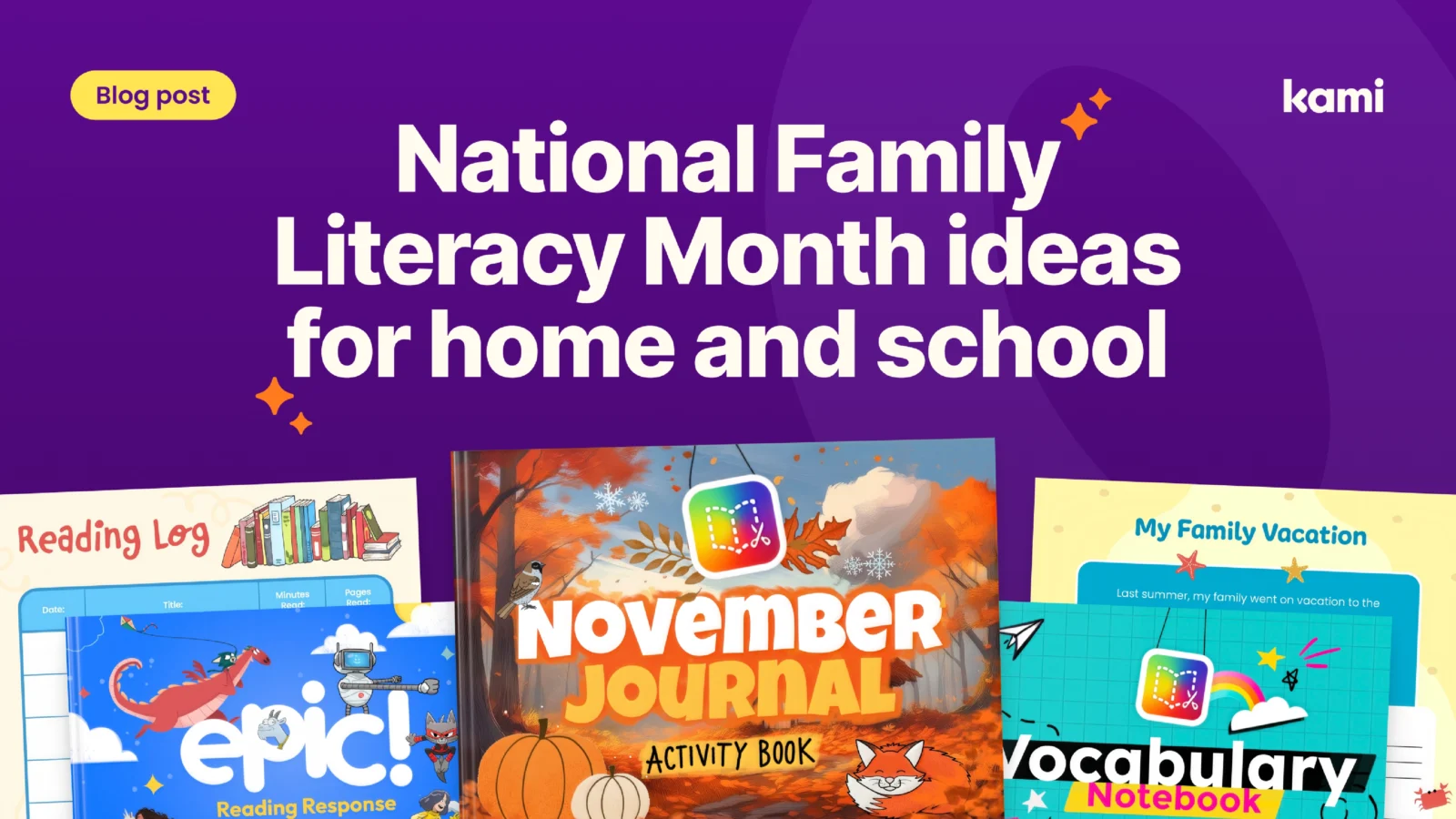
For a seasonal starting point, the November Activity Journal (K-12) ties naturally to the month.
To build a daily habit, two versions of Daily Writing Prompts exist: one for younger students (K-12) and one for older students (grades 6-12), each giving families a few minutes of writing to do together each evening.
For families using digital libraries, the Epic! Reading Response Journal and the simpler Epic! Reading Response Template (both grades 3-5) give kids a place to reflect on what they read at home, and the Sora Reading Response Journal (K-5) pairs with library ebooks and audiobooks the same way.
Vocabulary gets its own pair of templates: the Elementary Vocabulary Notebook (K-5) builds word skills through family reading, while the Newcomer Vocabulary Notebook (K-5) supports multilingual families building English alongside home languages.
For storytelling, the All About Me Journal (K-12) lets kids tell their own story and share it with family, and Newcomers: All About Me (K-12) offers the same format as a welcoming entry point for multilingual families
Kami App templates for reading habits, at school or at home
These Kami App templates started as classroom tools, but the format works just as well on a kitchen table.
For tracking progress, the Reading Progress Record and Reading Log give students a simple way to record what they are reading, while the Reading Challenge turns that tracking into a goal, and the Reading Award gives families a way to recognize the effort.
For writing practice, Write a Story about Someone You Love and Write a Story about Your Favorite Memory give students a personal prompt instead of a generic one.
Rounding out the set, the My Family Vacation Reading Passage connects reading comprehension to a familiar experience, and the Reading Comprehension Worksheet offers a standard format families and teachers can both use.
Independent exploration: how Kami Companion supports literacy at home
Not every literacy habit needs a template. Some of the most valuable reading and writing a student does at home starts with curiosity, not an assignment: looking something up, reading about a hobby, following a topic nobody asked them to study.
Kami Companion makes that kind of independent exploration more accessible. It provides built-in reading, language, and expression supports across web-based content, so students who need extra support to read or write confidently can follow their own interests online without a parent or teacher managing every step. For a student still building reading fluency, or a multilingual learner working in a second language, that independence matters. It means the websites, articles, and resources a student finds on their own are actually usable, not an immediate dead end.
Common questions about family literacy month
What are some family literacy activities? Shared reading, keeping a reading log or journal, writing together, and talking about what a child reads all count as family literacy activities. The templates above give each of these a simple structure.
What are the four components of family literacy? Family literacy programs typically focus on children’s education, adult education for parents and caregivers, parent and child together time, and parenting support. Reading and writing activities done at home touch on several of these at once.
Is there a national literacy month? Yes. National Family Literacy Month is observed every November, alongside related observances like Family Literacy Day.
Try it this November
Pick one template from the list above and build it into a weekly habit, at home or in the classroom. For independent reading and writing support, explore Kami Companion to see how it fits into a student’s day outside school hours.
Blogs you may also like

Making sense of classroom AI in Kami

How to deepen student thinking with the Cycle of Learning

Kami Customer Story: How Comal ISD won teacher buy-in