

Most school library lesson plans are written for a class period that a library media specialist doesn’t actually have. You cover more ground than almost any other role in a building, reading culture, research skills, digital citizenship, and increasingly AI literacy, often in a fixed 30-minute rotation with a different grade level each time.
These five lesson plans are built for that reality: one topic each, one remixable resource, and enough structure to run start to finish without extra prep.
1. A 30-minute digital citizenship lesson
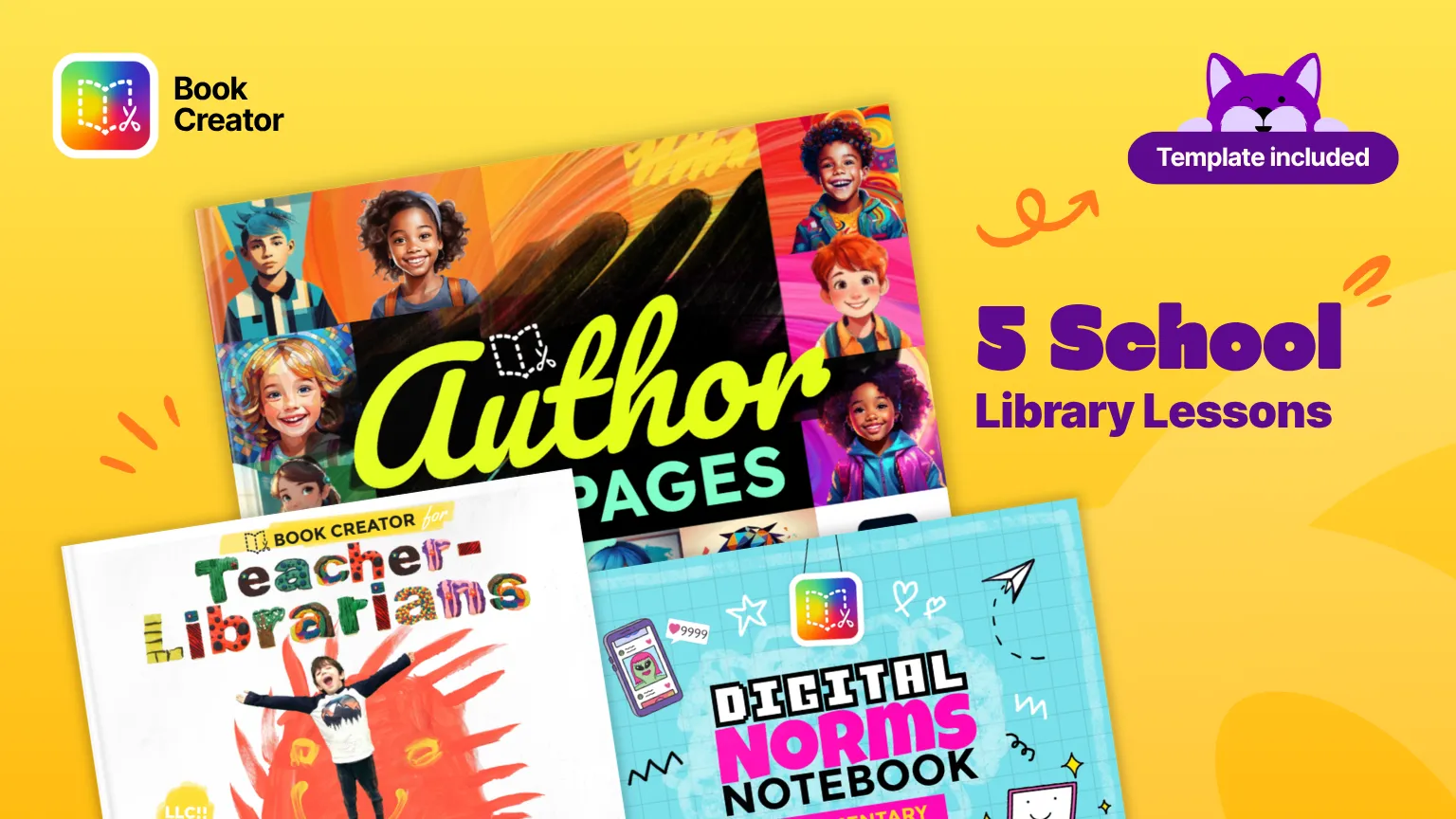
Digital citizenship is the piece of the Future Ready Librarian Framework’s updated “literacies” pillar that most library media specialists already own, even if it’s never been named that directly. It sits alongside broader efforts like Common Sense Education’s digital citizenship curriculum, if you want a wider research base to point to. The Digital Norms Notebook: Elementary and Digital Norms Notebook: Secondary give you the whole lesson already built: open with one scenario page as a class (10 minutes), have students respond to the norm in question (15 minutes), and close with a quick share of what they wrote (5 minutes). Remix once, and it’s ready for the next grade band you see that day.
If you want a story-driven way into the same territory, Shannon McClintock Miller’s ISTE (International Society for Technology in Education) Digital Explorers series maps digital citizenship and AI literacy onto early chapter books your students will actually ask to reread. See our post on digital citizenship for students for the full rundown of books and companion activities.
2. A 30-minute literacy lesson, both directions
Reading response routines are the fastest way to turn finished books into evidence of comprehension instead of just a completion count, and they fit a 30-minute block without modification: students finish a book or section before class, spend 20 minutes on one response prompt, and use the last 10 minutes to share with a partner. We’ve covered this in depth for two platforms: our post on books to read on Sora covers Sora’s library and its reading response template, and our post on the Epic reading log covers the same approach for Epic, plus the Cat Ninja activity books if you need a hook for reluctant readers.
For the flip side of reading, the Author Pages book, built with the Adobe Express integration in Book Creator, gives students a reason to see themselves as writers, not just readers, in about the same 30 minutes. Students build their own author page the way a published author would, generating imagery for their own bio and body of work along the way. It’s a small shift in framing that does a lot: a student who has made an author page reads differently afterward, because they’ve stood on the other side of the page at least once.
3. A 30-minute AI literacy lesson
AI literacy is the newest and least settled of the literacies your framework is now asking you to show evidence for, which makes a grounded starting point more valuable than a comprehensive one. Portrait of an AI-Ready Graduate gives students a structured way to reflect on what responsible, creative AI use actually looks like for them, in one sitting, rather than handing them a set of rules to memorize. Remix it, pick two or three of its reflection prompts, and let students respond in whatever format they’re most comfortable with.
4. A 30-minute author study lesson
An author visit is rare and expensive. An author study, built around a single author’s full body of work, gets most of the way there for the cost of one remixed book and one 30-minute block. Our author study activities post covers Beth Campbell’s author study books in full: what’s inside each one, a 30-minute routine you can run without extra prep, and how to get them in front of students without a workflow mess.
5. A 30-minute portfolio lesson for students
Everything above produces something worth keeping: a digital citizenship reflection, a reading response, an author page, an AI literacy entry. A digital portfolio gives students a single place to keep that work across the year. In one 30-minute block, students can set up their portfolio, add a title page, and drop in their first entry from whichever lesson above they’ve just finished, the same way your own librarian portfolio keeps your program’s evidence in one place. Model the habit for yourself first, then hand your students the same structure.
Where to start with these school library lesson plans
Pick the lesson that matches whatever’s in front of you this week, remix the one resource attached to it, and use the linked post if you want the fuller version. You don’t need all five running at once for any of this to be worth doing.
If you’d rather sequence them, a reasonable order is digital citizenship first, since it sets norms the other four lessons depend on, then a reading response routine, which is the one students will repeat most often across the year. Author studies work well once a reading culture is established and students have opinions about books worth comparing. AI literacy fits naturally after digital citizenship, because it asks the same questions about sourcing and responsibility in a newer context. Portfolios come last, not because they matter least, but because they’re most useful once there’s work worth collecting.
One practical note on repeating these: the value compounds. A single reading response is a nice moment. A dozen of them in one book, revisited in March, is a record of how a student’s thinking changed, and that’s a far more interesting conversation than any one entry.
Frequently asked questions
For a single skill, yes. What doesn’t fit in 30 minutes is a full unit, or any lesson that requires students to learn a new tool before they can start. That’s why each of the lessons above uses a template students open and respond in directly, and why the setup work happens once rather than per class.
The pattern that holds up is short opener, one focused discussion move, student response, quick share. Roughly 5 minutes framing, 10 talking, 10 to 15 creating, and a few minutes to close. Cutting the opener is usually more productive than cutting the response time, since the response is where the evidence of learning comes from.
That depends on your school’s goals, but the Future Ready Librarian framework’s “literacies” grouping is a reasonable map: digital citizenship, media literacy, and AI literacy alongside reading. If you’re deciding where to start, digital citizenship tends to have the most existing curriculum support, and AI literacy tends to have the most urgent demand.
No. All five lessons run in Book Creator, so students use the login they already have. That matters more than it sounds: account setup is often the thing that consumes a 30-minute block entirely.
Mostly yes, with the caveat that the digital citizenship notebook comes in separate elementary and secondary versions for a reason. The reading response, author study, and portfolio lessons scale by changing the prompt rather than the format, which is what makes them practical for a role that might see kindergarten and sixth grade in the same day.
A single artifact: a reflection page, a response to one prompt, an author page, a portfolio entry. Each one is small on its own, and each one is usable later as evidence for your librarian portfolio, which is what makes running them regularly worth more than running any one of them well.
Blogs you may also like
Your March Classroom Activities, Planned

Summer Reading Resources: Journals, Author Studies, and More
April Classroom Resources: End-of-Year Energy That Actually Inspires