

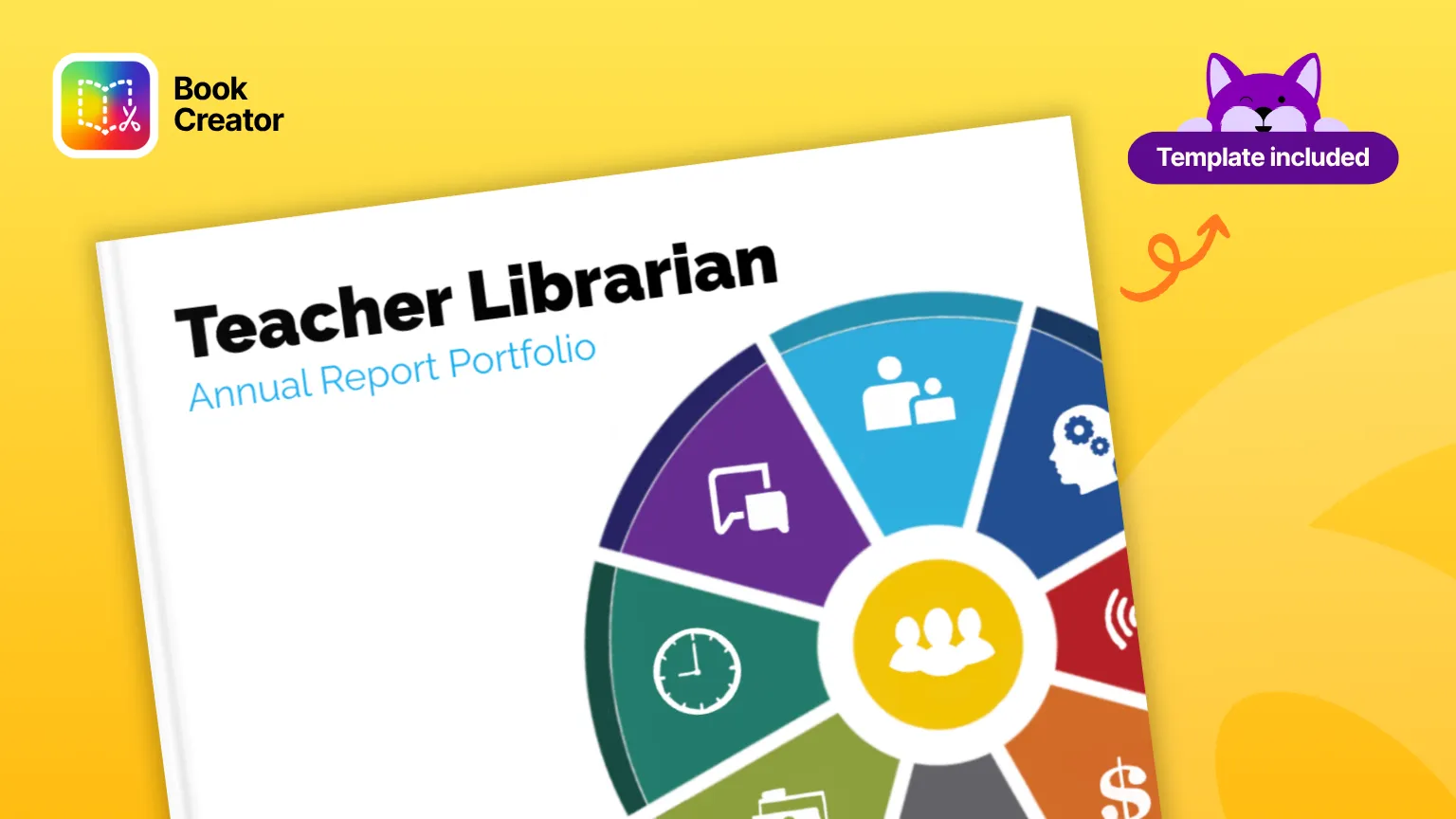

t’s back to school season, and building a librarian portfolio, the collection of goals and evidence that turns into your annual report each spring, is nowhere near your list right now. You’re busy setting up the library for a new year, not thinking about a report that’s still months away. That’s exactly why now is the moment to start the portfolio, before the digital citizenship unit, the reading intervention groups, and everything else you’ll teach this year pile up ungathered.
Most reports get written the night before they’re due, pulled together from memory and whatever circulation numbers can be exported in time. Neither the report nor the memory holds up well by then.
What a portfolio needs to do that circulation numbers can’t
A principal or school board reading your report is trying to answer one question: is the library program worth the position, the budget line, and the space it takes up. Circulation counts and visit logs answer “was the library used.” They don’t answer “did it change anything,” which is the question that actually protects the program when budgets get tight. That gap matters more this year than in past ones, since the second edition of the AASL standards, from the American Association of School Librarians, puts more weight on demonstrated impact, not just documented activity. We covered that shift in more depth in our post on the AASL standards, if you want the fuller context first.
A portfolio structure that reuses what you already have
The structure below isn’t a form to fill out from scratch. It’s a way to organize the work your students are already producing into a portfolio that reads as evidence instead of a list of activities. Keep it up over the year, and it becomes your annual report almost by default.
Program snapshot. One page, one paragraph. What the library program covers this year: instruction, collection, technology support, whatever applies. This is context, not the case itself, so keep it short.
Goals and standards alignment. Two or three goals you set for the year, each tied to a specific AASL standard or a school or district priority. This is the section that turns “here’s what we did” into “here’s why it mattered.”
Evidence, by goal. For each goal, one or two concrete examples of student work: a reflection, a project excerpt, a short before-and-after comparison. This is the heart of the report, and it’s the part most annual reports skip entirely in favor of numbers.
Numbers that support the story. Circulation counts, class visits, PD sessions led, still belong in the report. They just move to a supporting role instead of carrying the whole argument.
What’s next. One goal or gap for the coming year. Reports that end with a forward-looking ask read as leadership, not just a summary.
Building it in Book Creator instead of a slide deck
A slide deck can hold this structure, but it can’t hold the student work itself in a way that feels immediate. Book Creator lets you build the portfolio as a book: text, images, and short video or audio clips from actual student projects sitting next to the goals they support. A principal flipping through it sees the evidence directly instead of a bullet point describing it.
We built an exemplar version of this, the Future Ready Librarian Annual Report, as a portfolio starting point you can remix rather than build from a blank page. It follows the structure above and is set up so you can drop in your own examples, goals, and numbers without redesigning anything.
Book Creator holds three outside certifications worth knowing here: an ESSA (Every Student Succeeds Act) Level III rating for evidence of improved outcomes in English language arts, a UDL (Universal Design for Learning) Product Certification, and an ISTE (International Society for Technology in Education) Seal of Alignment, so the format itself is backed by outside review. That matters when the portfolio’s whole job is to build credibility with people who don’t see the library day to day.
Use the journal when you want individual, structured reflection. Use the choice board when you want something more flexible and more social. Many classrooms end up using both, depending on the book or the week.
Because both live in Book Creator, students can respond with writing, a quick drawing, or a short recorded reflection, so either template works whether a student is a fluent writer or still building that skill. And because entries stay in one running book, a student, or you, can flip back and see how their reading and their reflections have grown since the first entry.
Watch a Future Ready Librarian leader use this exact portfolio
This isn’t just our own idea of what a good librarian portfolio looks like. Shannon McClintock Miller, who leads the Future Ready Librarian movement, co-created this template with us, and she uses it herself as her own goals-and-evidence portfolio throughout the year. In our webinar on the topic, she described bringing it to her own school board that fall, as part of the professional development plan she builds around the Future Ready Librarian Framework. Watch the full conversation below.
She also walks through how simple remixing actually is: open the book, tap remix, choose the library you want it copied into, and make a copy. From there it’s yours to edit, drop in your own goals and evidence, and make it match your program.
Where the evidence comes from if you’re starting from zero
If this is your first year building a portfolio this way, you don’t need a new initiative to fill it. Reading response journals, research reflections, and citizenship unit wrap-ups already generate the kind of student work a portfolio needs. We’ve built a couple of ready-to-use starting points for exactly this: see our posts on books to read on Sora and the Epic reading log, both built for library instructional time and both zero setup for students who are already using those platforms.
Start with your first entry, not a full portfolio
You don’t need a year of evidence to start the portfolio, just a plan for collecting it. Pick the first unit you’re teaching this year, decide which goal it supports, and note that pairing in the template now. When students finish that unit, pull one or two examples of their work straight into the matching evidence section. One real entry at the start of the year makes the rest of the year’s collecting feel like a habit instead of a scramble next spring.
Frequently asked questions
The portfolio is the year-round habit; the report is what it produces. A portfolio is where you collect goals, evidence, and student work as the year happens. The annual report is the version you hand to a principal or school board in the spring. Keeping the portfolio makes the report largely a matter of trimming rather than writing.
Five sections cover it: a short program snapshot, two or three goals tied to a standard or district priority, one or two pieces of evidence per goal, your usage numbers in a supporting role, and one goal or gap for next year. The evidence section is the part most reports skip, and it’s the part that does the persuading.
Short enough that a busy administrator reads all of it. The goal isn’t comprehensiveness, it’s a clear case. If the evidence for each goal is specific, a handful of pages will outperform a long document padded with statistics.
Usually a principal, sometimes a district administrator or school board. All of them are answering roughly the same question: is this program worth the position, the budget line, and the space. Writing toward that question rather than toward a list of activities tends to change what you include.
At the beginning of the year. You don’t need evidence yet, just the structure and a decision about which goal your first unit supports. One real entry early on turns the rest of the year’s collecting into a habit instead of a spring scramble.
Blogs you may also like
Your March Classroom Activities, Planned

Summer Reading Resources: Journals, Author Studies, and More
April Classroom Resources: End-of-Year Energy That Actually Inspires