


Teachers don’t need another “great idea” that takes two hours to prep. You need author study activities you can run in the time you have, whether that’s a 30-minute block with students or a planning period that disappears to meetings.
That’s the problem Beth Campbell set out to solve. Beth is a retired librarian who spent four decades working with students from preschool through postgraduate programs. Across every grade level, one thing stayed true: when students connect with a great book, reading starts to feel social, and a community of readers can form in a way no worksheet creates.
Those moments are hard to repeat. An author visit can unify a whole campus, but it’s expensive and rare. A perfect read-aloud pulls everyone in, but it doesn’t come with the activities and discussion structures teachers need afterward. Beth’s solution was to build author-focused books that make those moments easier to create, more often, with less prep. Watch her walk through the books, from finding them in Discover to remixing and assigning them, in her Kami webinar, Creating Communities of Readers.
What is an author study?
An author study is a lesson or unit built around one author or illustrator: their life, their creative process, and their body of work. Students read across several titles, hear from the creator, and talk about the choices behind each story.
At its heart, an author study introduces students to the real person behind the stories, someone who loves creating and sharing them. Because it isn’t tied to reading levels or test scores, every student can take part. A student reading below grade level and one reading above it can both ask why an author chose a character, or how an illustrator picked a color palette.
Why author studies build a community of readers
A strong author study gives students shared context and shared language. They start recognizing patterns across texts, comparing themes across books, and talking to each other about what they notice. It’s also a low-pressure way to differentiate: students can read different titles by the same author, at different levels, and still join the same class conversation. Beth saw this firsthand with only a short window of time with students: author studies created structure without flattening choice.
Author studies are also a natural fit for inquiry, which sits at the center of many school library standards. One teacher librarian uses them with her youngest students:
“So many of our library standards are about inquiry. At the youngest levels this starts with helping students generate questions and know where to look for answers. I love using the Jill Esbaum Author’s Studio for this purpose! Her books introduce unique animals which immediately prompts questions. My 1st graders use this Authors’ Studio to record and explore their questions!”
Carey Copeland, teacher librarian, Neil Armstrong Elementary School, Park View, Iowa
Author study activities that fit into a teacher schedule
Most author study resources are either too broad to fit a specific book or too time-intensive to use without building a full unit. Beth’s books are modular. Use two pages or 20, in order or only what matches your goal for the day. Each author book combines:
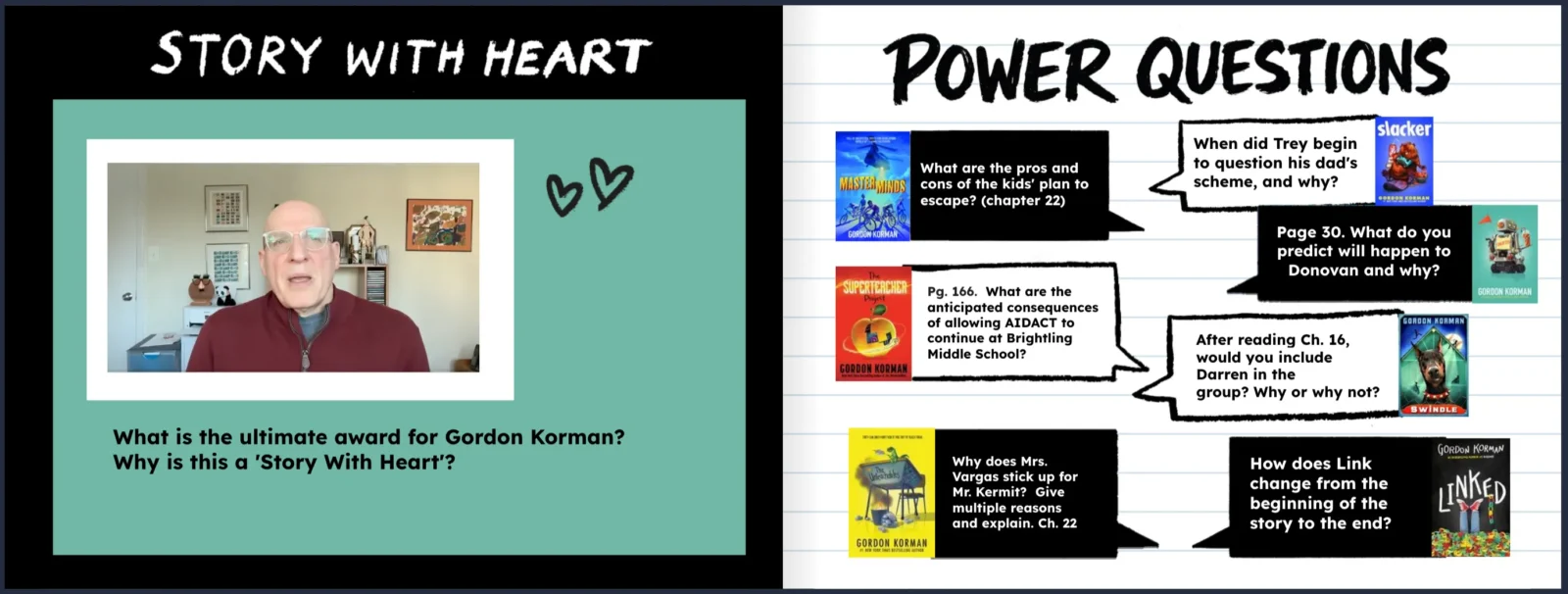
- Short videos (two to four minutes) from Beth’s interviews with authors and illustrators, so students hear backstories and creative insights in the creator’s own words.
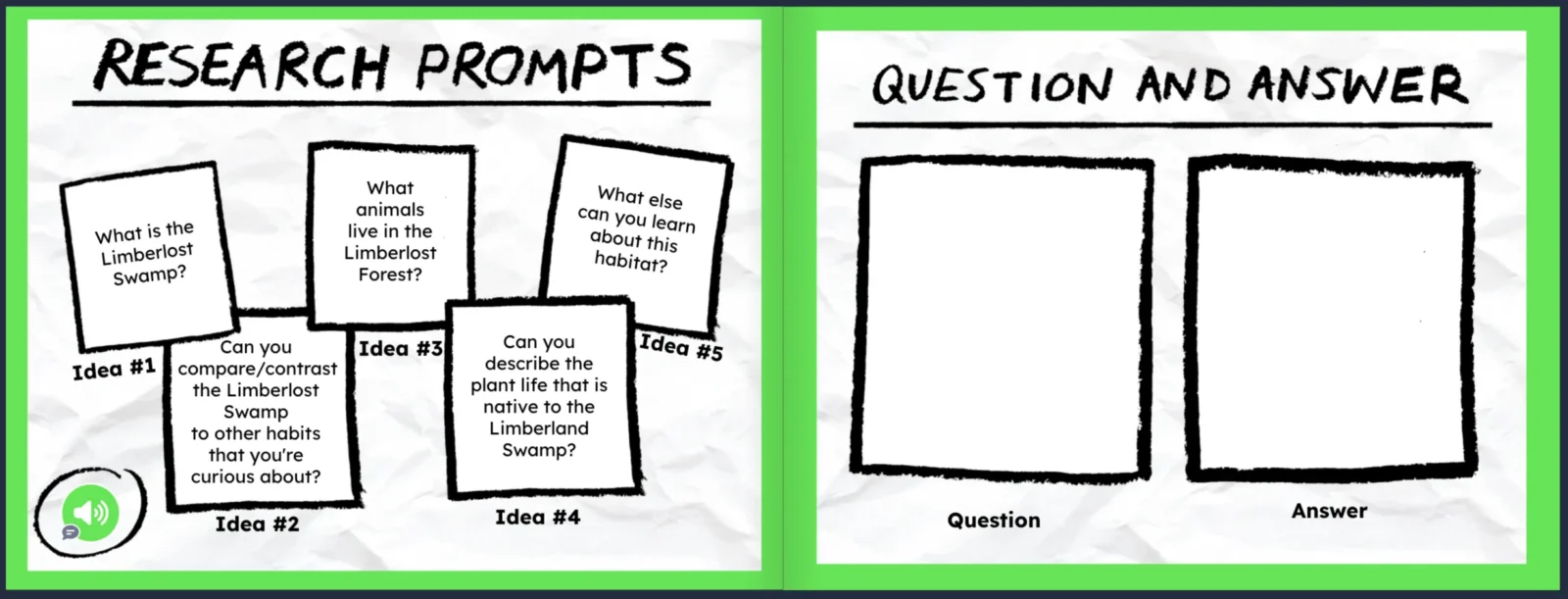
- Standards-aligned prompts for identifying the main idea, describing character traits, sequencing a story, research, discussion, and writing. Students respond with text, video, audio, or drawings, and read-aloud buttons let them listen to the directions.
- Lesson plans with standards-aligned guidance for teachers and teacher librarians.
- Quotes worth revisiting that are specific enough to spark real discussion.
- Small-group options tied to specific titles, so different reading groups can work on different books.
In the webinar, Beth showed this with Gordon Korman: discussion pages, research and writing videos, and book-specific prompts for small groups.
Meet the authors and illustrators in Authors’ Studio
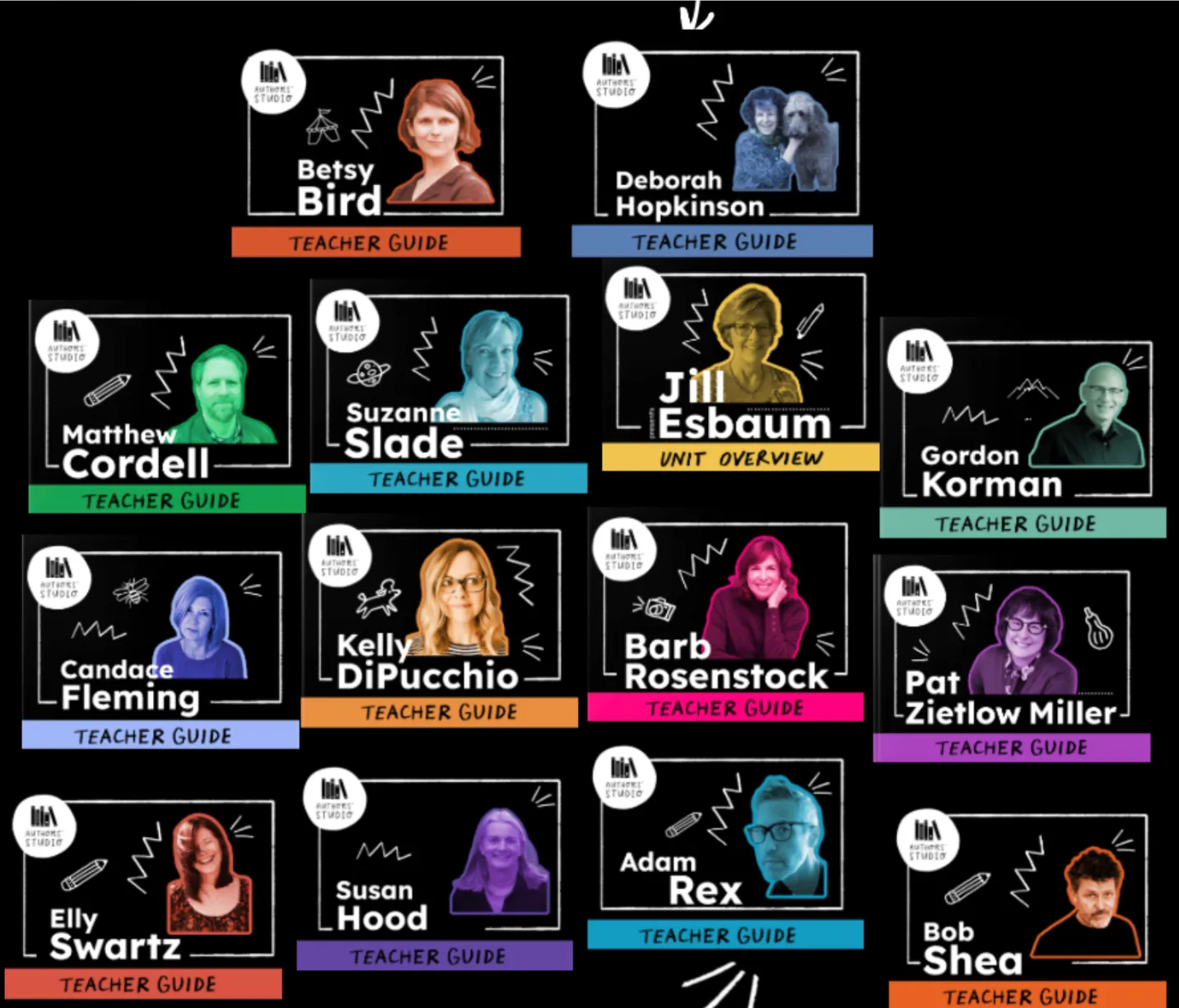
Authors’ Studio features 16 award-winning authors and illustrators: Gordon Korman, Candace Fleming, Kelly DiPucchio, Jill Esbaum, Barb Rosenstock, Suzanne Slade, Pat Zietlow Miller, Matthew Cordell, Adam Rex, Bob Shea, Susan Hood, Elly Swartz, Jarrett Lerner, Deborah Hopkinson, Betsy Bird, and Miranda Paul.
Together they’ve written more than 600 works, and some of their titles are available on Epic and Sora, so students can move straight from an author study to the books themselves. Each author book also invites students to explore the creator’s full body of work and choose what to read next, as a class or on their own.
A simple 30-minute author study routine
- Two minutes: Open with a shared reading moment, such as a short read-aloud, a book collage page, or a one-minute author clip.
- Eight minutes: Build community through talk with a turn and talk, a whole-class share, or a small-group “notice and wonder” on a quote or author photo. Keep the question concrete, so students can answer without guessing what the adult wants.
- Fifteen minutes: Let students respond their way, by audio, writing, drawing, or video.
- Five minutes: Share out one idea to remember, one question, and one book to try next. If you do nothing else, do this.
How to share Beth Campbell’s books with your class
- Find the books in the Authors’ Studio library, or search “Beth Campbell” in Book Creator Discover.
- Remix a book to make your own editable copy.
- Make two copies: a teacher copy with every page, and a student copy trimmed to one or two core pages for the first lesson, such as a “power questions” page and a discussion page. You can always remix again later.
- Assign the student copy so each student gets their own. You can assign to everyone or select students, hide the teacher version, and lock the page order.
The books work in ELA classes, library time, gifted groups, mixed-ability classrooms, and research and writing mini-lessons. If you teach several grades, try one author school-wide. Shared authors create shared conversation.
A practical next step you can do this week
Pick one author book and run one small lesson: one short video, one discussion question, and one response page. Reading communities don’t form because students were told to love books. They form when students get repeated chances to talk about books in ways that feel real.
Start your first author study. Open the Authors’ Studio library and try a two-page lesson in your next 30-minute block. Have an author or illustrator you’d love to see featured? Tell Beth.
Blogs you may also like
National Family Literacy Month ideas for home and school

A classroom pen pal program that connects your students to the world
A librarian toolkit for getting Book Creator off the ground this year