
Demystifying Depth of Knowledge (DOK): A Practical Guide for Teachers

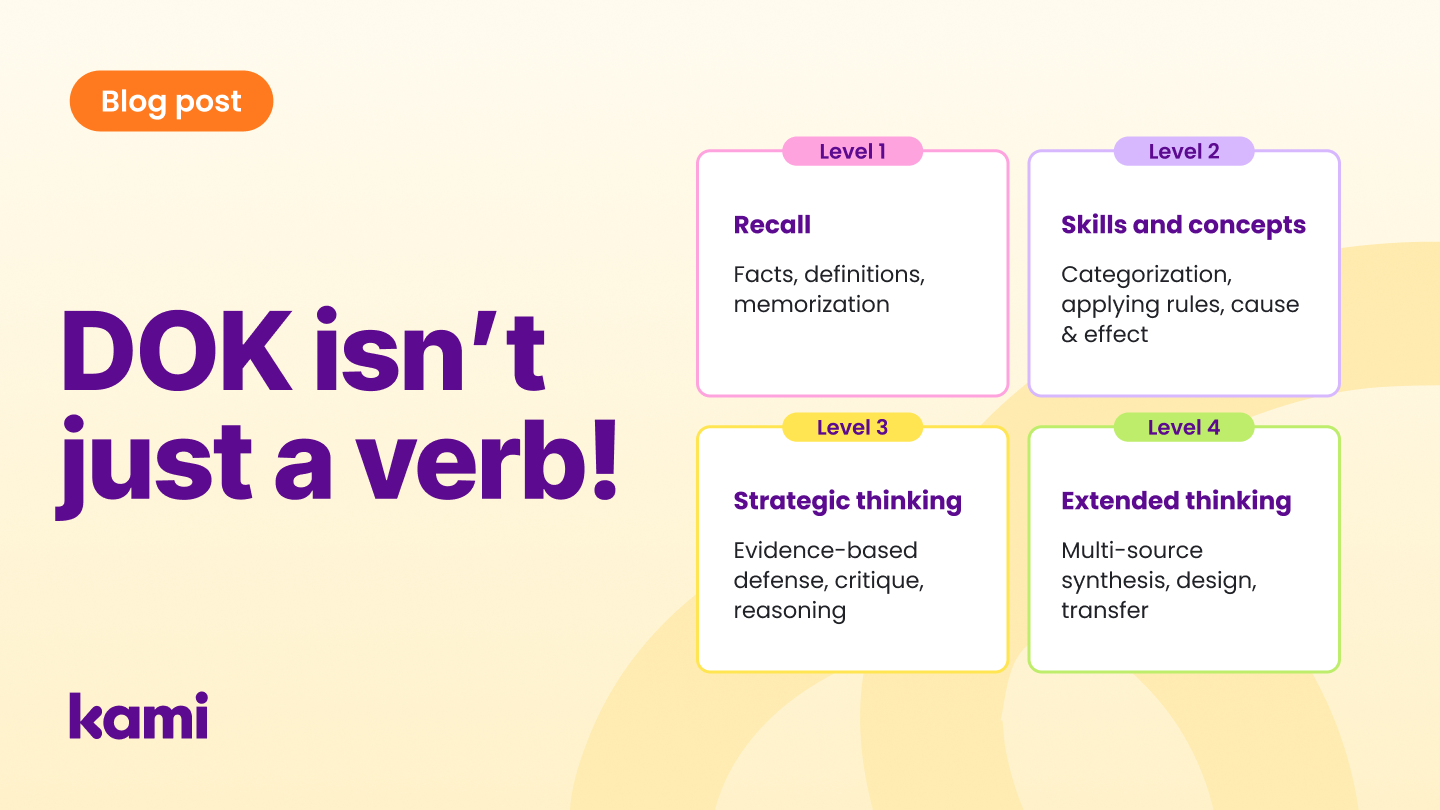

Ask a room of educators to define ‘rigor,’ and you’ll likely get ten different answers. We all want our students thinking deeply and solving complex problems, but in the thick of lesson planning, rigor often gets confused with effort.
Busywork is easy to mistake for rigor because it fills class periods and keeps students quiet at their desks. But assigning an elaborate, time-consuming poster project where 80% of the time is spent coloring and cutting paper doesn’t mean students are engaging in high-level cognitive processing.
This is why Dr. Norman Webb created the Depth of Knowledge framework in 1997 (Webb, 1997). Originally designed to help assessment creators evaluate the cognitive demand of test questions, DOK quickly moved beyond formal testing. As initiatives like the Common Core State Standards placed greater emphasis on classroom rigor, educators quickly recognized DOK as an invaluable tool for analyzing the cognitive complexity of daily instructional tasks, assignments, and learning activities.
What is Depth of Knowledge (DOK)?
Depth of Knowledge (DOK) measures cognitive demand, the complexity of mental processing required to complete a learning task or assessment item.
Understanding the distinction between difficulty and complexity is the foundation of the framework:
- Difficulty is about effort, frequency, or performance skill. It answers the question: How many steps are there? How long will this take? How will I know if I am correct?
- Complexity (DOK) is about mental depth and processing. It answers the question: What level of reasoning, analysis, or synthesis does the student need to demonstrate?
Memorizing 50 US state capitals is difficult and time-consuming, but it remains basic recall (DOK 1). Analyzing how a region’s geography impacted its economic development requires strategic reasoning (DOK 3).
The 4 DOK Levels Explained
According to Webb’s updated foundational framework, cognitive demand is categorized into four distinct levels. (Webb, 2002)
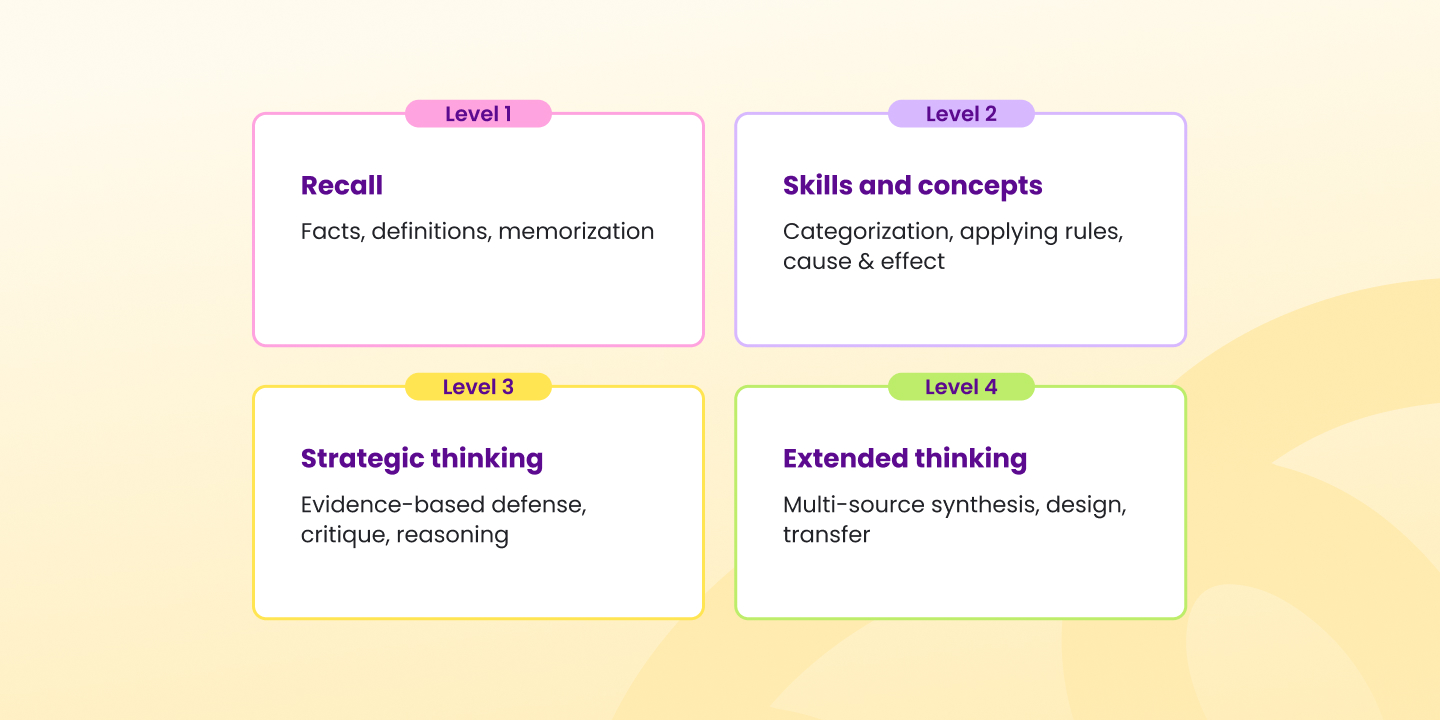
DOK Level 1: Recall & Reproduction (“What is the answer?”)
Focuses on facts, terms, definitions, and simple, one-step procedures. Answers are clearly right or wrong, and recall is the primary mental process.
- Classroom Example: What is the formula for calculating the area of a rectangle?
DOK Level 2: Skills & Concepts (“How do I use this?”)
Requires students to apply rules, classify data, compare ideas, organize information, or explain cause-and-effect relationships.
- Classroom Example: Organize these six organisms into a desert food web, then explain the cause-and-effect relationship on the population if the primary consumer is removed.
DOK Level 3: Strategic Thinking (“Why does this work, and how do I prove it?”)
Calls for reasoning, planning, using evidence, critiquing hypotheses, and solving multi-step problems with more than one defensible answer.
- Classroom Example: Analyze two paintings from different art movements depicting the same subject. Evaluate how each artist uses color and focal point to evoke emotion, and defend which piece communicates its message more effectively using visual evidence.
DOK Level 4: Extended Thinking (“How do I create something new with this?”)
Involves high-order synthesis, long-term research, transfer across disciplines, and designing original solutions over time.
- Classroom Example: Conduct a spatial audit of your school’s cafeteria. Synthesize traffic flow data, building code restrictions, and geometric tiling patterns to design a reconfigured floor plan that maximizes seating capacity while maintaining safe pathways.
Depth of Knowledge Verbs (And Why Context Matters)
Verb wheels are a starting point, not the answer. Many instructional charts link specific verbs (like describe, analyze, or evaluate) directly to DOK levels. While verb lists are a handy starting point, the verb alone does not dictate the DOK level. The rigor is determined by the context and the depth of cognitive processing the prompt requires. However, as outlined in Karin Hess’s DOK Flip Chart, verbs can still be helpful indicators for mapping cognitive requirements across subjects:
| DOK Level | Commonly Associated Verbs | Classroom Context Example |
|---|---|---|
| DOK 1 | Define, List, Label, Identify, State | List the core components of an ecosystem. |
| DOK 2 | Categorize, Organize, Graph, Summarize, Apply | Categorize these organisms into their correct trophic levels. |
| DOK 3 | Formulate, Critique, Revise, Assess, Justify | Critique a proposed conservation plan and justify your revisions using field data |
| DOK 4 | Design, Synthesize, Connect, Create, Prove | Synthesize three independent ecological studies to design a sustainable habitat model. |
Teacher Tip:
The verb “describe” can be DOK 1 (“Describe what happens in step 2”) or DOK 3 (“Describe the logical flaws in this argument”).
Always look at what the student’s mind has to do with the information.
Depth of Knowledge Visual Reference
Here is a simple framework mapping Webb’s four levels to classroom cognitive expectations:
DOK vs. Bloom’s Taxonomy: How They Compare
It is common to confuse Webb’s DOK with Bloom’s Taxonomy, but comparative reviews show they measure two completely different dimensions of learning (Ang et al., 2016; Masharipova, 2024):
- Bloom’s Taxonomy: categorizes the cognitive process (Remember, Understand, Apply, Analyze, Evaluate, Create). It is a taxonomy of thinking verbs.
- Webb’s DOK: measures the depth of context and complexity required by the task. It evaluates what a student must do with their knowledge within a given context.
For instance, analyzing a poem to identify metaphors and similes is Bloom’s “Analyze,” but it remains DOK 2 if students are just following a standard formula. Analyzing how those same metaphors reveal an author’s subtle bias across two conflicting texts elevates the task to DOK 3 due to the increased cognitive rigor and complexity. This structural distinction is key when evaluating classroom assessments (Schmidt, 2022) or modernizing content standards (Wine & Hoffman, 2023).
Bridging DOK Theory into Classroom Practice
Understanding Webb’s framework gives us a common language for assessing the cognitive demand of our assignments and assessments. But how do we structure day-to-day classroom activities so students don’t get stuck in routine recall?
DOK isn’t meant to keep students permanently at Level 3 or 4. Foundational fluency (DOK 1) creates the schema necessary for strategic reasoning (DOK 3) and creative synthesis (DOK 4). To see how Webb’s levels translate into a step-by-step instructional sequence, and how Kami helps move student thinking across every level, read How to deepen student thinking with the Cycle of Learning.
Frequently Asked Questions About DOK
Is DOK 4 better than DOK 1?
No. DOK levels are non-hierarchical in value. Lower DOK levels build the foundational knowledge that higher DOK levels depend on. Effective instruction incorporates a balanced mix across all four levels. Engagement can be achieved by beginning a lesson with DOK 4-level questions, then having students work through other DOK-level assignments.
Does DOK 4 require weeks of class time?
Not necessarily. DOK 4 measures cognitive depth, rigor, the synthesis of multiple complex sources, or the transfer of concepts to entirely new scenarios, not just time spent on a task or assignment. A concise synthesis task can reach DOK 4 in a couple of class periods.
How do I raise the DOK level of an existing assignment?
Shift from asking for correct answers to demanding evidence-based justifications. Prompts that require students to self-explain or defend their choices significantly enhance cognitive processing (Chiu & Chi, 2014). Instead of asking students “Which solution is correct?”, ask them to “Defend this solution against its strongest alternative using evidence.”
Blogs you may also like
Demystifying Depth of Knowledge (DOK): A Practical Guide for Teachers

How to deepen student thinking with the Cycle of Learning

Digital citizenship in schools: screen value over screen time