

A CTE coordinator sits down the week before an advisory board meeting and starts pulling together an update. The technical numbers are easy: enrollment, completion rates, credentials earned. Then comes the harder question a board member is likely to ask anyway: what does this actually look like for a student. That’s the part that usually gets answered with a story from memory instead of something the board can see for themselves.
Advisory boards exist because programs need employers and community partners at the table, not just numbers on a slide. Perkins V (the federal Strengthening Career and Technical Education for the 21st Century Act) leans on that same idea, asking every program to build employability skills, not just technical ones, into the work. Proving that happened tends to be the harder half of the law to satisfy. Both audiences are asking a version of the same thing: show me the work, not just a summary of it.
Why the usual update falls short
Most CTE classrooms have plenty of the evidence an advisory board would actually want to see. Students troubleshoot a failed build, present findings to a group, adjust a plan after it doesn’t work the first time. That is real, in-the-moment demonstration of the exact skills employers say they care about most: communication, collaboration, adaptability, and technical judgment.
The problem is timing. Almost none of that gets captured as it happens. By the time a coordinator sits down to prepare for a board meeting, the best moments are already reduced to a general impression: “students did great work this semester.” That’s not nothing, but it isn’t the kind of specific, checkable evidence that makes a board member’s decision to advocate for the program, or fund it further, feel easy.
A documentation habit, not a new program
The fix isn’t a new curriculum unit or an additional reporting system layered on top of everything else a coordinator already tracks. It’s a small documentation habit built into project work that is already happening.
In Book Creator, a project can double as its own evidence file. A student captures a photo of a failed weld, records a 30-second reflection on what they changed, and that page becomes real, dated proof of problem-solving and adaptability, tied to a specific project instead of a general claim. Because Book Creator combines text, image, audio, and video on the same page, a student who explains a technical fix clearly out loud but struggles to write it up doesn’t lose that evidence to a writing barrier that has nothing to do with the skill actually being demonstrated.
Aggregated across a semester, those individual captures become a portfolio a coordinator can bring into a board meeting, a state monitoring visit, or a program review, instead of reconstructing highlights under deadline pressure. Book Creator holds a UDL (Universal Design for Learning) Product Certification from CAST, so this works for every student building toward that portfolio, including those in special populations.
Turning that evidence into a board conversation
Having the evidence is one part of this. Bringing it into the room in a way that actually lands with an advisory board, made up of employers and community members rather than educators, is a separate skill.
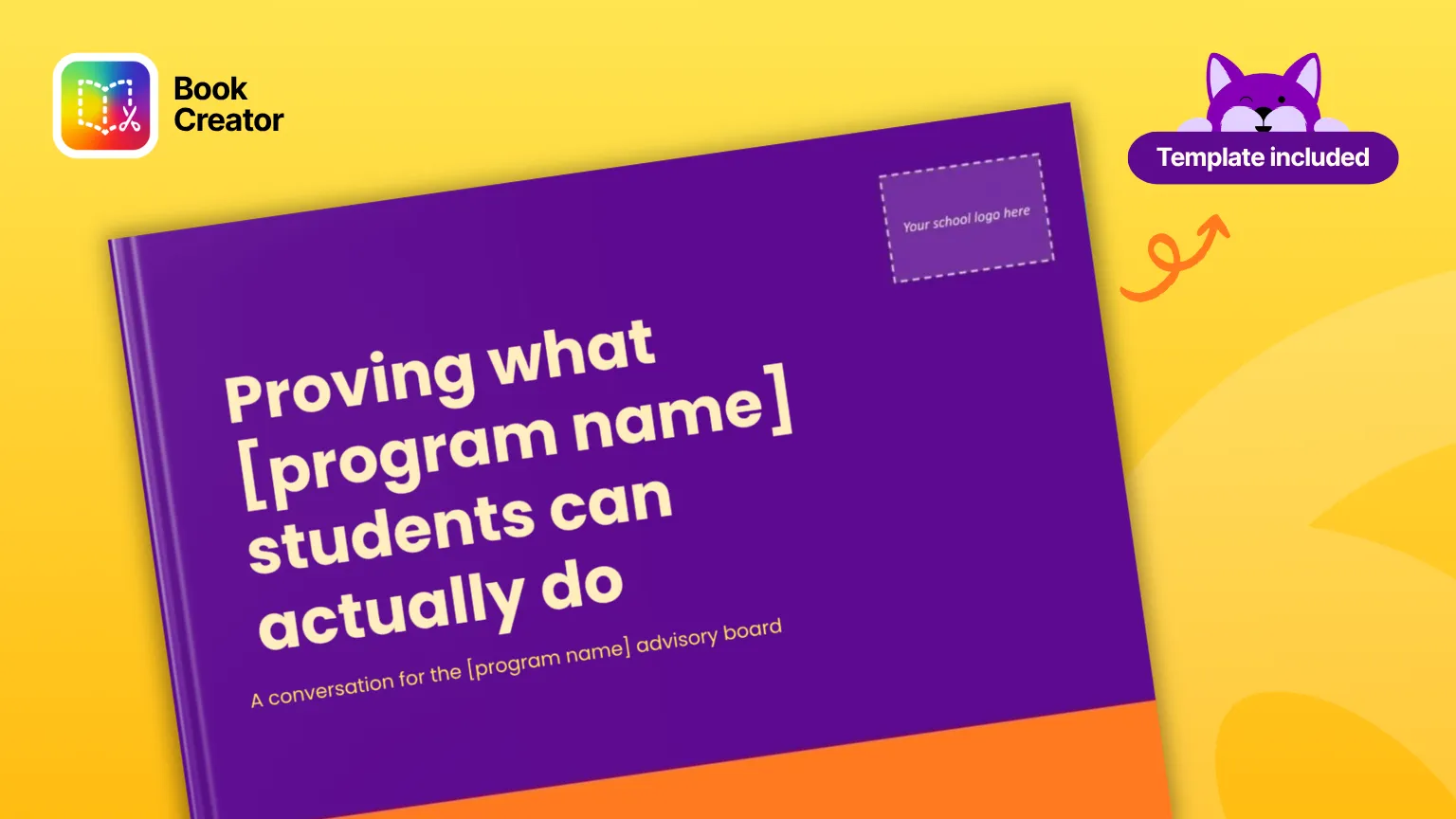
That’s the gap this kit is built to close. It includes three pieces meant to be used together:
A short remixable book a coordinator can present at a board meeting, framing the problem, showing what documented evidence looks like, and connecting it to what board members care about most.
A one-pager written to hand directly to board members, laying out why this matters to them specifically and what kind of support would actually help, since not every board can offer the same thing.
A talk track for the coordinator, including how to open the conversation, questions likely to come up, and three versions of the ask depending on what a given board can realistically provide: an endorsement letter for a Perkins V application, a standing portfolio review at an existing meeting, or, where a board has discretionary funds, support for classroom licenses.
None of this assumes an advisory board will write a check. Some boards can. Many can’t, and don’t need to be asked to. The kit is built so the ask matches what’s actually on the table.
Where this connects
This same documentation habit is the thread running through a few other things worth reading if this resonates. See our post on documenting project-based learning for CTE credentials for how the same capture-as-you-go approach supports credentialing specifically, and our post on Perkins V evidence of employability skills for how it feeds state reporting requirements directly. For programs building this into internship and job shadow placements rather than in-class projects, our post on work-based learning documentation covers the same idea applied outside the classroom.
For background on why advisory committees matter to CTE programs more broadly, Advance CTE’s resource hub is a useful, non-vendor reference on how states are implementing Perkins V requirements in practice.
Get the kit
The CTE advisory board showcase kit is free to download and includes the deck, the board-facing one-pager, and the coordinator’s talk track. Download and remix the kit to get everything you need before your next meeting.
Blogs you may also like
What is a career portfolio?

Work-based learning happened. Where’s the record of it?
The gap between a Portrait of a Graduate and proof