

A student earns an industry-recognized welding credential. The certificate confirms they passed an assessment on a specific day. It says nothing about the six weeks of failed joints, adjusted technique, and instructor feedback that got them there, and it says nothing about whether the student can talk through their own reasoning if a future employer asks how they solved a problem on the shop floor.
That’s the gap between a career and technical education CTE credentials and the project-based learning (PBL) behind it. The credential is a single data point. The documentation of the work that earned it is the part that actually shows how a student thinks, adjusts, and problem-solves, and it’s usually the part that never gets captured anywhere.
Why CTE credentials alone are an incomplete record
Industry-recognized credentials matter, and credential attainment is one of the measures states can select for their Perkins V program quality indicator. But a credential is a pass or fail outcome. It doesn’t show the iteration that got a student there, and iteration is exactly what advisory boards, employers, and college admissions readers say they want to see when a CTE program makes its case.
A program that can produce both the credential and the documented project work behind it is making a stronger argument than a program that can only produce the credential. The credential says a student met a bar. The documentation shows how.
What documentation actually needs to capture
Useful project-based documentation for CTE credentialing isn’t a full narrative of every day in the shop or lab. It’s a small number of specific captures: the initial plan or design, evidence of a real problem encountered mid-project, the adjustment the student made in response, and the final result alongside a short student reflection on what they’d do differently.
That structure matters because it mirrors what a credentialing body, an advisory board, or an employer actually wants to know: not just that a student can execute a known procedure, but that they can recognize when something isn’t working and correct course. A student explaining, in their own words, why a first weld failed and what they changed is more convincing evidence of readiness than a photo of a finished part.
Where this documentation tends to fall apart
The usual failure isn’t a lack of good project work. CTE classrooms produce plenty of it. The failure is timing. Documentation attempted after a project wraps relies on a teacher or student reconstructing decisions from memory, weeks after the fact, which is when the most useful detail, the specific adjustment that fixed the problem, is usually already lost.
The fix is capturing documentation as the project happens rather than after it. A quick photo of the failed weld and a 30-second voice reflection recorded the same day the student made the fix is far more useful than a paragraph written from memory a month later.
Building this into an existing project, not a new one
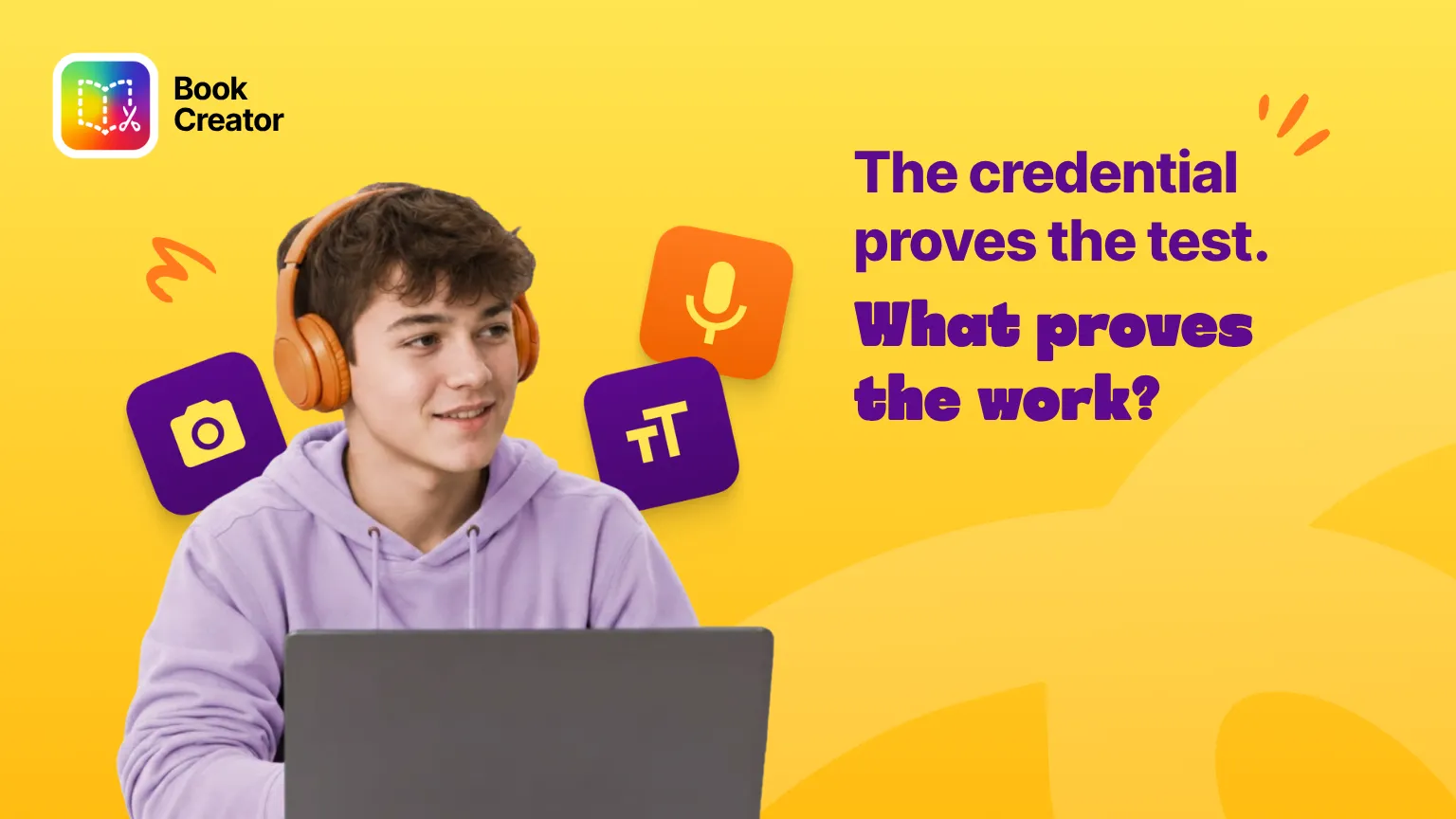
In Book Creator, a project can double as its own documentation record. Students add pages as a project unfolds, a photo of the plan, a photo or short video of the problem, a recorded or written explanation of the adjustment, and a final page with the result. Because pages combine text, image, audio, and video, a student who can explain a technical fix clearly out loud but struggles to write it up doesn’t lose that evidence to a writing requirement that has nothing to do with the skill being assessed.
This also solves a real logistical problem for programs juggling multiple credentialing pathways at once: each project becomes a self-contained, shareable record that a coordinator can pull for a program review, an advisory board meeting, or a student’s own portfolio, without hunting down photos and notes scattered across different teachers’ devices. Since advisory boards include people outside the district, follow your district’s policy on sharing student work with external partners, and get whatever consent it requires, before a student’s project record goes in front of that audience.
Connecting this to broader reporting
Documentation built this way isn’t just useful at the student level. Aggregated across a program, it becomes the kind of evidence base that supports Perkins V reporting on program quality and employability skills, which is the layer above individual credentialing. See our post on documenting employability skills evidence for how the same documentation habit feeds that reporting requirement directly.
It also connects upward to broader career readiness documentation. See our posts on what a career portfolio is and the STEM portfolio built from seven challenges for how this same capture-as-you-go approach applies beyond credentialing specifically, our post on work-based learning documentation for how it applies to placements outside the classroom entirely, and our post on the portrait of a graduate portfolio for tying the same project evidence back to a district’s named graduate competencies.
For current guidance on credential quality and how states evaluate which credentials count, see the Credential Engine resource library, a neutral, non-vendor source districts commonly reference, and Advance CTE’s credentials resource hub for how states are approaching credential value and endorsement
Blogs you may also like
What is a career portfolio?

Work-based learning happened. Where’s the record of it?
The gap between a Portrait of a Graduate and proof