
From Purchase to Practice: How Districts Drive EdTech Adoption



This is part of Kami’s ongoing series of executive briefings for education leaders. Each month, we’ll discuss solutions to a top-of-mind issue and share actionable resources and inspiration for leading your team. Be sure to subscribe to have this free resource delivered to your inbox.
In October’s Throughline Issue, we talked about the hard work of pruning, cutting away the redundant platforms, unused subscriptions, and legacy initiatives cluttering a district’s digital ecosystem.
Now comes the equally critical next question: What about the tools you kept?
District leaders know the frustration: an edtech platform that shines in vendor demos ends up with single-digit usage on your dashboard just a few months later. Somewhere between the purchase order and the classroom, momentum stalls. The knee-jerk reaction is to attribute this drop-off to “educator resistance.” However, learning science and organizational research tell a different story: low adoption is rarely a willingness problem; it is most likely a flawed implementation design.
The crux of the matter is this: district leaders cannot truly evaluate a tool’s pedagogical efficacy on student learning outcomes without consistent, high-fidelity usage data. To unlock that data, district leaders must align edtech implementation with the core principles of adult learning theory and cognitive science. Below are a few research-backed strategies districts can use to turn purchased tools into daily practice.
Designing Onboarding That Reduces Educator Overwhelm
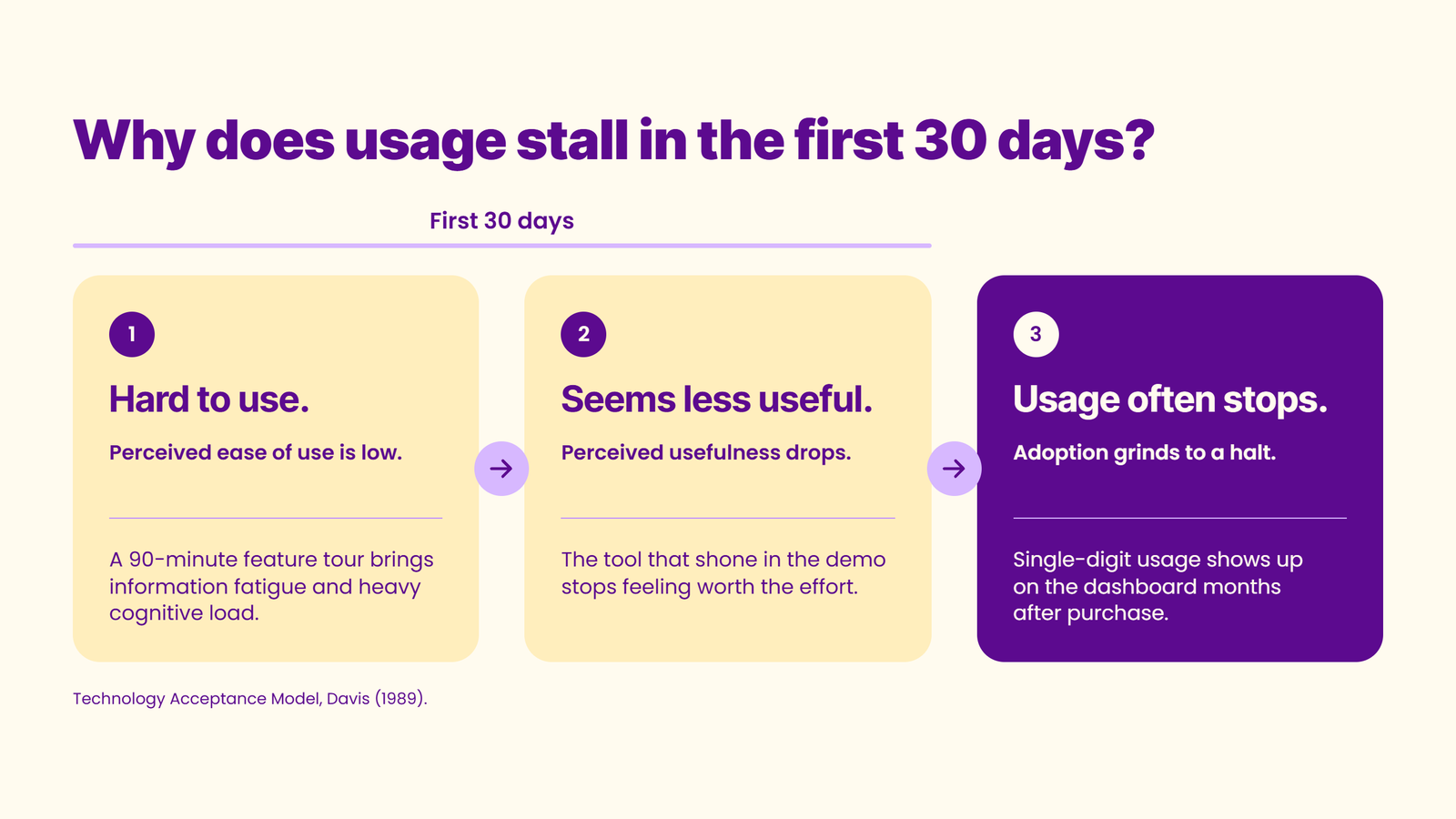
When a consumer buys software or the latest new phone, the onboarding process is meticulously engineered to guide them to their first “aha!” moment within minutes. This is usually not the case in education. Too often, and for a multitude of reasons, that easy journey is replaced with a 90-minute sit-and-get presentation during an August professional development session; when, frankly, teachers would rather be getting their rooms ready for their new students.
The result of these marathon feature tours isn’t platform empowerment; it brings about information fatigue. When edtech onboarding focuses on exhaustive feature tours rather than immediate use, it induces heavy extraneous cognitive load for educators (Sweller, 1988). According to the Technology Acceptance Model (TAM) developed by Fred Davis (1989), user adoption rests on two key factors: Perceived Usefulness (PU) and Perceived Ease of Use (PEOU). If PEOU is low in the first 30 days, PU drops, and usage often grinds to a halt.
However, the burden of building that journey shouldn’t fall squarely on the district, nor should it be outsourced or reliant entirely on the vendor. Too often, districts accept off-the-shelf, one-size-fits-all training from companies that don’t understand local context. Conversely, some edtech vendors deliver licenses and walk away, failing to align their tools with a district’s operational realities or strategic goals.
Sustainable onboarding must be co-designed:
- The edtech company’s role: Edtech vendors should bring specialized customer success expertise, user data insights, and agile onboarding frameworks grounded in adult learning theory (andragogy).
- The district’s role: District leadership sets non-negotiable parameters, including local curriculum maps, pedagogical frameworks, union considerations, and realistic time constraints.
When districts and edtech vendor partners collaborate to build an onboarding journey within these parameters, professional learning shifts from a generic feature demo to a targeted, high-value experience.
- Focus on Time-to-Value: What is the one feature that saves a teacher 20 minutes this week? Start there, not by requiring complete mastery of every tool in the platform.
- Scaffolding Mastery and Continuous Support: Replace one-off summer trainings with bite-sized, asynchronous micro-modules accessible at the exact moment of need.
Empower Educator Champions to Build Sustainable, High-Trust Support
Everett Rogers’ groundbreaking research on the Diffusion of Innovations (2003) describes how ideas spread through established social networks rather than administrative mandates. Teachers turn to trusted peers and department opinion leaders to judge whether a tool is worth the effort. Peer influence drives sustainable change. If your budget allows for a Trainer-of-Trainers (ToT) model, it is one of the highest-yield investments districts can make.
- Select for Trust, Not Just Tech Skills:
Build your champion cohort with respected classroom veterans, not just your tech enthusiasts. When a skeptical colleague sees a trusted peer using a tool to solve a real classroom problem, resistance can give way to curiosity. The ISTE Coaching Standards (2024) and Knight’s research in Instructional Coaching: A Partnership Approach to Improve Instruction (2007) show that peer coaching doubles the rate of classroom technology transfer compared to traditional PD. - Protect Their Time:
Support your TOT cohort or staff with clear, turnkey resources and dedicated release time so coaching colleagues doesn’t become an additional burden. These can be co-developed or sourced from the edtech vendor partner.
Respect Educator Expertise and Solve Real Classroom Pain Points
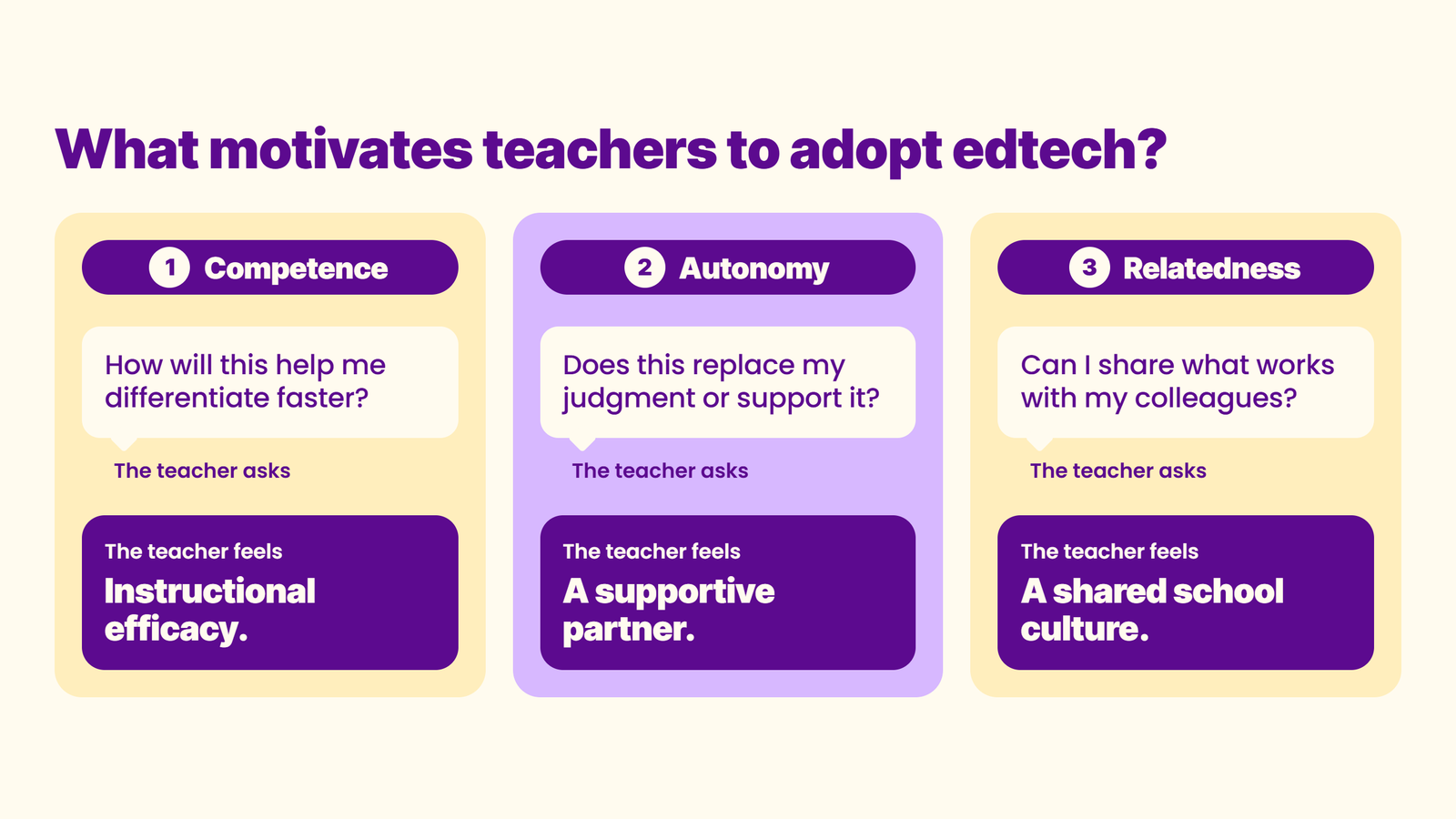
Malcolm Knowles’ theory of Andragogy (1984) establishes that adult learners are problem-centered and self-directed. Furthermore, Deci and Ryan’s Self-Determination Theory (2000) shows that intrinsic motivation requires three components: Autonomy, Competence, and Relatedness.
- Solve Immediate Problems (Competence): Teachers rarely care about platform features; they care about workflow solutions. Frame tech adoption around pain points: How will this help me differentiate faster? How will this eliminate my grading time? When software immediately solves a workflow headache, teachers feel an instant sense of instructional efficacy and competence.
- Respect Prior Expertise (Autonomy & Self-Concept): Position the tool as an amplifier that enhances existing pedagogical expertise, never as a rigid script that replaces professional judgment. Preserving professional autonomy ensures teachers view technology as a supportive partner rather than an administrative mandate.
- Promote Collaborative Practice (Relatedness): Create space for teachers to share templates, strategies, and successes within their professional learning communities (PLCs). Grounding edtech in peer collaboration meets the need for relatedness, turning isolated tool use into a shared school and/or district culture.
Deploy Low-Cost Motivators to Spark Momentum
While educator intrinsic buy-in is the goal, smart extrinsic motivators can lower the friction to get started:
- Micro-Credentials: If possible, partner with your HR department to tie tool proficiency to salary-lane advancement or continuing education units (CEUs).
- Time Equity: Offer a coverage period or dedicated prep slot for teachers who participate in pilot cohorts or share a lesson template with their department.
- Public Celebration: Spotlight teacher innovators in district communications and school board showcases. Recognition can build momentum.
The Bottom Line on EdTech Adoption: Workflow Over Everything
If a new tool feels like “one more thing” on an educator’s already overflowing plate, it will fail. To drive real usage that moves the needle on student learning outcomes, leadership must explicitly connect the dots:
Tool Adoption = Reduced Workflow Friction + Visible Student Impact
When edtech gives teachers time back to reallocate to high-impact instruction, willingness stops being a barrier, and true, human-centered blended learning thrives.
Read more briefs like this for education leaders: Subscribe to our free monthly briefing to get curated resources delivered straight to your inbox.
Blogs you may also like

EdTech Evaluation Framework: How District Leaders Vet New Tools | Kami


Initiative Fatigue in Schools: Leading for Coherence

Authentic Learning in the Age of AI: A Leader’s Guide