


Even experienced educators regularly encounter the question: How does a student qualify for either an IEP (Individualized Education Plan) or a 504 plan? Both exist to support students with different learning needs. Both are legal documents that require educational systems to make specific commitments to a student’s access and progress. However, they function in different ways, draw from different federal laws, and create different legal obligations for teachers, schools, and districts.
Getting the distinction right matters. Not just for compliance but because the wrong plan, or a plan that is misunderstood by the people implementing it, may mean that a student does not get the support they legally require.
This guide explains clearly what each plan is, potential qualifications, what the plans require, and, critically for classroom teachers, what digital accessibility support looks like under each.
The one-sentence difference
An IEP provides modifications to instruction. A 504 plan provides accommodations to access instruction. Both support students with different learning needs, but they are governed by different laws.
What is a 504 plan?
A 504 plan is a written legal document outlining the accommodations and services a student with a disability will receive at school. It is governed by Section 504 of the Rehabilitation Act of 1973. This is a U.S. federal civil rights law that prohibits discrimination against people with disabilities in any program receiving federal funding. Every public school in the United States falls under this requirement.
The goal of a 504 plan is not to provide specialized instruction, but rather accommodations to access instruction. Its purpose is to remove barriers to ensure a student with a disability can access the same learning environment, curriculum, and activities as their non-disabled peers. The plan says: Here is what this student needs in order to participate on equal terms.
Who qualifies for a 504 plan?
Eligibility for a 504 plan is different than what is required for an IEP. A student qualifies if they have a physical, medical, mental, or emotional impairment that substantially limits one or more major life activities, which explicitly includes learning, reading, concentrating, thinking, communicating, and caring for oneself.
Students who commonly receive 504 plans include those with ADHD, anxiety, depression, dyslexia, processing disorders, chronic health conditions (such as diabetes or severe allergies), and physical disabilities that do not require specialized instruction but do require an accommodation. A physician’s input is one piece of information a 504 team should consider alongside teacher recommendations, parent concerns, and classroom observations. Importantly, a student does not need to be performing below grade level to qualify; the impairment just needs to substantially limit a major life activity, such as school.
What does a 504 plan include?
Unlike an IEP, a 504 plan does not include annual goals, progress tracking requirements, or a program of specialized instruction. The law only requires that a plan be reviewed “periodically” (which most people interpret as roughly once a year) and re-evaluated every 3 years. The 504 plan focuses on the removal of physical or environmental accommodations, changes to how a student accesses or demonstrates learning without changing the learning that is expected for that grade level.
Common 504 accommodations include: extended time on tests and assignments, preferential seating, reduced-distraction test environments, access to text-to-speech technology, screen masking tools, oral administration of assessments, note-taking support, and access to translation tools for English language learners with qualifying disabilities. Medical 504 plans focus on health management, physical access, and handling absences or flare-ups (for conditions like Type 1 Diabetes, severe allergies, asthma, epilepsy, or Crohn’s disease). Emotional or psychiatric 504 plans focus on managing anxiety, depression, PTSD, OCD, or severe mood disorders so the student can stay regulated and present in school. The specific accommodations are determined based on the individual student’s needs and documented in the plan.
While the administrative procedures are different from IDEA (the IEP law), a 504 plan is still a legally binding federal document. Schools face serious legal consequences and federal OCR (Office for Civil Rights) investigations if they violate or do not follow a student’s 504 plan.
What is an IEP?
An Individualized Education Program (IEP) is a legally binding document developed under the Individuals with Disabilities Education Act (IDEA); a federal education law that guarantees students with disabilities a free appropriate public education (FAPE) in the least restrictive environment (LRE).
While a 504 plan adapts the learning environment, an IEP modifies the instruction itself. Both are legally binding federal protections, but an IEP requires formal skill goals, specialized teaching, and detailed progress tracking. Because it involves direct specialized teaching, the IEP process requires a multidisciplinary team to set formal goals and track data.
Who qualifies for an IEP?
Eligibility for an IEP requires a formal evaluation conducted in a standardized, verified testing environment. Based on diagnostic testing by a school psychologist and the evaluation team, the student’s disability must fall under one of 13 categories defined by IDEA: specific learning disability, speech or language impairment, other health impairment, autism spectrum disorder, emotional disturbance, intellectual disability, hearing impairment (including deafness), visual impairment (including blindness), deaf-blindness, orthopedic impairment, traumatic brain injury, multiple disabilities, or developmental delay (ages 3–9, depending on the state).
Having a disability qualifies a student for legal protection, but an IEP is only triggered when that disability requires specialized instruction. For example, a student with dyslexia who performs well with extra time and text-to-speech tools may only need a 504 plan. If that same student needs explicit, specialized reading intervention from a trained specialist, they may qualify for an IEP.
What does an IEP include?
Federal law (IDEA) specifies that an IEP must be reviewed annually and include: the student’s current levels of academic achievement and functional performance (PLAAFP); measurable annual goals; how progress will be measured and reported; a detailed statement of special education and related services (including specific frequency, location, and duration); program modifications or staff supports; the extent of participation in general education settings; accommodations or alternate options for state and districtwide assessments; and postsecondary transition planning beginning by age 16.
IEPs are developed by a team that must include the student’s parent(s) or guardian(s), at least one general education teacher, at least one special education teacher, a representative of the school district, someone who can interpret evaluation results — usually a school psychologist, and the student when appropriate. Additionally, the process guarantees procedural safeguards for parents/guardians, including the right to participate and give consent, and mandates annual reviews and a full re-evaluation of the student at least once every three years.
IEP vs 504 plan: A clear comparison
| IEP | 504 Plan | |
|---|---|---|
| Governing law | Individuals with Disabilities Education Act (IDEA) | Section 504 of the Rehabilitation Act |
| Primary purpose | Specialized instruction and related services | Accommodations to remove barriers to educational access |
| Eligibility | One of 13 IDEA disability categories + need for special education | Physical or mental impairment that substantially limits a major life activity |
| Includes annual goals? | Yes, measurable annual goals required | No |
| Includes specialized instruction? | Yes | No |
| Team required? | Yes, defined required members including parents | The law mandates a “group of knowledgeable persons,” but does not list specific job titles. |
| Review frequency | At least annually; re-evaluation every 3 years | Explicitly requires a formal re-evaluation before any “significant change in placement.” This includes moving from elementary to middle school, middle to high school, or making major changes to the accommodations provided. |
| Legal protections | Enforceable through IDEA due process procedures | Section 504 complaint process through the Office of Civil Rights |
| Assistive Technology (AT) consideration | Legally required to consider assistive technology as part of IEP development | May include AT as an accommodation |
| Extends beyond high school? | Typically ends at high school graduation or age 21. Transfers to ADA/504 in collegiate setting. | College accommodations can be applied for through ADA/504. K-12 504 plans do not carry forward. |
Can a student have both an IEP and a 504 plan?
Students do not have both an IEP and 504 plans at the same time. An IEP includes both specialized instruction and accommodations, so it fully encompasses what a 504 plan provides.
Students can transition between the two as their needs shift: a student on a 504 plan might qualify for an IEP if they begin needing specialized instruction, while a student who achieves their IEP goals might step down to a 504 plan to keep their classroom accommodations.
Assistive Technology (AT) for IEP and 504 students: What the law requires
Under IDEA, school IEP teams are legally required to consider whether a student needs assistive technology (AT) devices or services as part of the IEP development process. If the team determines that AT is required for the student to receive a free appropriate public education (FAPE), the district/school must provide it at no cost to the student. This includes both the device itself and any training needed for the student, teachers, or family/caregivers.
Under Section 504, assistive technology may be included as an accommodation when it is necessary for a student to access the same learning opportunities as peers. The mandate is for access: if a student with a reading disability cannot access grade-level text without AT, it must be provided.
The practical implication for districts/schools is that the question is not whether to offer AT, but which AT tools are genuinely effective and can be deployed at scale without adding administrative burden or singling out students who rely on them.
What digital assistive technology should work for IEP and 504 students?
While 504 and IEP plans usually list the required technology features (like text-to-speech with word highlighting), educators face a common practical hurdle: a tool that works smoothly on a student’s classroom laptop often fails to work across different apps, locked browsers, or paper-based environments.
On paper, a student may have a 504 accommodation for text-to-speech. But in practice, that feature might work inside an online document while failing on an uploaded science PDF, a linked news article, or the district’s online testing portal. The accommodation is documented, but the tool breaks down across different file formats and web platforms.
Browser-level accessibility toolbars solve this gap. By operating directly within the web browser rather than a single program, the tool follows the student across online materials, eliminating the need for custom teacher setups or separate apps for every assignment.
How Kami Companion supports IEP and 504 accommodations across web-based curricula
Kami Companion is a floating accessibility toolbar that works on web-based content a student visits. It does not require the teacher to create accessible versions of content, and it does not require the student to switch AT tools depending on where they are working. It activates with a single click and travels with the student across every page.
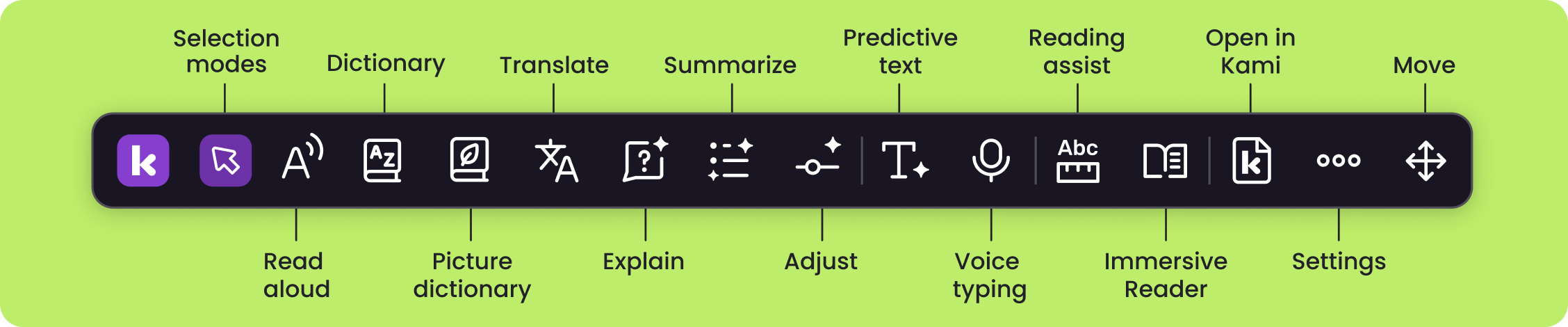
| Feature | What it does | Common IEP / 504 accommodation it supports |
|---|---|---|
| Read Aloud (TTS) | Reads any text on screen aloud with adjustable speed and voice. Works on websites and web-based documents. | Text-to-speech access for students with dyslexia, reading disabilities, visual impairments, or processing disorders |
| Real-time Translation | Translates web content into 100+ languages instantly. | Language access for ELL students with qualifying disabilities |
| Screen Masking | Reduces visual clutter by masking portions of the screen, supporting focus and reducing cognitive overload. | Visual processing support; ADHD accommodations; sensory sensitivity |
| Dictionary + Picture Dictionary | Provides instant word definitions and visual references for vocabulary on any web page. | Vocabulary support for students with language-based learning disabilities; comprehension support |
| Comprehension Tools | AI-powered reading comprehension support — summarization and clarification of complex text. | Extended processing time equivalent for complex texts; comprehension support for students with cognitive processing differences |
| Highlighting and Annotation | Students can highlight, annotate, and organize information on any webpage. | Note-taking support; executive functioning accommodations; organization aids |
Why browser-based AT supports the LRE requirement
IDEA’s Least Restrictive Environment (LRE) mandate drives a push toward full classroom inclusion. Rather than pulling students out to receive services or technology, the goal is to bring those supports directly into the general education setting.
Tools such as Kami Companion actively support the Least Restrictive Environment (LRE) mandate by keeping students in the general education classroom. Instead of leaving for a resource room or waiting on a teacher to launch specialized software, a student can independently turn on text-to-speech or reading supports directly within their browser. They stay engaged in the same lesson, alongside their peers, without disruption or stigma.
For AT coordinators and special education directors, this approach also streamlines plan management. Specifying a browser-wide tool on an IEP or 504 plan ensures consistent coverage across digital assignments, eliminating the need to document platform-specific workarounds.
For AT coordinators and SPED directors: Deployment and compliance
Kami Companion is deployed via Google Admin Console or Microsoft 365 Admin Center, which means district IT teams can push it to every device in a district in minutes. There is no individual installation required, no per-student manual activation, and no separate login. For students who rely on AT tools across the school day, this removes one of the most common barriers to consistent AT use: having to ask for access.
Kami Companion is WCAG 2.1 AA-aligned, FERPA and COPPA compliant, and SOC 2 Type 2 certified. It supports ADA Title II requirements for digital accessibility. For districts where the 2025 ADA Title II ruling requires public entities, including school districts, to bring digital content into WCAG 2.1 Level AA compliance by April 2027, Kami Companion provides a practical layer of accessibility support across existing digital content without requiring that content to be individually remediated.
Frequently asked questions: IEP vs 504
Can a student with ADHD qualify for an IEP?
ADHD can qualify a student for an IEP under the “Other Health Impairment” (OHI) category if the ADHD adversely affects educational performance and the student needs specialized instruction. However, many students with ADHD receive a 504 plan instead if they do not require specialized instruction but do need accommodations such as extended time, preferential seating, or reduced-distraction environments.
Does a student with dyslexia qualify for an IEP or a 504?
Either may apply. A student with dyslexia who requires intensive reading intervention, such as a structured literacy program delivered by a specialist, would typically qualify for an IEP under Specific Learning Disability. A student whose dyslexia is managed with accommodations (extended time, text-to-speech, reduced reading assessments) may be better served by a 504 plan. The determining factor is whether specialized instruction is needed.
What happens to IEP accommodations when a student moves to college?
High school IEPs and 504 plans expire at graduation. In higher education, rights are protected under Section 504 and the ADA, but the process shifts entirely: colleges provide reasonable access accommodations, but not specialized instruction or modified coursework. Rather than plans transferring automatically, students must self-disclose their disability to the college accessibility office and submit documentation (which can include their high school evaluation or plan) to establish eligibility.
Who is responsible for implementing IEP and 504 accommodations day to day?
Every teacher who works with the student is legally required to provide their documented accommodations, whether that is a 504 plan or an IEP. While special education teachers and case carriers/coordinators manage the plans, general education classroom teachers are responsible for making sure students receive supports in their daily lessons, assignments, and assessments.
Summary: Key differences at a glance
An IEP provides specialized instruction for students within one of 13 IDEA disability categories who require tailored teaching to make educational progress. A 504 plan provides accommodations for a broader range of disabilities to remove barriers in the general education setting. Both plans carry full legal protection, and both must be implemented by every teacher who instructs the student. When these plans include digital assistive technology, the tool must function consistently across every digital space a student encounters, not just inside a single app.
Ultimately, for reading and accessibility accommodations, the question isn’t just if a text-to-speech tool is listed on paper. It’s whether that tool actually follows the student everywhere they read and learn online, or leaves them unsupported the moment they leave a specific program.
Supporting students with IEPs and 504 plans across web-based content
Kami Companion is an accessible browser extension that places a floating toolbar on any website, delivering read-aloud, real-time translation, screen masking, AI comprehension supports, and vocabulary tools directly within the online curricular content students use. Aligned with WCAG 2.1 AA standards and fully FERPA and COPPA compliant, it can be centrally deployed across a district via Google Admin Console or Microsoft 365 Admin Center. With 1.8 million+ learning moments already supported, Kami Companion is the trusted tool of leading districts and schools.
Blogs you may also like

Summer Reading Resources: Journals, Author Studies, and More


An Educator’s Journey with Kami
Kami Companion and UDL — how built-in supports bring the framework to life